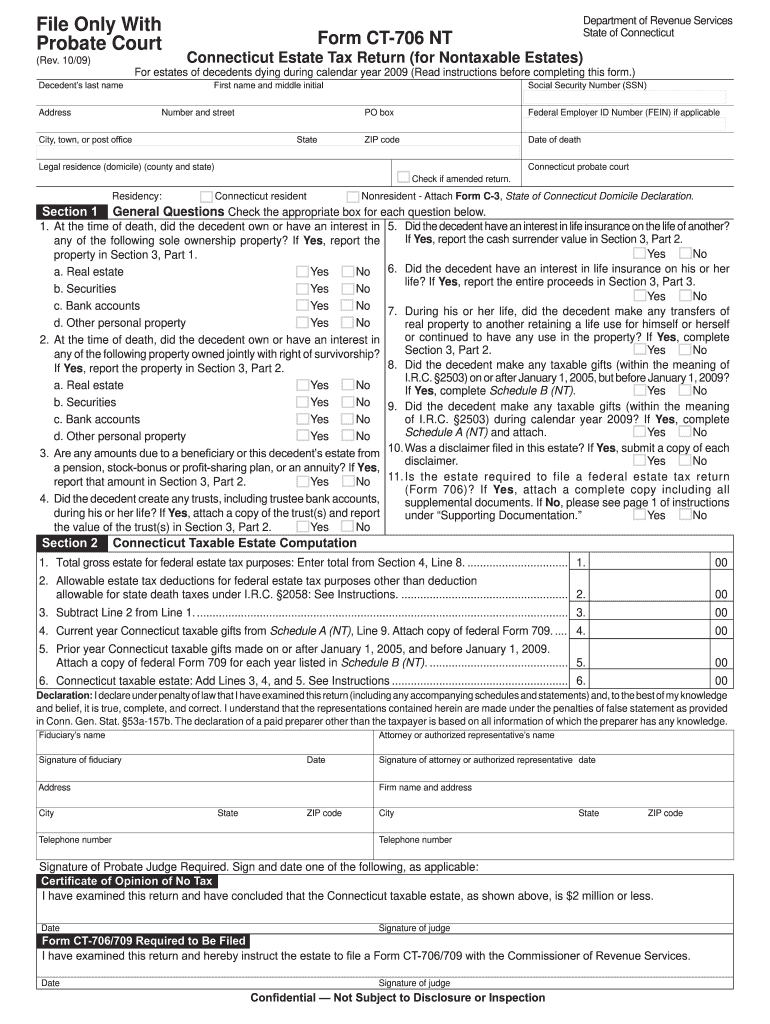
Yes No 11. Is the estate required to file a federal estate tax return (Form 706)? If Yes, attach a complete copy including all supplemental documents. If No, please see page 1 of instructions under Supporting Documentation. Yes No Section 2 Connecticut Taxable Estate Computation 1. Total gross estate for federal estate tax purposes: Enter total from Section 4, Line 8.................................. 1. 00 2. Allowable estate tax deductions for federal estate t.
Loading

Open form follow the instructions

Easily sign the form with your finger

Send filled & signed form or save
How to fill out the CT DRS CT-706 NT online
Filling out the CT DRS CT-706 NT form online can simplify the process of reporting estate taxes for nontaxable estates. This guide provides a step-by-step approach to ensure the form is completed accurately and efficiently.
Follow the steps to complete the CT DRS CT-706 NT form online.
- Click ‘Get Form’ button to access and open the CT DRS CT-706 NT form in your browser.
- Provide the address where the decedent resided, including the street number, city, state, and ZIP code.
- Input the date of death and indicate the decedent's legal residence by checking the appropriate box for residency status.
- In Section 1, respond to general questions by checking ‘Yes’ or ‘No’ for each inquiry regarding property ownership and interests.
- For Section 2, complete the Connecticut taxable estate computation by entering amounts for the total gross estate, allowable deductions, and taxable gifts, following the instructions provided in the form.
- In Section 3, report property and proceeds for federal estate tax purposes, categorizing them into solely-owned property, jointly-owned property, and life insurance proceeds.
- Fill in all necessary schedules and computations as required in Schedule A (NT) and Schedule B (NT), including any gifts made in prior periods.
- Finally, review the completed form for accuracy. Once verified, you can save changes, download, print, or share the form as needed.
Complete your CT DRS CT-706 NT form online today to ensure compliance and ease of filing.
Experience a faster way to fill out and sign forms on the web. Access the most extensive library of templates available.
Related content
Form CT-706 NT (Rev. 06/22). Page 2 of 5. Part 1 - Solely-Owned Property. A. Item. No. B...
2021 Form CT-706 NT Instructions: Connecticut Estate Tax Return (for Nontaxable Estates)...
KEY PART NUMBER. U/M DESCRIPTION. 135420-09-000. EA RADIO-AM/FM/CASS/CD COMBO-AUX/CD...
Get answers to your most pressing questions about US Legal Forms API.
Who is responsible for filing form 706?
The executor or administrator of the estate is typically responsible for filing form 706 in Connecticut. They must ensure that all information submitted is correct and complete as it holds legal significance. When handling estates, consulting the CT DRS CT-706 NT guidelines can help ensure you fulfill your filing obligations properly.
Where do I file my CT 706?
Files for CT 706 should be submitted to the Connecticut Department of Revenue Services. It is important to include all required documentation and adhere to deadlines to avoid penalties. Make sure to reference the CT DRS CT-706 NT guidelines to ensure your submission is complete and accurate.
Where do I file my CT amended return?
You should file your CT amended return by mailing it to the Connecticut Department of Revenue Services. Check the latest CT DRS guidelines for any specific instructions regarding your exemption situation. Amendments related to the CT DRS CT-706 NT also follow these same procedures.
Who must file CT 706?
Any person responsible for the estate of a decedent must file CT 706 if the estate meets the taxable threshold. This includes estate executors and administrators who manage the distribution of assets. If you are involved in handling an estate, reviewing the requirements of the CT DRS CT-706 NT is crucial for compliance.
How to avoid estate tax in Connecticut?
To avoid estate tax in Connecticut, consider establishing trusts or making strategic lifetime gifts to reduce your taxable estate. Additionally, taking advantage of deductions and exemptions available in Connecticut can significantly lower your estate's value. Consulting a tax professional can also guide you on effective strategies related to the CT DRS CT-706 NT.
What is a CT-706 NT?
The CT-706 NT is a tax form used to report and calculate the Connecticut estate tax. This form is specifically for non-resident decedents and requires detailed information about the estate's assets. Understanding the CT-706 NT can help you accurately file your estate taxes and comply with Connecticut's tax regulations.
Where do I mail my CT income tax return?
You can mail your CT income tax return to the address specified on the form. Generally, for most taxpayers, the address goes to the Connecticut Department of Revenue Services. Make sure to check the instructions on the CT DRS CT-706 NT form for any specific mailing requirements.
How do I get a CT tax registration number?
To obtain a CT tax registration number, visit the Connecticut Department of Revenue Services (CT DRS) website. You can apply online or complete a paper form and submit it by mail. Your tax registration number is essential for conducting business and filing taxes in Connecticut, including when dealing with the CT DRS CT-706 NT.
What is the CT-706 NT extension form?
The CT-706 NT extension form enables individuals to extend the filing deadline for their Connecticut estate tax return. This form, specifically tied to the CT DRS CT-706 NT, is essential for those who need extra time to prepare their documentation. Filing this extension can help reduce stress and ensure that you have all necessary information at your fingertips before submitting your return.
What is the extension form for trust return?
The extension form for trust returns in Connecticut allows trustees to request more time to file their tax return. Completing this form helps avoid penalties for late submissions and gives you, as the trustee, ample time to gather the required information. Understanding how this process works can enhance your management of trust obligations.
Use professional pre-built templates to fill in and sign documents online faster. Get access to thousands of forms.
If you believe that this page should be taken down, please follow our DMCA take down process here.
This form is available in several versions. Select the version you need from the drop-down list below.