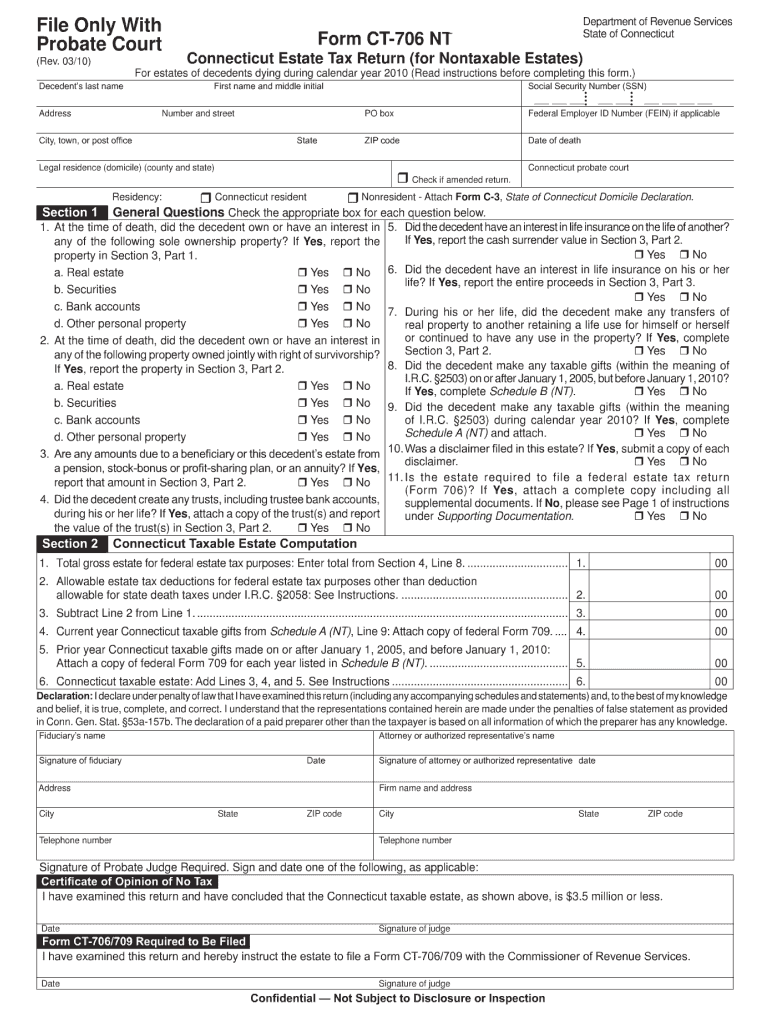
States of decedents dying during calendar year 2010 (Read instructions before completing this form.) Decedent s last name First name and middle initial Social Security Number (SSN) Address Number and street PO box Federal Employer ID Number (FEIN) if applicable City, town, or post office State ZIP code Date of death Legal residence (domicile) (county and state) Conne.

Open form follow the instructions

Easily sign the form with your finger

Send filled & signed form or save
How to fill out the CT DRS CT-706 NT online
Filling out the CT DRS CT-706 NT form online can ensure a smoother process for filing estate tax returns for nontaxable estates in Connecticut. This guide provides clear instructions on each section of the form to assist users in completing it accurately.
Follow the steps to complete the CT DRS CT-706 NT form online
- Click ‘Get Form’ button to obtain the form and open it in the editor.
- Begin by entering the decedent’s last name, first name, middle initial, and Social Security Number in the specified fields. Ensure that the address details are entered accurately, including street address, city, state, and ZIP code.
- Indicate the date of death and select the appropriate residency status by checking the box for either 'Connecticut resident' or 'Nonresident'. If nonresident, remember to attach Form C-3.
- In Section 1, answer the general questions by checking 'Yes' or 'No' as applicable. Each question pertains to the decedent's ownership of property, financial accounts, or other assets.
- Proceed to Section 2 to compute the Connecticut taxable estate. Enter the total amounts as instructed, making sure to follow the calculations provided in the form.
- Fill out Section 3, where you will report solely-owned property, jointly-owned property, and life insurance proceeds. Ensure to complete all corresponding columns for accurate reporting.
- In the Declaration section, provide the names and signatures of any fiduciaries, attorneys, or authorized representatives involved in the process. Ensure that the required signatures are included.
- Once all sections are completed, review the entire form for accuracy. Users can then save their changes, download, print, or share the completed form as needed.
Start completing your CT DRS CT-706 NT form online today to ensure timely filing!
Experience a faster way to fill out and sign forms on the web. Access the most extensive library of templates available.
Related content
Form CT-706 NT (Rev. 06/22). Page 2 of 5. Part 1 - Solely-Owned Property. A. Item. No. B...
2021 Form CT-706 NT Instructions: Connecticut Estate Tax Return (for Nontaxable Estates)...
KEY PART NUMBER. U/M DESCRIPTION. 135420-09-000. EA RADIO-AM/FM/CASS/CD COMBO-AUX/CD...
Get answers to your most pressing questions about US Legal Forms API.
Who must file a Connecticut income tax return?
In Connecticut, anyone who earns income above a specific threshold must file a state income tax return. This requirement applies to residents, part-year residents, and non-residents with Connecticut-source income. If you're uncertain about your filing status or need guidance on which forms to use, consulting resources from uslegalforms related to Connecticut's tax requirements can be beneficial.
How to file an estate tax return in CT?
To file an estate tax return in Connecticut, you must first determine if your estate meets the filing threshold. If it does, you need to collect necessary documents and complete the CT DRS CT-706 NT form. After accurately filling out the form, submit it to the appropriate Connecticut state agency along with any required payment. You can seek assistance from services like uslegalforms to streamline this process.
Who needs to file form 706?
Form 706 needs to be filed by estates that exceed the federal estate tax exemption limit, which is currently $12.92 million as of 2023. This requirement also applies to estates that have assets in multiple states. If your estate falls into this category, make sure to utilize CT DRS CT-706 NT to fulfill your filing obligations correctly. Using reliable platforms like uslegalforms can simplify this process.
What is the CT-706 NT extension form?
The CT-706 NT extension form allows executors to request additional time to file the Connecticut estate tax return. This form is essential if you anticipate needing more time to gather necessary documents and assess the estate fully. Filing for an extension can help ensure you complete the CT DRS CT-706 NT accurately without rushing, reducing potential errors.
How much can you inherit in CT without paying taxes?
In Connecticut, heirs can inherit $12.92 million without incurring estate tax as of 2023. This value can change with legislation, so keeping updated is crucial. If the estate surpasses this limit, the estate tax comes into play, requiring the CT DRS CT-706 NT form. Knowing these details can help heirs plan effectively.
Who is subject to Connecticut estate tax?
In Connecticut, estate tax applies to estates valued over $12.92 million as of 2023. This means if your estate exceeds this threshold at the time of death, you will need to consider the CT DRS CT-706 NT form when filing. For smaller estates, you may not need to file, but it's always wise to check your specific situation. Understanding this can help you effectively manage your estate.
Where do I file my CT 706?
You should file your CT 706 with the Connecticut Department of Revenue Services. Make sure you complete the form accurately and submit it within the designated timeframe to avoid penalties. Understanding the filing process for CT DRS CT-706 NT ensures a smooth experience throughout estate administration.
What is a CT-706 NT?
706 NT is a specific form used for reporting the estate tax for estates that do not include real property in Connecticut. This form is crucial for identifying the tax obligations of nonresident estates. Utilizing the CT DRS CT706 NT effectively ensures compliance with state tax requirements.
How to avoid estate tax in Connecticut?
To avoid estate tax in Connecticut, consider strategies like gifting assets during your lifetime, utilizing trusts, and leveraging available deductions. Staying informed about the state laws concerning the CT DRS CT-706 NT can help you navigate your estate planning effectively. Consulting with a tax professional can provide tailored strategies.
Where do I mail my CT income tax return?
Mail your CT income tax return to the appropriate address specified by the Connecticut Department of Revenue Services. The mailing address may differ based on your filing status and method of payment. Make sure to check the latest guidelines on the CT DRS website for accurate information.
Use professional pre-built templates to fill in and sign documents online faster. Get access to thousands of forms.
If you believe that this page should be taken down, please follow our DMCA take down process here.
This form is available in several versions. Select the version you need from the drop-down list below.