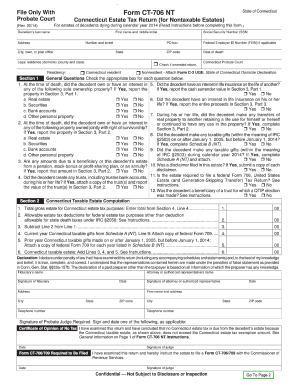
No 12. Was the decedent a bene ciary of a trust for which a QTIP election was made? See instructions. Yes No Section 2 Section 2 Connecticut Taxable Estate Computation 1. Total gross estate for Connecticut estate tax purposes: Enter total from Section 4, Line 4. ........................ 1. 00 2. Allowable estate tax deductions for federal estate tax purposes other than deduction allowable for state death taxes under IRC 2058: See Instructions. .

How it works
  • Open form

    Open form follow the instructions

  • Easily sign form

    Easily sign the form with your finger

  • Share form

    Send filled & signed form or save

How to fill out the CT DRS CT-706 NT online

Filling out the CT DRS CT-706 NT form can seem overwhelming, but with a clear understanding of each section, the process becomes much more manageable. This guide provides step-by-step instructions to help you accurately complete the Connecticut Estate Tax Return for nontaxable estates.

Follow the steps to complete your CT DRS CT-706 NT online.

  1. Click ‘Get Form’ button to obtain the form and open it for editing.
  2. Begin by entering the decedent's last name, first name, and middle initial, followed by their address, including any PO box details, city, state, and ZIP code.
  3. Input the decedent's Federal Employer Identification Number (FEIN) if applicable, as well as their Social Security Number (SSN), and check the appropriate box indicating if the return is amended or if the decedent was a resident or nonresident.
  4. Proceed to Section 1, where you will answer general questions about the decedent's property ownership. Check 'Yes' or 'No' for properties such as real estate, securities, and bank accounts owned solely or jointly.
  5. In Section 2, enter the gross estate total for Connecticut estate tax purposes based on your responses from Section 1. Calculate allowable estate tax deductions and enter the details as instructed.
  6. Move on to Section 3, where you will list the sole property, jointly-owned property, and life insurance proceeds. Ensure that all values are accurately reported at the date of death.
  7. Complete Section 4 by entering totals from Section 3, ensuring the total gross estate is summed accurately.
  8. If applicable, fill out Sections 5 and 6 for probate fees, reporting property located outside or within Connecticut, respectively.
  9. Complete necessary schedules for current year Connecticut taxable gifts in Schedule A (NT) and for prior taxable gifts in Schedule B (NT).
  10. Finally, review the declaration section. Sign and date where indicated, ensuring all necessary signatures, including that of the probate judge, are included.
  11. After completing the form, you can save the changes, download the document, print it out for submission, or share it as necessary.

Start completing your CT DRS CT-706 NT form online today!

Get form

Experience a faster way to fill out and sign forms on the web. Access the most extensive library of templates available.

Related content

Form CT-706 NT

Form CT-706 NT (Rev. 06/22). Page 2 of 5. Part 1 - Solely-Owned Property. A. Item. No. B...

Learn more
Estate, Inheritance, and Gift Taxes - The GC...

2021 Form CT-706 NT Instructions: Connecticut Estate Tax Return (for Nontaxable Estates)...

Learn more
2005 SPIRIT IF322E 300-SERIES

KEY PART NUMBER. U/M DESCRIPTION. 135420-09-000. EA RADIO-AM/FM/CASS/CD COMBO-AUX/CD...

Learn more
Questions & Answers

Get answers to your most pressing questions about US Legal Forms API.

Contact support

What is a CT-706 NT form?

The CT-706 NT form is used to report estates in Connecticut that do not owe estate tax. This form verifies your estate's non-taxable status and must be filed under specific circumstances. By completing the CT DRS CT-706 NT, you confirm compliance with state regulations while simplifying your estate's management. Knowing its purpose can help you navigate the estate tax landscape effectively.

File your CT 706 form with the Connecticut Department of Revenue Services to ensure it reaches the appropriate office. Checking guidelines specific to the CT DRS CT-706 NT can provide important details on filing requirements. Ensure you review all necessary documentation before submission for a smooth filing process. It's also beneficial to keep copies for your records.

To obtain a CT tax registration number, submit an application through the Connecticut Department of Revenue Services. This number is crucial for complying with state tax regulations and filing relevant tax forms. You can also refer to the CT DRS CT-706 NT for guidance on taxable estates and related obligations. Ensuring you have this number simplifies your tax reporting process.

You can file the CT 706 form at the Connecticut Department of Revenue Services. It's important to send your forms to the correct address to ensure timely processing. Consider using the CT DRS CT-706 NT form to streamline your filing experience and clarify your estate's tax status. Always confirm the filing methods are up to date to avoid unnecessary delays.

The CT-706 NT is a specific form used to report Connecticut estate tax. This form is particularly relevant for estates that do not have any estate tax obligations. By submitting the CT DRS CT-706 NT, you provide essential information about your estate while confirming your non-liability. This form simplifies the reporting process for qualified estates.

CT gift tax applies to transfers of wealth made without receiving equivalent value in return. In Connecticut, gifts over a certain amount may trigger this tax. It is crucial to record these transactions accurately. For proper management and reporting, utilize resources like the CT DRS CT-706 NT form to stay compliant and informed.

Individuals must file a CT estate tax return if their estate value exceeds the state's filing threshold. This requirement ensures that all applicable estates meet their tax obligations. By completing the CT DRS CT-706 NT accurately, you can determine your estate's tax liability and avoid penalties. Understanding these requirements is essential for estate planning.

To avoid estate tax in Connecticut, consider strategies like gifting assets during your lifetime or establishing trusts. These methods can help manage your taxable estate effectively. Additionally, utilizing the CT DRS CT-706 NT form can provide insights into estate tax obligations. Engaging with a tax professional can also offer personalized advice for your unique situation.

Filing an estate tax return in Connecticut involves gathering all necessary information about the decedent's assets, liabilities, and deductions. You will need to complete the CT-706 form and submit it to the Connecticut Department of Revenue Services. Utilizing the CT DRS CT-706 NT can simplify this process and ensure you meet all filing requirements accurately.

The executor of an estate must file the CT-706 form if the estate exceeds the Connecticut estate tax exemption limit. This requirement serves to officially report the value of the estate and calculate any tax owed. By properly filing the CT DRS CT-706 NT, you contribute to the transparency and legality of the estate administration process.

Get This Form Now!

Use professional pre-built templates to fill in and sign documents online faster. Get access to thousands of forms.

If you believe that this page should be taken down, please follow our DMCA take down process here.

CT DRS CT-706 NT Form

This form is available in several versions. Select the version you need from the drop-down list below.

Get CT DRS CT-706 NT