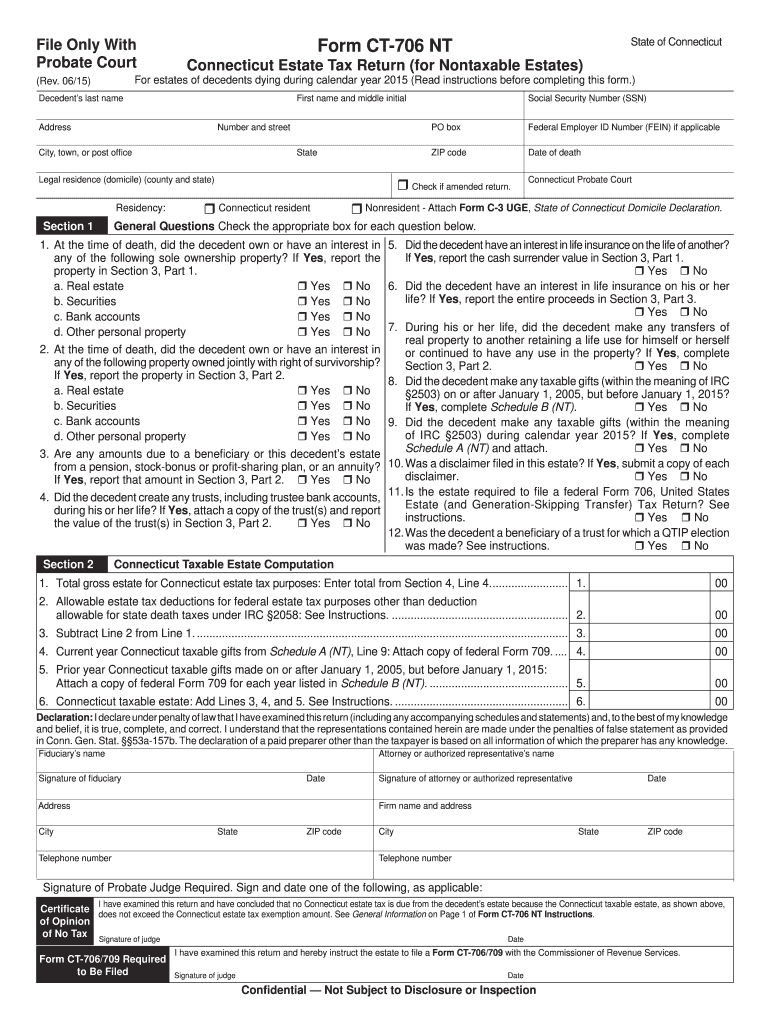
Kipping Transfer) Tax Return? See instructions. Yes No 12. Was the decedent a beneficiary of a trust for which a QTIP election was made? See instructions. Yes No Connecticut Taxable Estate Computation 1. Total gross estate for Connecticut estate tax purposes: Enter total from Section 4, Line 4. ........................ 1. 00 2. Allowable estate tax deductions for federal estate tax purposes other than deduction allowable for state death taxes under IRC 2058: See Instruction.
Loading

Open form follow the instructions

Easily sign the form with your finger

Send filled & signed form or save
How to fill out the CT DRS CT-706 NT online
The CT DRS CT-706 NT is an essential document for reporting estate tax for nontaxable estates in Connecticut. This guide provides a clear, supportive overview of how to complete the form online, ensuring all users can navigate the process with ease.
Follow the steps to complete the CT DRS CT-706 NT online efficiently.
- Press the ‘Get Form’ button to access the CT DRS CT-706 NT form and open it in your preferred editing tool.
- Begin by entering the decedent’s last name, first name, and middle initial in the designated fields.
- Fill in the decedent's address, including number, street, city or town, state, and ZIP code.
- Provide the legal residence details including county and state, along with the decedent's Social Security Number (SSN) and Federal Employer ID Number (if applicable).
- Indicate the date of death and check the appropriate box if this is an amended return along with the decedent’s residency status.
- In Section 1, respond to the general questions by checking ‘Yes’ or ‘No’ based on the decedent's ownership interests in various types of property.
- Continue to Section 2 and answer the questions related to life insurance and any taxable gifts made by the decedent.
- In Section 3, report the property and proceeds reported for Connecticut estate tax purposes, ensuring to list all property accurately with fair market values.
- Proceed to Section 4 to calculate the total gross estate for Connecticut estate tax purposes by adding the amounts from previous sections.
- Complete the declaration section, including signatures and necessary information of the fiduciary or authorized representative.
- Finally, after reviewing all entries for accuracy, save changes, download, print, or share the completed CT DRS CT-706 NT form as required.
Get started on completing your CT DRS CT-706 NT form online today.
Experience a faster way to fill out and sign forms on the web. Access the most extensive library of templates available.
Related content
Form CT-706 NT (Rev. 06/22). Page 2 of 5. Part 1 - Solely-Owned Property. A. Item. No. B...
2021 Form CT-706 NT Instructions: Connecticut Estate Tax Return (for Nontaxable Estates)...
KEY PART NUMBER. U/M DESCRIPTION. 135420-09-000. EA RADIO-AM/FM/CASS/CD COMBO-AUX/CD...
Get answers to your most pressing questions about US Legal Forms API.
Is a tax registration number the same as a tax ID number?
While a tax registration number and a tax ID number are often used interchangeably, they can refer to different identifiers. The tax ID number is generally a broader term that includes various types of identification numbers issued by tax authorities, such as the IRS or state agencies. Knowing the difference is crucial for proper tax reporting and compliance. If you're unsure about which number applies to your situation, reaching out to uslegalforms can provide the guidance you need.
Is CT tax registration number the same as EIN?
A CT tax registration number is not the same as an EIN (Employer Identification Number). The EIN is issued by the IRS for federal tax purposes, while the CT tax registration number is specific to Connecticut state taxes. Each serves different functions within the tax system, so it's important to understand which number you need for your specific business operations. Consulting resources such as uslegalforms can help clarify these distinctions.
How to avoid estate tax in Connecticut?
Avoiding estate tax in Connecticut primarily involves planning and strategic asset management. By utilizing trusts or gifting strategies, you can legally minimize your estate's tax liability. Working with a tax professional familiar with Connecticut laws can also provide you personalized strategies. Additionally, staying informed about the CT DRS CT-706 NT can help you navigate the complexities of estate tax effectively.
How to get a CT tax registration number?
Getting a CT tax registration number involves submitting an application to the Connecticut Department of Revenue Services. You may need to provide details about your business, including its structure and activities. Once your application is approved, you will receive your registration number, which is essential for all tax-related matters in Connecticut. Using services like uslegalforms can simplify this application process significantly.
How do I get a copy of my CT registration?
To obtain a copy of your CT registration, you should contact the Connecticut Department of Revenue Services directly. They can provide you with the necessary forms to request your registration copy. Alternatively, accessing your account information through their website may offer a quick way to retrieve this document. Being proactive about keeping your records organized will benefit you in future transactions.
Where do I file my CT 706?
You should file your CT 706 with the Connecticut Department of Revenue Services. The form can typically be submitted by mail or, in some instances, electronically through their official website. It is crucial to ensure that you file before the due date to avoid any penalties. For a smoother process, consider utilizing platforms like uslegalforms, which provide guided assistance.
How do I get a CT tax registration number?
To obtain a CT tax registration number, you must apply through the Connecticut Department of Revenue Services. This process often involves submitting an application form, detailing your business activities, and providing any necessary documentation. Once your application is reviewed and approved, you will receive your CT tax registration number promptly. This number is vital for tax reporting and compliance.
What is a CT-706 NT?
706 NT is a tax form used in Connecticut for reporting estate tax obligations. This form specifically applies to estates that qualify for filing under certain thresholds. It facilitates the assessment and calculation of any due estate taxes to the Connecticut Department of Revenue Services. Completing the CT DRS CT706 NT correctly ensures compliance with state tax laws.
How much can you inherit in CT without paying taxes?
The amount you can inherit in Connecticut without incurring estate taxes varies based on the total value of the estate. Typically, if an estate's value is under a specified limit, beneficiaries can inherit without tax implications. It is essential to verify current figures and criteria, as these can change. For accurate guidance, consider using the CT DRS CT-706 NT for complete and updated information.
What is the most you can inherit without paying taxes?
In Connecticut, the threshold for inheriting without facing state estate taxes is determined by the value of the estate. As of the latest regulations, estates valued below a certain amount generally do not incur tax liability. Understanding these limits can significantly enhance your financial planning. Utilizing the CT DRS CT-706 NT ensures you have the tools needed to navigate these financial guidelines effectively.
Use professional pre-built templates to fill in and sign documents online faster. Get access to thousands of forms.
If you believe that this page should be taken down, please follow our DMCA take down process here.
This form is available in several versions. Select the version you need from the drop-down list below.