Date ) Preparer s SSN or PTIN FEIN Name of transferor: Transferor s CT Tax Registration Number: Date of transfer: Part V Interests in Connecticut real property (including farm land, forest land, open space land, and maritime heritage land) owned directly by the entity in which a controlling interest was transferred Town Code (Table A) Location of Real Property Town Street Address/Parcel No. Check ( ) if.
Loading

Open form follow the instructions

Easily sign the form with your finger

Send filled & signed form or save
How to fill out the CT DRS AU-330 online
This guide provides a step-by-step approach to completing the CT DRS AU-330 form online. By following these instructions, you can ensure that your submission is accurate and complete, enabling a smoother process for handling controlling interest transfer taxes.
Follow the steps to successfully complete the form online.
- Press the ‘Get Form’ button to access the CT DRS AU-330 form, allowing you to begin filling it out in the editor.
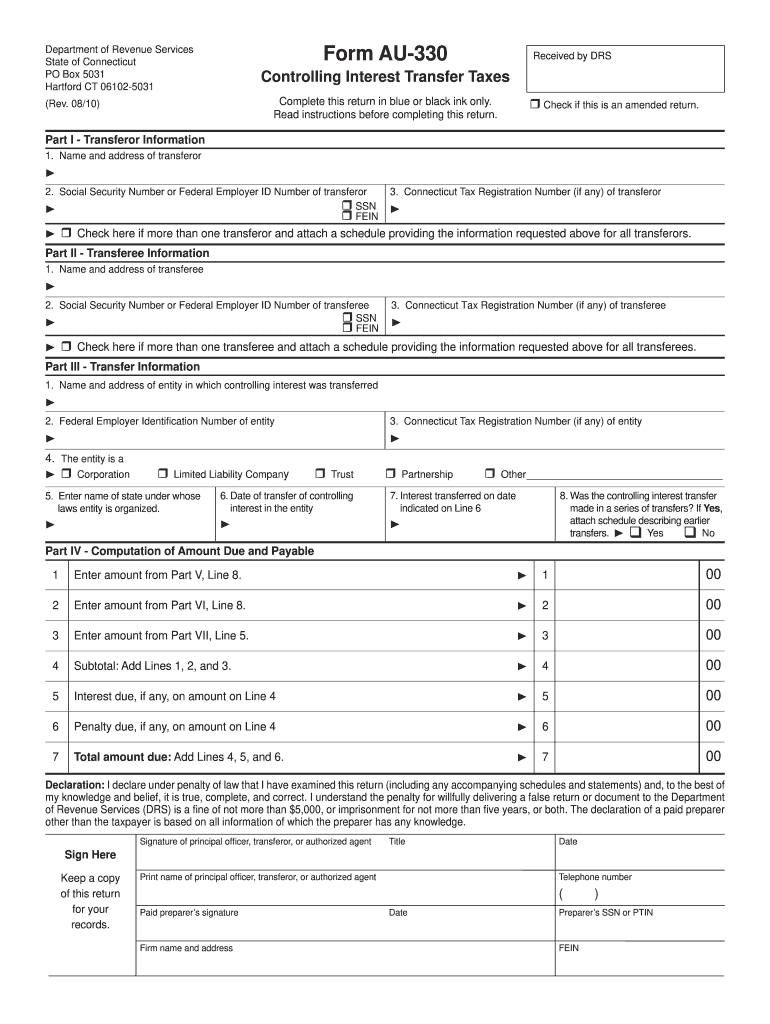
- In Part I, enter the name and address of the transferor. For identification, provide the Social Security Number or Federal Employer ID Number (check the appropriate box) and, if applicable, the Connecticut Tax Registration Number. If there is more than one transferor, indicate this by checking the box and attach a schedule with corresponding details.
- In Part II, repeat the process for the transferee's information. Fill in their name and address, along with their Social Security Number or Federal Employer ID Number and Connecticut Tax Registration Number, if any. Again, indicate if there are multiple transferees and attach a schedule as necessary.
- Part III requires details about the entity that received the controlling interest. Include the entity's name, address, Federal Employer Identification Number, and Connecticut Tax Registration Number. Specify the type of entity (e.g., corporation, limited liability company) and provide the state of organization along with the date of transfer and the interest that was transferred. If the transfer occurred in a series of transfers, check 'Yes' and provide additional documentation.
- Part IV includes the computation of the amount due. Enter the figures from Parts V, VI, and VII as applicable. Follow the instructions to add up all necessary lines and ensure that the total amount due includes interest or penalties if required.
- Finally, complete the Declaration by signing and dating the form. Ensure that you print your name and include a contact telephone number. If applicable, have the paid preparer sign and indicate their information.
- After verifying that all information is accurate, you can save changes, download the completed form, print it, or share it as needed.
Complete your documents online today for a hassle-free filing experience.
Experience a faster way to fill out and sign forms on the web. Access the most extensive library of templates available.
Related content
Form AU-330 is the Connecticut Controlling Interest Transfer Tax Return, completed through...
Jun 10, 2013 — “We estimated that the number of cancers caused by CT scans performed...
AVISO DE SEGURANÇA. Apenas pessoal qualificado deverá instalar e reparar o equipamento...
Get answers to your most pressing questions about US Legal Forms API.
What is a CT Form AU 330?
The CT Form AU-330 is a tax form utilized primarily for reporting and amending tax information in Connecticut. This form is critical for both individuals and businesses, helping to ensure that tax filings are accurate and compliant with state regulations. If you have questions about your tax status or need assistance with completing this form, consider exploring the resources available on the uslegalforms platform. Proper completion of the CT DRS AU-330 can facilitate smoother interactions with state tax authorities.
What is the tax rate for small businesses in CT?
The tax rate for small businesses in Connecticut varies based on several factors, including the type of business structure and income generated. Generally, LLCs may fall under personal income tax rates unless they elect corporate status. For clarity on tax expectations, the CT DRS AU-330 form can be useful in delineating the specific rates that apply to your situation. Understanding these rates can help you better plan your business finances.
Does CT accept amended returns electronically?
Connecticut does allow for the electronic filing of amended tax returns, which can make the process more convenient for taxpayers. You can use the CT DRS AU-330 form to amend your previous filings and ensure accuracy. This electronic option helps reduce paperwork and speeds up processing times. Staying current with your filings is essential for avoiding future complications.
Do I need to file a CT state tax return?
Yes, you need to file a Connecticut state tax return if you earn income within the state. This requirement applies to both individuals and businesses registered in Connecticut. Filing the CT DRS AU-330 can help clarify your tax obligations and streamline this process. Seek professional guidance if you are uncertain about your filing requirements.
How is an LLC taxed in CT?
In Connecticut, an LLC is typically treated as a pass-through entity for tax purposes, meaning that income is reported on the owners' personal tax returns. However, if the LLC opts to be taxed as a corporation, different rules apply. The CT DRS AU-330 form may be relevant here, as it allows owners to outline their tax statuses clearly. Understanding these tax implications is crucial for maintaining compliance with state laws.
How do you avoid the penalty for underpayment of estimated tax?
To avoid penalties for underpayment of estimated tax, you can make sure your payments cover at least 90% of your current year tax obligation or 100% of your previous year's tax liability. Monitoring your income closely and using tools from CT DRS, including the CT DRS AU-330, can ensure you meet these requirements effectively.
What is exempt from CT conveyance tax?
Various transactions are exempt from the Connecticut conveyance tax, including certain transfers for charitable purposes or to state agencies. Understanding these exemptions can save you from unnecessary tax liabilities. If you're conducting a property transaction, refer to the CT DRS AU-330 for detailed guidelines on exemptions.
What is an exempt conveyance?
An exempt conveyance refers to specific property transfers that do not incur a conveyance tax under Connecticut law. Common examples include transfers to governmental entities or certain family members. If you're unsure about your situation, referring to the CT DRS AU-330 can provide clarity on what constitutes an exempt conveyance.
How do I get my underpayment penalty waived?
Getting your underpayment penalty waived in Connecticut may involve demonstrating reasonable cause for the underpayment. You can submit a request for waiver through the CT DRS, providing documentation to support your claim. Reviewing the CT DRS AU-330 is a good starting point to understand the criteria for a waiver.
How to avoid CT underpayment penalty?
To avoid the underpayment penalty in Connecticut, ensure that you make timely and accurate estimated tax payments throughout the fiscal year. Regularly reviewing your financials and utilizing CT DRS resources can help you stay compliant. Engage with the CT DRS AU-330 to understand your obligations, and plan accordingly.
Use professional pre-built templates to fill in and sign documents online faster. Get access to thousands of forms.
If you believe that this page should be taken down, please follow our DMCA take down process here.
This form is available in several versions. Select the version you need from the drop-down list below.