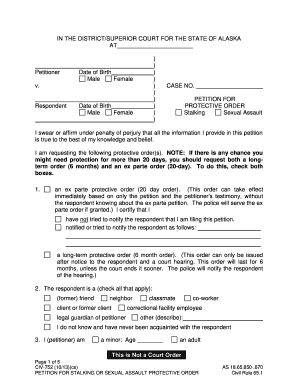
Talking Sexual Assault I swear or affirm under penalty of perjury that all the information I provide in this petition is true to the best of my knowledge and belief. I am requesting the following protective order(s). NOTE: If there is any chance you might need protection for more than 20 days, you should request both a longterm order (6 months) and an ex parte order (20-day). To do this, check both boxes. 1. an ex parte protective order (20 day order). (This order can take effect immediately b.
Open form follow the instructions
Easily sign the form with your finger
Send filled & signed form or save
How to fill out the AK CIV-752 online
The AK CIV-752 is a petition form used to request protective orders for stalking or sexual assault in the state of Alaska. This guide aims to assist users in accurately completing the form online, ensuring that every necessary detail is captured for effective legal action.
Follow the steps to fill out the AK CIV-752 online.
- Click the ‘Get Form’ button to access the AK CIV-752 form and open it in your editor.
- Identify the petitioner and respondent sections. Fill in the appropriate spaces with your personal information including full legal names and dates of birth. Indicate the gender for both parties by selecting the relevant options.
- Provide the case number if known. Specify if you are requesting an ex parte protective order for 20 days, a long-term protective order for six months, or both by checking the relevant boxes.
- Describe the relationship with the respondent by checking all applicable options like friend, neighbor, or co-worker. Ensure you provide accurate details.
- Declare whether you, as the petitioner, are a minor or an adult by selecting the correct option. If you are a minor, enter your age.
- Provide details of the respondent, including their age category, and describe the harassment or violence you have experienced. Include specific incidents, dates, and locations to give the court a clear context.
- List any requests you have for the court regarding the respondent's actions, such as maintaining distance from your home, workplace, or school, by checking applicable options.
- Disclose any other pending court cases involving either party, or any related matters the court should be aware of, ensuring all significant information is included.
- Complete the information about the respondent, including any known aliases, contact details, and addresses, if applicable.
- Fill out your mailing address where you can safely receive court documents. If confidentiality is a concern, consult the court clerk on how to protect this information.
- Review all entries for accuracy and completeness. Sign and date the petition to validate it.
- Once you have filled out the form completely, save your changes, and utilize the options to download, print, or share the document as needed.
Complete the AK CIV-752 online today to ensure your protective order is effectively filed.
Experience a faster way to fill out and sign forms on the web. Access the most extensive library of templates available.
Related content
CIV-752 (11/21)(cs). AS 18.65.850-.870. PETITION FOR STALKING PROTECTIVE ORDER. Civil Rule...
by C Sawyer · 2023 — Rule 4 of Alaska's Rules of Civil Procedure prescribes how service...
Aug 9, 2007 — Ford appeals, arguing that the court abused its discretion by granting...
Get answers to your most pressing questions about US Legal Forms API.
What is title 47 in Alaska?
Title 47 in Alaska addresses various civil and criminal procedures related to mental health, public safety, and protective orders, including those against stalking. The AK CIV-752 focuses on how these statutes apply to stalking protective orders. Knowing the contents of Title 47 can give you a clearer picture of the legal framework designed to protect individuals. If you have concerns about stalking, this title is an important resource.
How do you petition for a stalking protective order?
To petition for a stalking protective order in Alaska, you must file your request in the appropriate court, usually with the help of the AK CIV-752. The process involves providing evidence of stalking behavior and explaining how it affects your safety. Having a clear understanding of the requirements can significantly improve your chances of obtaining the order. Consider seeking legal assistance if you need help navigating the process.
What is the law on stalking in Alaska?
The law on stalking in Alaska protects individuals from repeated unwanted attention that leads to fear and distress. Under the AK CIV-752, victims can pursue protective orders to prevent further stalking behavior. Understanding these laws is essential for anyone experiencing stalking, as they outline your rights and the legal measures available. It is advisable to keep records of incidents to support any legal action.
How long does a no contact order last in Alaska?
A no contact order in Alaska typically lasts for one year, but its duration can be extended based on the situation of the case. The AK CIV-752 provides guidance on how to seek an extension if necessary. These orders are designed to keep individuals safe from unwanted interactions, and understanding the terms is crucial. If you feel unsafe, consider consulting the relevant resources for immediate assistance.
What qualifies as harassment in Alaska?
Harassment in Alaska involves actions that annoy, harass, or alarm another person, such as unwanted communication or following someone without their consent. The AK CIV-752 can guide you in understanding these definitions and the legal implications. If you believe you are a victim, knowing these details can empower you to take appropriate actions. Seek legal advice if you need clarity on specific situations.
What are the stalking laws in Alaska?
In Alaska, stalking is defined under the law as engaging in repeated behavior that causes a person to feel frightened, intimidated, or harassed. The AK CIV-752 outlines the necessary steps for individuals seeking protection from stalking. Familiarizing yourself with these laws can help ensure your safety and provide avenues for legal recourse. It’s vital to understand your rights and the protections available to you.
What is the statute 13.36 080 in Alaska?
Alaska Statute 13.36.080 relates to guardianship, outlining the powers and responsibilities granted to guardians over individuals unable to care for themselves. This statute ensures that vulnerable populations receive the care and protection they need. If guardianship issues arise, forms such as the AK CIV-752 can help clarify rights and procedures.
What is the statute 28.10 505 in Alaska?
Statute 28.10 505 in Alaska addresses specific rules regarding the operation of motor vehicles, particularly in relation to insurance and safety requirements. While it primarily concerns traffic regulations, understanding the implications of such statutes can be beneficial if you face legal challenges. If necessary, tools like the AK CIV-752 can assist in navigating related legal issues.
What are the pros and cons of a restraining order?
The pros of a restraining order include increased safety and legal protection against harassment or violence. However, drawbacks may involve potential backlash or complicated legal processes. It's crucial to weigh these factors carefully. Consulting resources related to the AK CIV-752 can offer insights and help you make an informed decision regarding your specific situation.
How do restraining orders work in Alaska?
Restraining orders in Alaska are legal documents that prohibit an individual from contacting or approaching another person. These orders are enforceable by law and can be sought in situations involving threats, violence, or harassment. To better understand how to obtain and enforce a restraining order using the AK CIV-752, consider examining local legal resources or obtaining legal aid.
Use professional pre-built templates to fill in and sign documents online faster. Get access to thousands of forms.
If you believe that this page should be taken down, please follow our DMCA take down process here.
This form is available in several versions. Select the version you need from the drop-down list below.