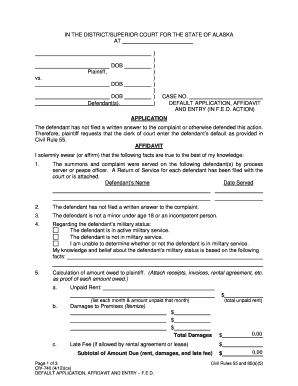
The defendant has not filed a written answer to the complaint or otherwise defended this action. Therefore, plaintiff requests that the clerk of court enter the defendant s default as provided in Civil Rule 55. AFFIDAVIT I solemnly swear (or affirm) that the following facts are true to the best of my knowledge: 1. The summons and complaint were served on the following defendant(s) by process server or peace officer. A Return of Service for each defendant has been filed with the court or is a.
Open form follow the instructions
Easily sign the form with your finger
Send filled & signed form or save
How to fill out the AK CIV-740 online
The AK CIV-740 form is a critical document used in eviction proceedings in Alaska. Completing this form accurately is essential for ensuring that the court recognizes your request for default judgment against a defendant who has failed to respond to a complaint.
Follow the steps to complete the AK CIV-740 form online.
- Press the ‘Get Form’ button to obtain the AK CIV-740. This action will open the form in your online editor.
- Begin by providing the names of the plaintiff and defendant, along with the case number at the top of the form.
- In the Application section, indicate that the defendant has not filed a written answer or defended the action.
- Complete the Affidavit section by affirming the truth of your statements. List the name of each defendant and the corresponding date when the summons and complaint were served.
- Confirm that the defendant is not a minor and provide accurate information regarding their military status.
- Calculate the total amount owed to you as the plaintiff, detailing unpaid rent, damages to the premises, and any late fees if applicable.
- Subtract any amounts the defendant has already paid, including security deposits or other payments, to arrive at the total amount owed.
- Enter any filing, service fees, or other costs associated with your case.
- Indicate whether you request prejudgment interest and provide the date for this request.
- Sign the application, print your name, and complete the mailing address section.
- Complete the Certificate of Service section, certifying that a copy of the application was mailed to the defendant.
- Finally, review your information for accuracy, save your changes, and choose to download, print, or share the completed form as needed.
Start filling out your AK CIV-740 form online today to ensure your case progresses smoothly.
Experience a faster way to fill out and sign forms on the web. Access the most extensive library of templates available.
Related content
Online Dispute Resolution. CIV-325 Complaint to Enforce AK ODR Agreement; CIV ... CIV-740...
This site publishes the exciting research of Dr. Nahum Arav and the Quasar Outflow Group.
This drawing and specifications, harka are the prep erty of Digital Equipment Corporation...
Get answers to your most pressing questions about US Legal Forms API.
What is the title 4 rewrite in Alaska?
The title 4 rewrite in Alaska involves revisions to Civil Rule 4 that clarify the requirements for serving legal documents. This rewrite aims to increase efficiency and ensure that all parties receive proper notification. By staying informed about changes to AK CIV-740, you can navigate legal processes more effectively. You can find comprehensive information and resources to assist you with these updates on uslegalforms.
What is the Civil Rule 4 in Alaska?
Civil Rule 4 in Alaska establishes the framework for serving summons and complaints in civil cases. This rule identifies who can serve documents, the methods of service, and the timelines involved. Adhering to AK CIV-740 is essential for upholding the integrity of the civil process and protecting your legal rights. For those looking to streamline document preparation and service, uslegalforms provides helpful templates and guidance.
What is Alaska Civil Rule 4?
AK CIV-740 refers to Alaska Civil Rule 4, which outlines the procedures for serving legal documents in civil cases in Alaska. Understanding this rule is crucial for anyone involved in a civil matter, as it sets the standards for notice and the proper delivery of legal paperwork. When you follow these guidelines, you ensure that all parties are informed and that the court can take appropriate action. For detailed assistance on navigating these rules, you can explore resources available on the uslegalforms platform.
What is the rule 36 in Alaska?
Rule 36 in Alaska governs requests for admission in civil cases, allowing one party to ask another to admit or deny certain statements or facts. This rule streamlines the discovery process by clarifying what is agreed upon and what remains in dispute. Incorporating insights from AK CIV-740 can facilitate more effective communication between parties. Understanding these admissions can significantly impact the progression of your case.
What is the rule of civil procedure 3 in Alaska?
Rule of Civil Procedure 3 in Alaska outlines the initiation of civil actions in court. It provides detailed steps on how a case can be started, including the necessary documentation and filings. Knowing how to effectively use AK CIV-740 can assist you during this initial stage of legal proceedings. This foundational understanding ensures a smoother start to your legal journey.
What is the G rule in Alaska Civil Rule 77?
The 'G rule' in Alaska Civil Rule 77 relates to the scheduling of motions and the procedures for hearings. It emphasizes timely hearings to ensure that cases progress without unnecessary delays. If you're filing motions, incorporating techniques from AK CIV-740 can streamline your process. For anyone involved in litigation, understanding this rule helps prevent potential setbacks.
What is the civil rule 69?
In general, Civil Rule 69 pertains to the enforcement of judgments and consists of rules that explain how a winning party can collect what is owed. This rule applies to various legal contexts, making it crucial for litigants to grasp its implications fully. When navigating complex legal scenarios, referring to AK CIV-740 offers insights into effectively managing judgment enforcement. Gaining clarity on these rules can equip you for successful compliance.
What is the rule 69 of the Federal Rules of Civil Procedure?
Rule 69 of the Federal Rules of Civil Procedure is similar to Alaska's Civil Rule 69, focusing on the enforcement of judgments. This rule specifies the methods available for enforcing a court’s monetary judgment, including execution and garnishment. Understanding how AK CIV-740 aligns with federal guidelines can enhance your legal approach. Federal procedures can sometimes serve as a template for state implementations.
What is Alaska civil rule 65?
Alaska Civil Rule 65 addresses injunctions and restraining orders. This rule details the procedures for obtaining either temporary or permanent injunctions, which can affect various types of legal disputes. If your case involves urgent matters, referencing AK CIV-740 may provide clarity on how to proceed effectively. This rule is essential for protecting rights during litigation.
What is the Civil Rule 69 in Alaska?
Civil Rule 69 in Alaska governs the process of enforcing monetary judgments. It covers actions like the seizure of property to satisfy debts. If you are dealing with collections, understanding AK CIV-740 in this context can be beneficial. This rule provides mechanisms to ensure that creditors can recover what they are owed.
Use professional pre-built templates to fill in and sign documents online faster. Get access to thousands of forms.
If you believe that this page should be taken down, please follow our DMCA take down process here.