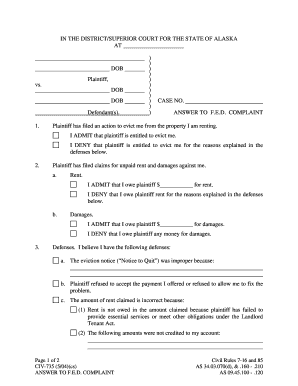
Vict me from the property I am renting. I ADMIT that plaintiff is entitled to evict me. I DENY that plaintiff is entitled to evict me for the reasons explained in the defenses below. 2. Plaintiff has filed claims for unpaid rent and damages against me. a. Rent. I ADMIT that I owe plaintiff $ for rent. I DENY that I owe plaintiff rent for the reasons explained in the defenses below. b. Damages. I ADMIT that I owe plaintiff $ for damages. I DENY that I owe plaintiff any money for damages.
Open form follow the instructions
Easily sign the form with your finger
Send filled & signed form or save
How to fill out the AK CIV-735 online
The AK CIV-735 form is essential for responding to eviction actions in the state of Alaska. This guide provides detailed, step-by-step instructions on how to fill out the form accurately online.
Follow the steps to complete the AK CIV-735 form.
- Click ‘Get Form’ button to access the AK CIV-735 form and open it in the online editor.
- Enter the case number in the designated field at the top of the form. Ensure that the number is accurate to match the court records.
- In the plaintiff and defendant sections, input the full names along with their dates of birth. Be sure to correctly identify yourself as the defendant.
- Address the claims made by the plaintiff regarding unpaid rent and damages. Indicate whether you admit or deny these claims and provide details in the appropriate fields.
- In the defenses section, list any defenses you have against the eviction. Be as thorough as necessary to explain why you believe the eviction notice may be improper or why you owe different amounts.
- Specify any counterclaims you wish to make against the plaintiff. This includes detailing any damages owed to you and the reasons those claims are valid.
- In the request for relief section, clearly state what you wish to ask the court for, including any damages or costs.
- Provide the date and your signature at the bottom of the form, ensuring you also print your name clearly.
- Complete the certificate of service, noting the method used to deliver a copy of the answer to the plaintiff, as well as their mailing address.
- After ensuring all information is correct, you can save changes, download, print, or share the completed form as necessary.
Complete your documents online to ensure a smooth legal process.
Experience a faster way to fill out and sign forms on the web. Access the most extensive library of templates available.
Related content
The defendant admits the plaintiff can evict, but denies owing rent or damages. They also...
Description: We explore the relationships between the chemistry, ages, and locations of...
The radio set includes a transmitter (2.1-9.1 mc) and receiver (190-9100 kc) with 25W CW...
Get answers to your most pressing questions about US Legal Forms API.
How do you terminate a tenant in Alaska?
To terminate a tenant in Alaska, you must provide the appropriate notice based on the reason for termination, such as non-payment of rent or lease violations. Generally, a 30-day notice is required for month-to-month tenants, while other situations may have specific requirements. To effectively manage this process, consult AK CIV-735 for guidance on legal procedures and forms needed.
How do you evict squatters in Alaska?
Evicting squatters in Alaska involves following legal procedures to establish ownership. Begin by providing proper notice, often a 10-day notice to vacate, and if the squatter does not leave, file for eviction in court. Utilizing AK CIV-735 can assist in understanding your rights and the procedures necessary for a successful eviction.
How long does it take to evict someone in Alaska?
Evicting someone in Alaska typically takes between 30 and 60 days, depending on the circumstances surrounding the case. The landlord must follow specific legal protocols, including serving the correct notices and possibly attending a court hearing. To efficiently navigate this process, familiarize yourself with AK CIV-735, which outlines essential steps and resources.
How long does an eviction take in Alaska?
The timeline for an eviction in Alaska can vary based on several factors. Generally, the process takes about 30 to 60 days from the initial filing to the final judgment. This may include the time required to serve the tenant and any potential court delays. For a smoother process, consider using resources like AK CIV-735 to understand the steps involved.
Can you evict one person from a house?
Yes, you can evict one person from a house, but several factors come into play. If the tenant being evicted is part of a joint lease, you may need to follow specific legal procedures to ensure the eviction is valid. Using forms like the AK CIV-735 can help clarify the reason for the eviction and protect your rights as a landlord. It’s advisable to consult legal guidance to ensure the process adheres to Alaska’s laws.
How long does the eviction process take in Alaska?
The length of the eviction process in Alaska typically ranges from a few weeks to several months. This duration depends on the specific circumstances, including the type of notice served, such as the AK CIV-735, and whether the tenant contests the eviction. Given the court's schedule, landlords need patience and preparedness for potential delays. Proper documentation and legal reasoning are essential in navigating this process.
Can you evict someone in the winter in Alaska?
Yes, landlords can evict tenants during the winter months in Alaska, though this is often challenging due to harsh weather conditions. The overall eviction process still requires adherence to legal protocols, including proper notice, such as the AK CIV-735. Landlords may need to consider the tenant's circumstances during winter when pursuing eviction. Being understanding while following the process can lead to a more favorable outcome.
What are the reasons for eviction in Alaska?
In Alaska, landlords can evict tenants for various reasons, including non-payment of rent, lease violations, or illegal activities on the premises. The AK CIV-735 form provides a clear structure for delivering a notice regarding any violations. Additionally, landlords must ensure they have a legal basis for eviction to avoid complications. Familiarizing yourself with these reasons can help both landlords and tenants understand their rights.
How long does it take to evict a tenant in Alaska?
The eviction process in Alaska can take several weeks to a few months, depending on various factors. Initially, a landlord must provide the appropriate notice, such as the AK CIV-735 for a 30-day notice. After the notice period, if the tenant does not leave, the landlord can file an eviction lawsuit. The timeline may vary based on court scheduling and tenant responses.
What is the 30 day notice to quit in Alaska?
The 30-day notice to quit in Alaska is a legal document that a landlord must provide a tenant before terminating a lease. This notice informs the tenant that they must vacate the property within 30 days. The AK CIV-735 form is commonly used for this purpose, helping landlords follow the required legal process. Using this form ensures that you comply with Alaska’s landlord-tenant laws.
Use professional pre-built templates to fill in and sign documents online faster. Get access to thousands of forms.
If you believe that this page should be taken down, please follow our DMCA take down process here.