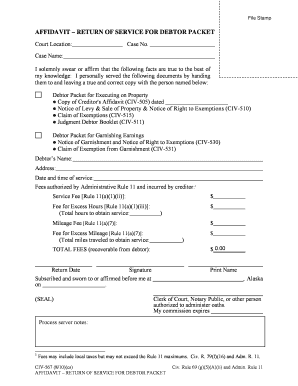
Sonally served the following documents by handing them to and leaving a true and correct copy with the person named below: Debtor Packet for Executing on Property Copy of Creditor's Affidavit (CIV-505) dated Notice of Levy & Sale of Property & Notice of Right to Exemptions (CIV-510) Claim of Exemptions (CIV-515) Judgment Debtor Booklet (CIV-511) Debtor Packet for Garnishing Earnings Notice of Garnishment and Notice of Right to Exemptions (CIV-530) Claim of Exemption from.
Loading
Open form follow the instructions
Easily sign the form with your finger
Send filled & signed form or save
How to fill out the AK CIV-567 online
The AK CIV-567 form is an affidavit for the return of service for a debtor packet. This guide will provide you with step-by-step instructions to fill out the form online accurately and efficiently.
Follow the steps to complete the AK CIV-567 form online.
- Click ‘Get Form’ button to obtain the form and open it in the editor.
- Begin by entering the court location in the designated field at the top of the form.
- Fill in the case number and case name as required, ensuring correct details are provided.
- Indicate the documents served, which include the Debtor Packet for Executing on Property and for Garnishing Earnings. Check the appropriate boxes next to the documents that apply.
- Provide the debtor's name and address in the specified fields.
- Record the date and time of service accurately to maintain the integrity of the affidavit.
- List any fees authorized by Administrative Rule 11 incurred by the creditor, including service fees and any additional charges for excess hours or mileage.
- Calculate the total fees recoverable from the debtor and enter that amount in the provided field.
- Sign the form where indicated, confirming the truthfulness of the statement under oath.
- Fill in the details of the clerk of court, notary public, or the person authorized to administer oaths, and ensure to include the date and seal if applicable.
- Finally, review all entries for accuracy before saving your changes, and choose to download, print, or share the completed form as needed.
Complete the AK CIV-567 form online today to ensure accurate filing for your service.
Experience a faster way to fill out and sign forms on the web. Access the most extensive library of templates available.
Related content
I solemnly swear or affirm that the following facts are true to the best of my knowledge:...
by M Naiman · 2022 — Alaska is unique among the fifty states in its use of a version of...
Civ il Lines, Delhi- 110054, 1123813761, kmrao31@radiffmail.com. 4322, Assistant...
Get answers to your most pressing questions about US Legal Forms API.
What is the rule 69 of the Federal Rules of Civil Procedure?
Rule 69 of the Federal Rules of Civil Procedure pertains to the execution of judgments, detailing the process for collecting on a court's decision. This federal guideline is crucial for ensuring that successful parties can secure what they are entitled to following a legal ruling. For a comprehensive overview, consider referencing AK CIV-567, which may provide valuable insights into both federal and state enforcement procedures.
What is the civil rule 69?
Civil Rule 69 focuses on the enforcement of judgments within civil proceedings. It covers aspects like judgment liens and the various ways creditors can recover debts or claims. By utilizing AK CIV-567, you can gain clarity on how to implement these rules effectively and protect your legal rights.
What is the Civil Rule 69 in Alaska?
Civil Rule 69 in Alaska outlines the procedures for enforcing judgments, including writs of execution and garnishment. This rule helps judgment creditors collect what they are owed by establishing legal processes for seizing assets. If you need to enforce a judgment, AK CIV-567 can guide you through the essential steps to ensure proper compliance with the law.
What is the rule 37 in Alaska?
Alaska Rule 37 deals with motions to compel discovery and the sanctions that may follow. If a party fails to comply with discovery requests, the other party can seek the court's intervention to obtain the necessary information. Using AK CIV-567 can help you understand and apply the correct procedures for filing these motions confidently.
What is the rule 36 in Alaska?
Rule 36 in Alaska allows parties to request admissions of facts from one another. This rule helps clarify the issues in a case by allowing one party to ask another to admit or deny specific statements. Utilizing AK CIV-567 can assist you in drafting these requests accurately to ensure all essential facts are addressed effectively.
What is Alaska civil rule 65?
Alaska Civil Rule 65 governs injunctions and restraining orders in civil cases. It provides the necessary procedures for individuals seeking to prevent others from taking action that may cause them harm. Understanding this rule is essential for effectively navigating legal disputes in Alaska. For detailed guidance, you might consider using AK CIV-567 to streamline your application process.
What is the Rule 76 in Alaska?
Rule 76 in Alaska pertains to the strategic use of discovery, specifically concerning the production of documents. This rule outlines procedural requirements for parties to disclose relevant documentation. When engaging with AK CIV-567, having a grasp of Rule 76 ensures compliance and prepares you effectively for discovery phases.
What is the G Rule in Alaska Civil Rule 77?
The G Rule in Alaska Civil Rule 77 focuses on the authority of the court and its clerks to issue orders and process. This rule outlines how courts handle motions, hearings, and other administrative duties. Knowing the G Rule is important when utilizing AK CIV-567 to navigate court processes smoothly.
How to file a civil lawsuit in Alaska?
To file a civil lawsuit in Alaska, you must first gather relevant documents and evidence to support your case. Next, complete the necessary forms, such as the AK CIV-567, which outlines the details of your claim. Once you have prepared your paperwork, submit it to the appropriate court along with any required filing fees. Utilizing resources from USLegalForms can simplify this process, guiding you step-by-step through each requirement.
What is Alaska Civil rule 55?
Rule 55 - Default (a) Entry. (1)Application for Default. When a party against whom a judgment for affirmative relief is sought has failed to appear and answer or otherwise defend as provided by these rules, and that fact is shown by affidavit or otherwise, the clerk shall enter a default.
Use professional pre-built templates to fill in and sign documents online faster. Get access to thousands of forms.
If you believe that this page should be taken down, please follow our DMCA take down process here.