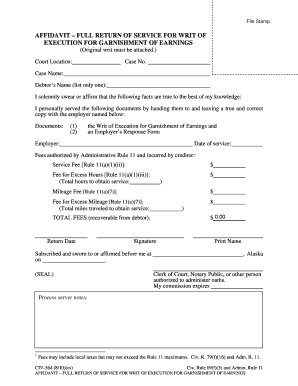
Y one): I solemnly swear or affirm that the following facts are true to the best of my knowledge: I personally served the following documents by handing them to and leaving a true and correct copy with the employer named below: Documents: (1) (2) the Writ of Execution for Garnishment of Earnings and an Employer s Response Form Employer: Date of service: Fees authorized by Administrative Rule 11 and incurred by creditor: 1 Service Fee Rule 11(a)(1)(ii) : $ Fee for Excess Hours Rule 11(.
Loading
Open form follow the instructions
Easily sign the form with your finger
Send filled & signed form or save
How to fill out the AK CIV-564 online
The AK CIV-564 form, also known as the affidavit – full return of service for writ of execution for garnishment of earnings, is essential for documenting the service of legal documents. This guide will provide you with clear, step-by-step instructions to accurately complete this form online.
Follow the steps to complete the AK CIV-564 form online.
- Click the ‘Get Form’ button to obtain the AK CIV-564 online and open it for editing.
- Begin by entering the court location in the designated field. This should include the name of the court where the case is filed.
- Enter the case number in the appropriate field. Make sure to provide the correct and complete case number to ensure proper indexing.
- Input the case name, which typically includes the names of the parties involved in the case. Ensure it matches the official court documentation.
- Specify the debtor's name, noting that only one debtor should be listed in this section.
- In the statement section, affirm the truthfulness of the information by selecting 'I solemnly swear or affirm that the following facts are true to the best of my knowledge.'
- List the documents served under the 'Documents' section. Include both the writ of execution for garnishment of earnings and any accompanying documents.
- Provide the name of the employer where the documents were served in the 'Employer' field.
- Date of service should be filled in with the accurate date on which the documents were served.
- Enter the fees incurred by the creditor for processing. Detail the service fee, excess hours fee (if applicable), mileage fee, and any excess mileage fee justifying the costs.
- Sum up all fees under 'TOTAL FEES' indicating the full amount that is recoverable from the debtor.
- Indicate the return date clearly, as guided by court procedures.
- Sign the document, affirming the information presented is true and complete.
- Have the form subscribed and sworn before an authorized individual such as a notary public or court clerk, including their name, location, and commission expiration date.
- Once you have completed all sections, review the information for accuracy. You can then save your changes, download, print, or share the form as needed.
Start completing your AK CIV-564 online today to ensure efficient and accurate filing.
Experience a faster way to fill out and sign forms on the web. Access the most extensive library of templates available.
Related content
Debtor's Name (list only one):. I solemnly swear or affirm that the following facts are...
by GM Bair · 1998 — TABLE OF CONTENTS. I.Introduction...
BACKGROUND HISTORY. A pathogenic fungus capable of causing sporadic deaths in some...
Get answers to your most pressing questions about US Legal Forms API.
What is the Civil Rule 90.7 in Alaska?
Civil Rule 90.7 addresses the issue of child custody and visitation in Alaska. This rule provides guidance on the factors courts consider when determining custody arrangements. For anyone dealing with custody matters, knowledge of AK CIV-564 can provide essential insight into the legal expectations and help inform your approach to the situation.
What is the Civil Rule 4 in Alaska?
Civil Rule 4 outlines the requirements for serving legal documents in civil cases in Alaska. This rule specifies how and when documents must be served to ensure proper notification of parties involved. Understanding AK CIV-564 helps individuals comply with these requirements, reducing the risk of delays in their legal matters.
What is the rule 76 in Alaska?
Rule 76 in Alaska, synonymous with Civil Rule 76, specifically pertains to depositions. It lays out critical procedures that govern how depositions should be taken and used in court. By leveraging the insights provided by AK CIV-564, you can navigate these procedures more effectively and increase your chances of a successful outcome.
What is the Civil Rule 77 in Alaska?
Civil Rule 77 addresses the powers and duties of judges in Alaska's civil court system. This rule outlines the authority of judges regarding hearings and court proceedings. When you understand AK CIV-564, you gain clarity about how judges operate, which can positively affect your legal strategy.
What is the Civil Rule 79 in Alaska?
Civil Rule 79 regulates the handling of court documents, including the management of exhibits and the record of proceedings. This rule helps ensure that all parties maintain proper documentation throughout a case. For individuals referencing AK CIV-564, knowing these details can streamline the court process and improve your case's organization.
What is the Civil Rule 76 in Alaska?
The Civil Rule 76 in Alaska outlines the procedures for the use of depositions in civil cases. This rule ensures that depositions are conducted fairly and that all parties have access to the necessary information. By understanding AK CIV-564, you can navigate these procedures more efficiently, reducing potential delays in your case.
What is the 5 year rule in California?
The 5 year rule in California pertains to the enforcement of judgments, stating that a civil judgment must be enforced within five years of its entry. After this period, the judgment can become unenforceable unless action is taken for renewal. Understanding this rule is important for both creditors and debtors to know their rights and obligations. For comprehensive information on managing judgments effectively, exploring uslegalforms can be beneficial.
What is the time limit for service of process in California?
In California, the time limit for serving a defendant with the initial complaint is generally 60 days from the filing date. However, there may be additional considerations that can extend this timeframe. Adhering to this timeline is crucial to avoid potential dismissals. To ensure compliance with service of process rules, utilizing services from uslegalforms can simplify this process.
What is Section 664.5 of the California Code of Civil Procedure?
Section 664.5 of the California Code of Civil Procedure pertains to the process of reviving a judgment. This section explains how a judgment can be renewed and the timeframes necessary for doing so. Understanding these provisions is vital for individuals wanting to maintain or reestablish their legal rights. For comprehensive assistance on judgment matters, uslegalforms offers valuable resources.
What are recoverable costs in California Code of Civil Procedure?
Recoverable costs under California Code of Civil Procedure refer to expenses that a prevailing party can claim after a legal action. This may include court fees, attorney's fees, and costs for serving documents. Knowing what costs can be recovered can significantly impact your overall financial obligation in a lawsuit. For clarity on what qualifies, look into the helpful tools provided by uslegalforms.
Use professional pre-built templates to fill in and sign documents online faster. Get access to thousands of forms.
If you believe that this page should be taken down, please follow our DMCA take down process here.