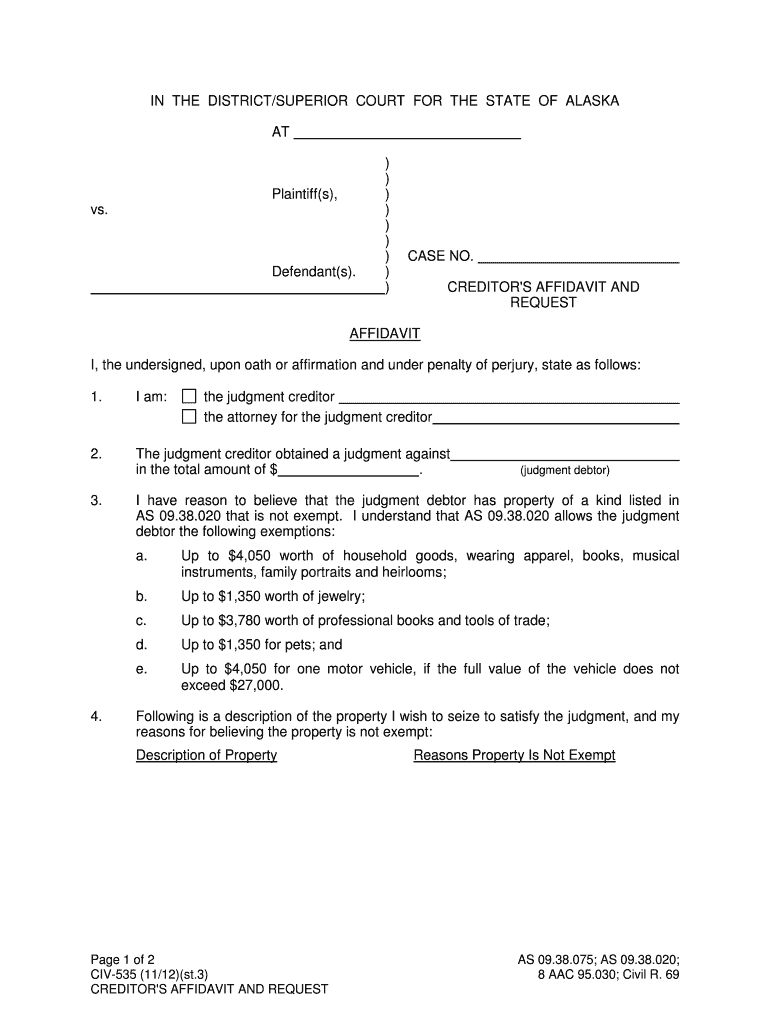
Tion and under penalty of perjury, state as follows: 1. I am: 2. The judgment creditor obtained a judgment against in the total amount of $ . 3. 4. the judgment creditor the attorney for the judgment creditor (judgment debtor) I have reason to believe that the judgment debtor has property of a kind listed in AS 09.38.020 that is not exempt. I understand that AS 09.38.020 allows the judgment debtor the following exemptions: a. Up to $4,050 worth of household goods, wearing apparel, books.
Loading

Open form follow the instructions

Easily sign the form with your finger

Send filled & signed form or save
How to fill out the AK CIV-535 online
The AK CIV-535 is an important legal document used for creditors to request an order from the court regarding a judgment debtor's property. This guide offers a structured approach for users to successfully complete the form online, ensuring clarity and accuracy in every section.
Follow the steps to fill out the AK CIV-535 with ease.
- Click ‘Get Form’ button to obtain the form and open it in the editor.
- Begin by entering the case number in the designated field. This number helps identify your specific case within the court system.
- In the affidavit section, specify your identity as the judgment creditor or the attorney for the judgment creditor. Clearly designate your role to provide context for the claim.
- State the details of the judgment against the judgment debtor, including the total amount owed. This information is crucial for establishing the basis of your claim.
- Provide a description of the property you wish to seize. Ensure that this description is detailed and accurate to avoid any confusion regarding the items in question.
- List the reasons you believe the property is not exempt. Refer to the exemptions allowable under Alaska law to ensure that your claims are justified.
- Complete the request section where you formally ask the court for relief. Here, outline your requests, including notifying the judgment debtor and specifying their rights.
- Fill in the date and sign the affidavit. If you are an attorney, include your printed name and title as necessary.
- Input your mailing address and the city, state, and ZIP code for proper processing and communication from the court.
- Final steps include reviewing the entire document for accuracy, saving your changes, and then downloading or printing the completed form for submission.
Complete your documents online today to ensure a timely and efficient process.
Experience a faster way to fill out and sign forms on the web. Access the most extensive library of templates available.
Related content
Online Dispute Resolution. CIV-325 Complaint to Enforce AK ODR Agreement ... CIV-535...
The University of Alaska Board of Regents retained EAB to recommend proven strategies...
by GO Brown · 2002 · Cited by 232 — On December 31, 1835, a Royal ordinance declared...
Get answers to your most pressing questions about US Legal Forms API.
How to file a civil lawsuit in Alaska?
Filing a civil lawsuit in Alaska involves several steps. First, you need to complete the AK CIV-535 form, which outlines your complaint clearly and provides the necessary details about your case. Next, file the form with the local court, along with any required fees. To ensure your filing is correct, consider using the uslegalforms platform, where you can access comprehensive resources and guidance on completing the AK CIV-535 form effectively.
What is the rule 45 in Alaska?
Rule 45 in Alaska, as mentioned earlier, pertains to subpoenas. It outlines how to properly issue a subpoena for witnesses and documents during civil litigation. Mastering the intricacies of this rule through resources like AK CIV-535 is crucial for ensuring your cases are properly supported with evidence.
What is the civil rule 69 in Alaska?
Civil Rule 69 in Alaska concerns the enforcement of judgments. It provides mechanisms for collecting on judgments that have been awarded, including the use of various legal processes. Understanding AK CIV-535 can equip you with the knowledge to effectively pursue your rights in judgment enforcement.
What is rule 45 in Alaska?
Rule 45 in Alaska relates to subpoenas, which are orders requiring someone to attend court or produce documents. This rule outlines how one may issue a subpoena and the responsibilities of those who receive one. Utilizing AK CIV-535 can guide you through these procedures, ensuring compliance with the legal requirements.
What is the rule 36 in Alaska?
Rule 36 in Alaska governs requests for admissions in civil cases. It allows one party to request the other to admit or deny specific facts. Navigating these requests effectively can be supported by using resources like AK CIV-535, helping you streamline the discovery process.
What is the Civil Rule 5 in Alaska?
Civil Rule 5 in Alaska deals with the service and filing of pleadings and papers. It provides specific guidelines for how documents should be served on other parties and filed with the court. By understanding AK CIV-535, you can ensure that all necessary documents are properly exchanged and recorded, which is critical for your case.
What is the rule of civil procedure 3 in Alaska?
The rule of civil procedure 3 in Alaska outlines the initiation of civil actions. It describes the necessary steps to start a lawsuit, including filing a complaint with the court. Familiarity with AK CIV-535 provides guidance on these formal requirements, helping you start your case correctly.
What is the rule 40 in Alaska?
Rule 40 in Alaska addresses the scheduling of civil cases. It specifies how courts should handle the assignment of cases to judges and the timeline for proceedings. Understanding AK CIV-535 can help you navigate the complexities of these scheduling rules, ensuring your case proceeds without unnecessary delays.
What is Alaska Civil Rule 4?
Alaska Civil Rule 4 establishes the protocol for serving legal documents and notices to parties involved in civil litigation. This rule is essential for ensuring that all parties receive appropriate notice, which is a cornerstone of fair legal proceedings. When dealing with forms like the AK CIV-535, understanding Alaska Civil Rule 4 can help avoid potential legal complications and streamline the process.
What is the title 4 rewrite in Alaska?
The title 4 rewrite in Alaska amends and updates the procedural rules governing civil actions. This rewrite aims to enhance clarity and improve the efficiency of civil procedures in the state. By refining these rules, Alaska ensures that individuals and attorneys can navigate the legal process more smoothly. If you're working with forms such as the AK CIV-535, being aware of these updates can be immensely beneficial.
Use professional pre-built templates to fill in and sign documents online faster. Get access to thousands of forms.
If you believe that this page should be taken down, please follow our DMCA take down process here.