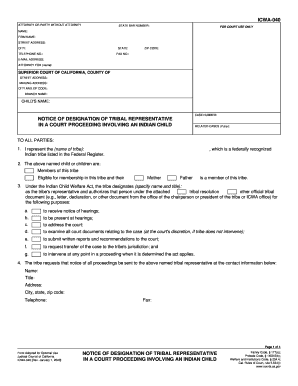
(name): SUPERIOR COURT OF CALIFORNIA, COUNTY OF STREET ADDRESS: MAILING ADDRESS: CITY AND ZIP CODE: BRANCH NAME: CHILD'S NAME: CASE NUMBER: NOTICE OF DESIGNATION OF TRIBAL REPRESENTATIVE IN A COURT PROCEEDING INVOLVING AN INDIAN CHILD RELATED CASES (if any): TO ALL PARTIES: 1. I represent the (name of tribe): Indian tribe listed in the Federal Register. , which is a federally recognized 2. The above named child or children are: Members of this tribe Eligible for membership in this tribe.

How it works
  • Open form

    Open form follow the instructions

  • Easily sign form

    Easily sign the form with your finger

  • Share form

    Send filled & signed form or save

How to fill out the CA ICWA-040 online

Filling out the CA ICWA-040 form online is an essential step for tribes involved in court proceedings related to an Indian child. This guide provides a clear and supportive overview to help users understand each component of the form and how to complete it effectively.

Follow the steps to fill out the CA ICWA-040 form accurately.

  1. Click ‘Get Form’ button to obtain the form and open it in the editor.
  2. Enter the attorney or party information. Fill out the fields for ‘name,’ ‘firm name,’ ‘street address,’ ‘city,’ ‘state,’ ‘telephone number,’ ‘ZIP code,’ ‘fax number,’ and ‘email address’ carefully ensuring all information is accurate.
  3. Provide the details of the court by entering the ‘superior court of California, county of,’ along with the ‘street address,’ ‘mailing address,’ ‘city and ZIP code,’ and ‘branch name.’
  4. Fill in the child's name and case number. This information is crucial as it directly relates to the court proceeding.
  5. Indicate the tribe by stating the name of the Indian tribe that is federally recognized, and confirm whether the named child is a member of the tribe or eligible for membership.
  6. Designate the tribal representative. Specify the name and title of the representive who will serve on behalf of the tribe in court proceedings.
  7. Provide a contact information section for the tribal representative, including their ‘name,’ ‘title,’ ‘address,’ ‘city, state, ZIP code,’ and ‘telephone number.’
  8. In the section for notice requests, indicate whether additional notices are to be sent to the tribal council, and if so, fill in the necessary contact details.
  9. Complete the declaration by typing or printing the name of the person filling out the form, date, and signature. Ensure that this information is accurate.
  10. Review all entered information for accuracy. Once satisfied, users can save changes, download, print, or share the completed form.

Start completing your CA ICWA-040 form online today to ensure proper legal representation.

Get form

Experience a faster way to fill out and sign forms on the web. Access the most extensive library of templates available.

Related content

ICWA-040 Notice of Designation of Tribal...

Jan 1, 2020 — ICWA-040 is a notice designating a tribal representative in court...

Learn more
California ICWA Compliance Task Force

127 ICWA-040. 128 Rule of Court 5.534(i)(2). 129 25 U.S.C. §§1911, 1931-1934 ... The...

Learn more
Questions & Answers

Get answers to your most pressing questions about US Legal Forms API.

Contact support

What is the burden of proof for ICWA?

The burden of proof under ICWA requires that the party seeking the termination of parental rights or foster placement must demonstrate that the evidence meets a higher standard—beyond a reasonable doubt. This higher standard is essential to ensure that Indian children are not removed from their families without just cause. Familiarizing yourself with CA ICWA-040 will help you navigate these legal requirements effectively.

An Indian child, under the ICWA, is defined as an unmarried person under the age of 18 who is either a member of an Indian tribe or is eligible for membership. This definition is pivotal for enforcing the provisions of CA ICWA-040, as the Act is dedicated to protecting the welfare of these children. Misunderstanding this definition can lead to challenges in custody proceedings.

Efforts to overturn ICWA primarily stem from concerns about state sovereignty and the perceived restrictions placed on state courts by federal law. Critics argue that ICWA may infringe upon the rights of non-Indian families involved in custody cases. However, supporters of CA ICWA-040 maintain that preserving tribal sovereignty and the welfare of Indian children is crucial for their cultural survival and identity.

ICWA applies to Indian children, meaning those who are members or eligible for membership in a federally recognized tribe. It's essential that individuals determine their eligibility by connecting with their tribe's enrollment office. If you are involved in custody matters concerning Indian children, understanding CA ICWA-040 can help clarify eligibility and guide you through the process.

The requirements of ICWA include notification to the child's tribe, providing them with the opportunity to intervene in custody proceedings. Furthermore, ICWA emphasizes that tribes have jurisdiction over their children, and if the tribe wishes to take custody, their preferences must be honored. Understanding these requirements is crucial for those navigating CA ICWA-040 to ensure compliance with tribal laws and protect children's welfare.

Yes, the Indian Child Welfare Act applies to custody cases involving Indian children, particularly when the state seeks to remove a child from their family or tribe. Under CA ICWA-040, authorities must follow distinct procedural requirements designed to protect the rights of Indian families and tribes. This ensures that custody proceedings do not disregard the child's cultural background and the importance of connecting with their tribal community.

The Indian Child Welfare Act (ICWA) outlines specific requirements for child custody proceedings involving Indian children. These include notifying the child's tribe of the proceedings and ensuring that their cultural, emotional, and spiritual needs are addressed. To comply with CA ICWA-040, courts must consider the best interests of the child while respecting their heritage and tribal connections.

The ICWA requirements stipulate that states must notify tribes when an ICWA-eligible child is involved in custody proceedings. Moreover, they must provide tribes with the opportunity to intervene in such cases. For more detailed guidance, exploring resources like US Legal Forms can clarify these requirements and assist you in navigating the legalities surrounding CA ICWA-040.

ICWA eligibility refers to the criteria determining which children fall under the protections of the Indian Child Welfare Act. Generally, it applies to children who are members of, or eligible for membership in, a federally recognized tribe. Understanding these criteria is crucial for families seeking to ensure compliance with CA ICWA-040 and maintain their children's cultural connections.

The Indian Child Welfare Act (ICWA) was established to protect the best interests of American Indian children and promote the stability of Indian tribes and families. Its main goal is to preserve the cultural identity of Native American children and prevent the unnecessary removal from their families and tribes. Understanding CA ICWA-040 helps individuals navigate this important legal landscape and supports the rights of these children.

Get This Form Now!

Use professional pre-built templates to fill in and sign documents online faster. Get access to thousands of forms.

If you believe that this page should be taken down, please follow our DMCA take down process here.

Get CA ICWA-040