Se type code will contain a major code, which will be either S or H, and a minor code, which will be a number. Select the code that best describes your case: Code Description S00 Small Claims - Collection - Credit Card (Original Owner) S05 Small Claims - Collection - Hospital S10 Small Claims - Collection - Medical Non-Hospital S15 Small Claims - Collection - Purchased Debt S20 Small Claims - Contract - Home Improvement S25 Small Claims - Contract - Other S50 Small Claims - Tort - Motor Vehicle.
Loading
Open form follow the instructions
Easily sign the form with your finger
Send filled & signed form or save
How to fill out the CT JD-CV-40 online
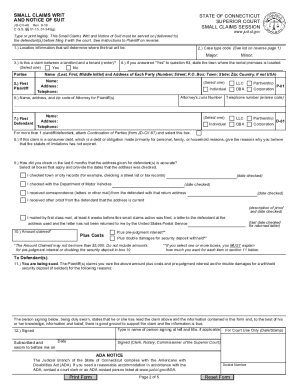
Filling out the CT JD-CV-40, also known as the Small Claims Writ and Notice of Suit, can seem daunting, but with this guide, you will navigate each section efficiently. This document allows individuals to file a claim for money damages of up to $5,000 in small claims court in Connecticut.
Follow the steps to successfully complete the CT JD-CV-40.
- Press the ‘Get Form’ button to access the CT JD-CV-40 online. This will allow you to open the document in your preferred digital editor.
- Begin at section 1, where you will need to provide location information that determines where the trial will occur. Enter the town where the rental property is located if you are a landlord or tenant. If you are filing as an individual, choose the town where you live, the defendant lives, or where the transaction occurred.
- For section 2, select the appropriate case type code from the provided list that best describes your case, using the major and minor code format.
- In section 3, indicate whether your claim is between a landlord and a tenant by selecting 'Yes' or 'No'. If you select 'Yes', proceed to section 4.
- If applicable, write the town where the rental property is located in section 4.
- Proceed to section 5 to enter the complete and correct legal name, address, and telephone number of the plaintiff(s). Select the appropriate type of plaintiff.
- If you are represented by an attorney, fill out section 6 with the attorney’s information.
- In section 7, provide the details of the defendant(s) you are suing. Make sure to include correct legal names and select the type of defendant.
- For section 8, include any necessary explanations related to the statute of limitations if applicable.
- In section 9, verify the accuracy of the addresses provided and indicate how you confirmed them.
- Fill out section 10 by entering the amount claimed, ensuring not to exceed the $5,000 limit. Check any applicable boxes for costs.
- Provide a brief description of the reason for the claim in section 11. You may attach additional documentation if necessary.
- Finalize the document in section 12 by signing under oath, ensuring that the oath is taken in the presence of an authorized person who will sign as well.
- Once finalized, you can save your changes, download the completed document, print it, or share it as needed.
Complete your small claims filings online with confidence and ensure all required documentation is in order.
Experience a faster way to fill out and sign forms on the web. Access the most extensive library of templates available.
Related content
JD-CV-40 Rev. 11-24. Small Claims Court is where a person can sue for money damages only...
by A Aneja — Implementing the requirement of the rules, JD-CV-40, the “Small Claims...
Academic Positions Held: Current: Clinical Instructor, Anesthesiology & Critical Care...
Get answers to your most pressing questions about US Legal Forms API.
How much can you sue for in small claims court in Nebraska?
In Nebraska, you can sue for amounts up to $3,900 in small claims court. This limit provides an accessible route for individuals seeking to resolve disputes quickly and efficiently. When preparing your case, remember that simplicity often leads to better outcomes, so utilizing tools and resources like the CT JD-CV-40 can be beneficial when applicable.
What is the small claims court limit in Nebraska?
In Nebraska, the small claims court limit is generally set at $3,900. This limit allows individuals to pursue claims without needing extensive legal representation. It's crucial to ensure that your claim falls within this limit when considering options and using forms for filing, as it can streamline the process considerably.
Is taking someone to small claims court worth it?
Taking someone to small claims court can be a practical solution for recovering owed debts or settling disputes without incurring significant legal fees. The CT JD-CV-40 form can be an essential part of the process, allowing you to present your claim effectively. We often find that many people achieve favorable resolutions in this straightforward setting, making it worth considering for smaller disputes.
How long do you have to sue someone in CT?
In Connecticut, the statute of limitations for most civil claims is six years, which gives you ample time to prepare your case. Make sure to review the specifics of your situation carefully, especially when using forms like CT JD-CV-40, as timely filing is essential. Delaying can affect your chances of a successful outcome, so it's wise to take action sooner rather than later.
What is the maximum amount you can sue for in civil court?
In civil court, the maximum amount you can sue for typically depends on the jurisdiction and the type of case. In Connecticut, where the CT JD-CV-40 form comes into play, you can generally pursue claims for substantial amounts, often exceeding $15,000. Always consider consulting with a legal expert to ensure you are filing correctly and to explore your options effectively.
What is the best evidence for small claims court?
The best evidence for small claims court is clear, concise documentation that supports your claim, such as contracts, receipts, and photographs. Each piece should be organized and relevant to the matter at hand. When addressing this part of your case, remember that the CT JD-CV-40 includes guidance on what types of evidence are most effective in persuading the judge.
How to serve a small claims writ and notice of Suit in CT?
To serve a small claims writ and notice of suit in Connecticut, you must follow specific state guidelines which typically require either personal delivery or mail. Use the official forms to ensure proper submission and adhere to the deadlines outlined by the court. The CT JD-CV-40 includes instructions that can streamline this process and reduce the potential for errors.
Do you need a lawyer for small claims court in CT?
In Connecticut, hiring a lawyer for small claims court is not required; individuals typically represent themselves. This allows for a more straightforward process focused on the core issues at hand. If you are uncertain about the steps, the CT JD-CV-40 provides a structured format for your case and helps you understand the filing procedure.
What is the limit for small claims court in Minnesota?
In Minnesota, the limit for small claims court is typically $15,000 for most cases. However, when dealing with consumer credit transactions, the limit drops to $4,000, which aims to protect vulnerable consumers. If you are preparing a claim, using the CT JD-CV-40 can assist you in understanding how to format and file your paperwork effectively.
What are the rules for small claims court in Oregon?
Oregon's small claims court facilitates disputes up to $10,000, with simplified procedures to foster accessibility. While specific rules may vary by county, generally, parties cannot be represented by attorneys, making the CT JD-CV-40 a helpful guide for completing the necessary paperwork. Familiarize yourself with local forms and regulations to increase your chances of a successful resolution.
Use professional pre-built templates to fill in and sign documents online faster. Get access to thousands of forms.
If you believe that this page should be taken down, please follow our DMCA take down process here.