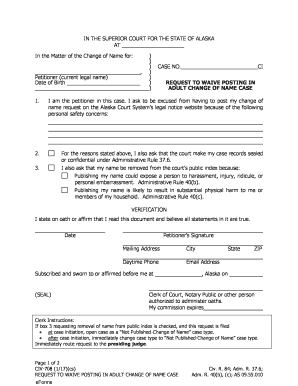
ADULT CHANGE OF NAME CASE 1. I am the petitioner in this case. I ask to be excused from having to post my change of name request on the Alaska Court System s legal notice website because of the following personal safety concerns: 2. For the reasons stated above, I also ask that the court make my case records sealed or confidential under Administrative Rule 37.6. I also ask that my name be removed from the court s public index because: Publishing my name could expose a person to harassmen.

How it works
  • Open form

    Open form follow the instructions

  • Easily sign form

    Easily sign the form with your finger

  • Share form

    Send filled & signed form or save

How to fill out the AK CIV-708 online

Filling out the AK CIV-708 form is an essential step for individuals seeking to request a waiver of posting in an adult change of name case. This guide provides clear and supportive instructions to help users navigate the form effectively and ensure all necessary information is provided.

Follow the steps to successfully complete the AK CIV-708 form.

  1. Click the ‘Get Form’ button to access the form and open it in your preferred online editor.
  2. Fill in the section labeled 'Petitioner (current legal name)' with your legal name as it appears on official documents.
  3. Enter your date of birth in the space provided, ensuring that it is formatted correctly.
  4. In the reasons section, clearly outline your personal safety concerns that warrant a waiver of posting. Be specific and concise.
  5. Next, indicate whether you request that your case records be sealed or confidential by referencing Administrative Rule 37.6. Provide reasons supporting this request.
  6. In the verification section, affirm that you have read the document and that all statements are true. Be sure to sign and date this section.
  7. Fill in your mailing address, city, ZIP code, daytime phone number, and email address in the designated fields.
  8. If required, have your signature notarized. This typically involves signing the form in front of a notary public.
  9. Review all the information entered to ensure accuracy before proceeding.
  10. After completing the form, you can save your changes, download the form for offline use, print it for physical submission, or share it as needed.

Complete your documents online with confidence and ensure a smooth filing process.

Get form

Experience a faster way to fill out and sign forms on the web. Access the most extensive library of templates available.

Related content

civ-708.pdf - Alaska Court System

Form CIV-708 is a request to waive posting of a name change case on the Alaska Court...

Learn more
YEAR IN REVIEW Alaska Supreme Court and Court of

by DS Hagy · 1994 — This case came before the court of appeals because several...

Learn more
heidi gibson

Aug 18, 2021 — This follows her prior work as an SSEC research fellow helping to develop...

Learn more
Questions & Answers

Get answers to your most pressing questions about US Legal Forms API.

Contact support

What is needed to file a lawsuit?

To file a lawsuit, you will need to gather pertinent information, including the names of the parties involved, a clear statement of your claims, and any supporting evidence. Completing the AK CIV-708 form is crucial as it outlines your case succinctly. Additionally, having a good understanding of the applicable laws and procedures will strengthen your case and improve your chances of a favorable outcome.

To petition for a name change in Alaska, you need to complete the appropriate forms that include specific details about your request. The AK CIV-708 form can be instrumental in this process, as it provides a structured way to present your case. After completing the paperwork, file it with the court, and attend a hearing, if required, to finalize the name change.

Yes, you can sue for emotional distress in Alaska under certain conditions. Generally, you must demonstrate that the emotional distress stems from another party's intentional or negligent actions. Using the AK CIV-708 form can help facilitate your legal process, allowing you to outline your claims effectively and pursue justice for your emotional injuries.

To initiate a lawsuit, start by identifying the proper court and the basis for your claim. Next, prepare your complaint using the AK CIV-708 form, outlining the relevant facts and legal reasons. Once your complaint is drafted, file it with the court and serve all necessary parties. Then, gather evidence to support your claims and attend all court hearings. Following these steps can help ensure your case proceeds smoothly.

If you miss court in Alaska, the judge may issue a default judgment against you, especially if you are the defendant. This means the court may rule in favor of the other party based on your absence. To avoid such consequences, it's crucial to understand the importance of attending all scheduled court dates and, if necessary, discussing any conflicts with your attorney in advance.

Filing a lawsuit in Alaska involves several essential steps. Start by drafting your complaint using the AK CIV-708 form, which outlines your claims and requested remedies. Next, file the complaint with the relevant court and ensure that all parties involved receive notice of the lawsuit. It's vital to follow the local court rules during this process.

To sue someone in Alaska, you must first identify the appropriate court where the lawsuit should be filed. You will need to complete the required forms, including the AK CIV-708 paperwork, and gather any evidence that supports your case. After filing the lawsuit, you must serve the defendant with the court documents, allowing them time to respond.

Judges in Alaska generally do not have a strict deadline to respond to motions; however, they strive to do so efficiently. The timeframe can vary based on the complexity of the motion and the court's calendar. Timely responses are important in maintaining the momentum of your case under AK CIV-708. For advice on managing expectations in this area, USLegalForms is a helpful platform.

Civil Rule 69 in Alaska governs the process of executing judgments. It outlines how a winning party can collect on a judgment through various means such as garnishment or seizure. Familiarity with Rule 69 can help you navigate post-judgment processes under AK CIV-708 effectively. To learn more about enforcement options, USLegalForms can be a helpful resource.

Rule 82 of the Alaska Rules of Civil Procedure pertains to attorney’s fees in civil cases. It allows a court to award costs based on the outcomes of the case. Understanding this rule is vital when dealing with expenses related to your case as it directly impacts the financial aspects surrounding AK CIV-708. Visit USLegalForms for guidance on how to interpret this rule.

Get This Form Now!

Use professional pre-built templates to fill in and sign documents online faster. Get access to thousands of forms.

If you believe that this page should be taken down, please follow our DMCA take down process here.

Get AK CIV-708