Open form follow the instructions
Easily sign the form with your finger
Send filled & signed form or save
How to fill out the FL 12.950(b) online
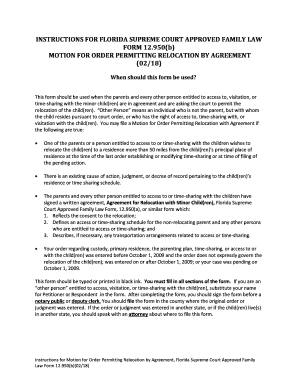
The FL 12.950(b) form is used to request the court's permission to relocate minor children when all parties involved have reached an agreement. This guide provides clear, step-by-step instructions to help you fill out the form correctly online.
Follow the steps to complete the FL 12.950(b) form online.
- Click ‘Get Form’ button to obtain the form and open it in the editor.
- Begin by filling in the case information at the top of the form, including the judicial circuit and county names, along with the case number and division.
- In the 'Petitioner' and 'Respondent' sections, write the full legal names of all parties involved in the motion.
- State your request clearly by specifying that you wish to relocate the minor child(ren). Provide the new address and ensure that it meets the requirement of being at least 50 miles away from the child's principal residence as per previous orders.
- List the names and birth dates of all minor child(ren) involved in the motion in the respective section.
- Include a statement confirming that a written agreement for relocation has been made, ensuring it includes all necessary details regarding access or time-sharing arrangements.
- Elaborate on the reasons for the proposed relocation and explain why this change is in the best interest of the child(ren).
- Indicate whether you seek a hearing for the motion or if you prefer it to be ratified without a hearing.
- Attach any required documents such as the Uniform Child Custody Jurisdiction and Enforcement Act affidavit and any other necessary forms as indicated.
- Ensure all parties sign the form and that it is notarized before you finalize it.
- After completing the form, you can save changes, download, or print the form to maintain a copy for your records before filing.
Complete your documents online today to ensure a smooth filing process.
Experience a faster way to fill out and sign forms on the web. Access the most extensive library of templates available.
Related content
Motion for order permitting relocation by agreement. Form Number. 12.950(b). Form Type...
by FFLAW RULES — The notice of intent to relocate with minor child, prepared in...
FL – would indicate locking fork. Tefzel® is a registered trademark of DuPont ... A, B...
Get answers to your most pressing questions about US Legal Forms API.
How to get 50/50 custody in Florida?
To achieve 50/50 custody in Florida, you need to present a parenting plan that outlines how time will be shared between both parents. The court encourages cooperative parenting, and showing that this arrangement benefits the child is crucial. By referencing FL 12.950(b), you can plan your case effectively, ensuring all necessary details are included in your submission. Resources from US Legal Forms can help you draft a comprehensive parenting plan that supports your custody goals.
Why would a judge deny relocation in Florida?
A judge may deny relocation in Florida if it is deemed not in the child's best interests. Factors such as the child's relationship with both parents, the impact of the move on the child’s life, and the reasons for the move are typically considered. Under FL 12.950(b), courts prioritize the well-being of the child above all else. Being aware of these points can help you better prepare your case when requesting relocation.
What is the rule 12.350 of the Florida family law rules?
Rule 12.350 of the Florida family law rules covers the procedures related to the disclosure of information and the exchange of documents in family law matters. This rule is designed to streamline court processes and ensure transparency between parties. It aligns with guidelines in FL 12.950(b) to maintain fairness in custody and support disputes. Familiarizing yourself with Rule 12.350 can help in effectively managing your case.
How far away can a parent move with joint custody in Florida?
For parents with joint custody in Florida, the same 50 mile rule applies. This means a parent can move up to 50 miles without needing to seek permission as outlined in FL 12.950(b). If a move exceeds this distance, the parent must obtain consent from the other parent or the court. Understanding this distance limitation can aid in making informed relocation decisions.
How far can a parent move with a child in Florida?
In Florida, a parent can typically move with a child up to 50 miles from their current home without needing permission, according to the 50 mile rule. If the relocation is more than 50 miles away, FL 12.950(b) requires the parent to seek consent from the other parent or obtain a court order. This ensures that both parents can maintain their relationship with the child. Always check the latest regulations to avoid misunderstandings.
What is the 50 mile rule in Florida custody?
The 50 mile rule in Florida custody refers to a legal guideline that typically prevents a parent from relocating more than 50 miles from their current residence without proper consent. According to FL 12.950(b), this rule aims to protect the child's relationship with both parents by ensuring proximity. If you wish to move farther away, you must obtain permission from the other parent or the court. Understanding these guidelines can help you navigate custody arrangements more smoothly.
How do you win a relocation hearing?
Winning a relocation hearing means being well-prepared and organized. Focus on presenting a compelling case that aligns with the guidelines of FL 12.950(b), such as highlighting the benefits of the move for the child. Gathering testimonials, expert opinions, and supporting documents can enhance your chances of a successful outcome.
How long does a relocation case take in Florida?
The duration of a relocation case in Florida can vary significantly based on several factors, including court schedules and the complexity of the case. Generally, expect the process to take several months, especially if both parents contest the relocation. To stay informed, consult with legal resources that explain the implications of FL 12.950(b).
How to win a relocation case in Florida?
Winning a relocation case in Florida requires presenting clear evidence that supports your position. Utilize the guidelines stated in FL 12.950(b) to demonstrate how the move serves the child's best interests. Strong and well-organized documentation will play a crucial role in persuading the judge.
How do I file an objection to relocation?
Filing an objection to relocation involves submitting a written response to the court and the relocating parent within the allotted time. Your objection should clearly state your reasons for opposing the move, referencing FL 12.950(b) as necessary. Make sure to include any relevant evidence that supports your case.
Use professional pre-built templates to fill in and sign documents online faster. Get access to thousands of forms.
If you believe that this page should be taken down, please follow our DMCA take down process here.