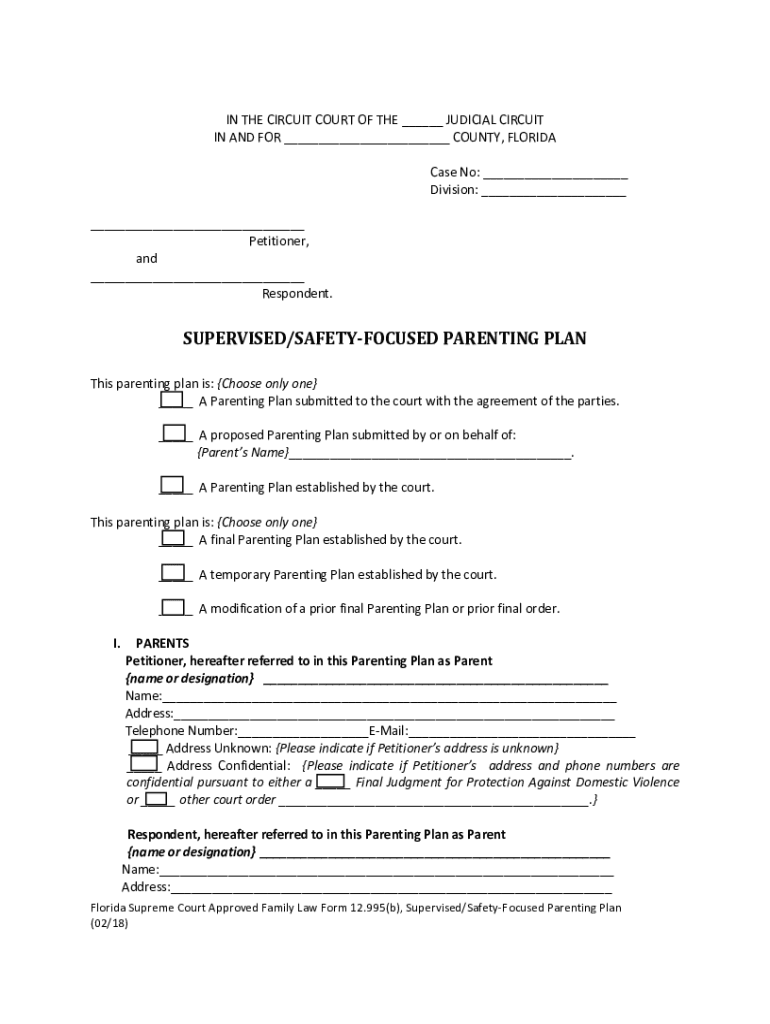
S involving minor child(ren). This form or a similar form should be used in cases when you feel your child(ren) cannot be safely alone with the other parent or if you believe shared parental responsibility presents a detriment to the child(ren). In this case, a Parenting Plan must be developed that allows time-sharing with any minor child(ren), while providing protection for the child(ren). If safety or supervised time-sharing is not a concern, Parenting Plan, Florida Supreme Court Approved Fami.
Loading

Open form follow the instructions

Easily sign the form with your finger

Send filled & signed form or save
How to fill out the FL 12.995(b) online
Filling out the Florida Supreme Court Approved Family Law Form 12.995(b) can be a crucial step in establishing a supervised or safety-focused parenting plan. This guide offers step-by-step instructions to help you easily complete the form online, ensuring that your needs and those of your child(ren) are adequately addressed.
Follow the steps to fill out the FL 12.995(b) form online.
- Press the ‘Get Form’ button to download the FL 12.995(b) form and open it in a suitable online editor.
- Begin by filling in the case information at the top of the form, including the circuit court, county, case number, and division. This section identifies your case and provides necessary filing context.
- In section I, identify the parents by entering the names, addresses, phone numbers, and email addresses. Ensure to indicate if any addresses are confidential or unknown, especially for safety considerations.
- In section II, list the names and dates of birth for each child involved, as this parenting plan will pertain to them.
- In section III, confirm the jurisdiction details, including the habitual residence of the child(ren) and the state of Florida being their home state.
- Section IV requires you to choose the type of parental responsibility. Indicate whether it is sole or shared and specify decision-making authority for education, healthcare, etc.
- Fill out section V by selecting the type of time-sharing schedule that will apply and providing the agreed-upon details for times and locations.
- Section VI addresses supervision requirements during time-sharing. Specify who will supervise and list any restrictions or costs associated with this supervision.
- Complete section VII by indicating where the time-sharing will occur, including specifics about supervision centers or other locations.
- In section VIII, designate which parent the child(ren) will reside majority of the time and provide the address for school boundary determinations.
- Clearly define transportation and exchange details in section IX. Specify who is responsible for transportation and the exchange points.
- In section X, outline communication methods between the parents and between each parent and the child(ren). Include the appropriate formats and any restrictions.
- Section XI includes details about access to the child(ren)’s activities and events. Specify any restrictions or permissions.
- In section XII, outline safety considerations that must be followed during time-sharing.
- Complete sections XIII and XIV, addressing any changes to the plan and any other provisions you wish to include in the agreement.
- Finally, have both parents sign the document. Include the date and ensure that signatures are notarized as required.
- Once completed, save your changes, and download or print the form for submission.
Make sure to complete the FL 12.995(b) form online to facilitate a smoother filing process.
Experience a faster way to fill out and sign forms on the web. Access the most extensive library of templates available.
Related content
A Parenting Plan is required in all cases involving minor child(ren). This form or a...
Supervised/Safety Focused Parenting Plan, Form 12.995(b) If the parents have reached an...
Chapter 3 - Transmit, Receive & Audio Circuit Boards. BTR-200 Instrument Disassembly. 3-1...
Get answers to your most pressing questions about US Legal Forms API.
How to file for visitation rights without a lawyer?
Filing for visitation rights without a lawyer involves using the appropriate court forms, including the FL 12.995(b) set. Begin by researching the specific requirements for visitation in your jurisdiction, then accurately complete the necessary documentation. After filing the forms at your local court, follow the court's procedures for scheduling a hearing, if required. Utilizing online resources, such as USLegalForms, can streamline this process by providing guidance and access to essential forms.
What is the new law for child custody in Florida?
The new law for child custody in Florida emphasizes shared parental responsibility and encourages both parents to take an active role in their child's life. This approach aligns with the FL 12.995(b) guidelines aimed at promoting the best interests of the child. It is important to stay informed about how these laws may impact your custody case, as they can influence court decisions significantly. Keeping abreast of any changes to the law can help you navigate the custody process more effectively.
How to file for child custody in Florida without a lawyer?
To file for child custody in Florida without a lawyer, start by obtaining the FL 12.995(b) forms from a trusted source, such as USLegalForms. Fill out the forms completely and provide all required details about your situation. After completing the forms, file them at your local court clerk's office. Make sure to keep copies of your submissions and follow up with the court as needed to ensure your case moves forward.
Do I need to file FL 335?
Filing FL 335 depends on the specifics of your case and what you are trying to achieve. In many child custody cases, FL 335 may be required to provide supplemental information to the court. If you're unsure whether you need to file this form, reviewing the requirements associated with FL 12.995(b) or consulting a legal resource may be beneficial. Ensure that your filings meet all necessary guidelines to avoid delays.
How to file for custody without a lawyer in Florida?
To file for custody without a lawyer in Florida, you can start by gathering all necessary documents related to your case, including the FL 12.995(b) forms. Next, complete the forms accurately with the required information regarding the custodial arrangement you seek. Once you have filled out the forms, submit them at your local courthouse. It’s crucial to follow the court’s instructions and ensure all documents are filed on time.
Do moms automatically have full custody in Florida?
In Florida, mothers do not automatically receive full custody, as decisions are made based on the best interests of the child as defined by FL 12.995(b). The court evaluates various factors, including each parent's relationship with the child and their ability to provide a stable environment. Both parents have the opportunity to present their case for custody. Using US Legal Forms can help you prepare the necessary documentation and understand your rights.
How to file for parental rights in Florida?
To file for parental rights in Florida, you need to follow the guidelines established in FL 12.995(b). Start by gathering necessary documents, such as your identification and any previous custody agreements. Then, submit your petition to the appropriate court along with the required fees. US Legal Forms can provide templates and guidance to make the filing process smoother for you.
What is shared parental responsibility with decision-making authority?
Shared parental responsibility with decision-making authority means both parents have the right to make important decisions regarding their child’s welfare, including education and healthcare choices. This arrangement is indicative of a cooperative parenting approach, which can significantly benefit the child’s development. Utilizing guidelines such as FL 12.995(b) can assist parents in establishing this type of responsibility effectively.
What is the best child custody schedule?
The best child custody schedule varies by family, but it often includes balanced time that allows children to nurture relationships with both parents. Factors such as school schedules, extracurricular activities, and the children's unique needs should also be considered. FL 12.995(b) can serve as a guiding resource to help parents develop a custody schedule that works best for their family's dynamics.
What is the most common child custody arrangement?
The most common child custody arrangement in Florida typically involves shared parental responsibility, where both parents have a say in major decisions affecting the child. This arrangement aims to promote the child's best interests while allowing both parents to maintain a strong relationship. Many parents refer to FL 12.995(b) when determining how to structure their custody agreements for clarity and consistency.
Use professional pre-built templates to fill in and sign documents online faster. Get access to thousands of forms.
If you believe that this page should be taken down, please follow our DMCA take down process here.