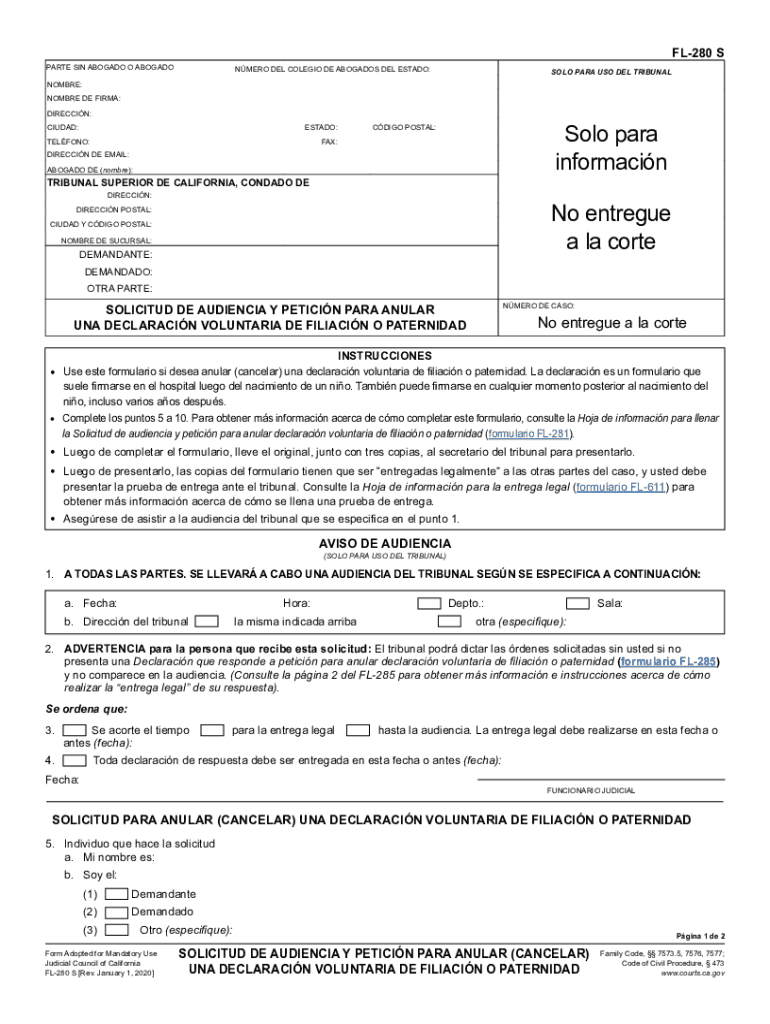
FL280 SPARTE SIN ABOGADO O ABOGADONMERO DEL COLEGIO DE ABOGADOS DEL ESTADO:SOLO PARA USO DEL TRIBUNALNOMBRE: NOMBRE DE FIRMA: DIRECCIN: CIUDAD:ESTADO:TELFONO:Solo para informacinCDIGO POSTAL:FAX:DIRECCIN.
Loading

Open form follow the instructions

Easily sign the form with your finger

Send filled & signed form or save
How to fill out the CA FL-280 S online
The CA FL-280 S is a crucial document for individuals seeking to annul a voluntary declaration of parentage. This guide provides clear and supportive instructions on how to complete the form online, ensuring users understand each section's requirements.
Follow the steps to fill out the CA FL-280 S online effectively.
- Click ‘Get Form’ button to obtain the form and launch it in the online editor.
- Enter your name in the designated field. This is essential as it identifies who is making the request.
- Input the name of your legal representative or firm if you have one. If not, you can leave this blank.
- Fill in your contact information, including your address, city, state, telephone number, and email address.
- Specify the court you are submitting this form to by providing its name and address.
- Complete the section for the request by identifying yourself as either the petitioner, respondent, or another relevant party.
- Indicate your case number, if applicable, alongside the information concerning your request to annul a declaration of parentage.
- Provide information related to the voluntary declaration, such as the child's name, date of birth, and the names of those who signed the declaration.
- State the reasons for your request to annul the declaration, checking all relevant reasons that apply to your situation.
- Review all the information entered for accuracy before finalizing the document.
- Once completed, you can save your changes, download, print, or share your document as required.
Take the first step in completing your forms online today!
Experience a faster way to fill out and sign forms on the web. Access the most extensive library of templates available.
Related content
FL-280 S PDF file type icon, Jan 1, 2006, Request for Hearing and Application to Set Aside...
S of US 90, 0.3 mi. W of bridge over Shoal River, in valley of Shoal River, ca. 3.4 air...
The Consolidated Annotated Frequency List (CAFL) .... Anal_itching (also use Parasites...
Get answers to your most pressing questions about US Legal Forms API.
What is transition level?
The altitude at or below which the vertical position of an aircraft is controlled by reference to altitudes. Transition Level. The lowest flight level available for use above the transition altitude. Transition Layer. The airspace between the transition altitude and the transition level.
What is the lowest flight level?
The lowest usable flight level is determined by the atmospheric pressure in the area of operation, as shown in TBL ENR 1.7-1.
What is flight level 230?
it means to expect to climb to any altitude starting at 18,000 all the way up to 60,000. Any of the altitudes in those areas are Flight level 230 for 23,000 feet etc.
What does fl180 mean?
FL180 and FL300 stand for Flight Level 180 and Fight Level 300. Flight levels are spaced 100ft apart on an altimeter that is set to the standard sea level pressure (QNE) of 1013.25 hectopascals or 29.92 inches of Mercury. So indeed, FL300 means 30,000 ft.
What is fl100?
A flight level is simply the level above Transition altitude, with the last two zeros chopped off. FL55 - 5500ft (pronounced Flight Level Five Five) FL100 - 10,000ft (Pronounced Flight Level one hundred)
What is fl300?
So indeed, FL300 means 30,000 ft. Altitude 18000 means that the altimeter indicates 18,000 feet and that the altimeter is set to the QNH, which is the pressure reading on the ground corrected to sea level pressure using the standard atmosphere.
What is filing a declaration?
A declaration is a written statement, sworn to be the truth under penalty of perjury by any person who has direct knowledge about the issues in a court case. What is it for? You usually use Declarations when filing or responding to motions in court.
What is an RFO in family law?
Family Law Motions and Requests For Orders (RFO's) A motion or request for order is the formal process of requesting the court for a specific ruling, action or other decision. In family law proceedings, a party can request the court intervene on certain issues when an agreement cannot be reached.
What is a RFO?
A Request for Offer (RFO) is an open and competitive purchasing process whereby an organization requests the submission of offers in response to specifications and/or a scope of services. An RFO may also include a cost proposal. ... The process is generally the same as the Request for Proposal (RFP) process.
What is a RFO form?
A request for order, or RFO, is the act of formally asking a judge to make orders in a legal matter. ... Required standardized legal forms are used in almost every RFO in family law court. After an RFO is started there are non-standardized documents that may also be required in order to prosecute or defend the filed RFO.
Use professional pre-built templates to fill in and sign documents online faster. Get access to thousands of forms.
If you believe that this page should be taken down, please follow our DMCA take down process here.