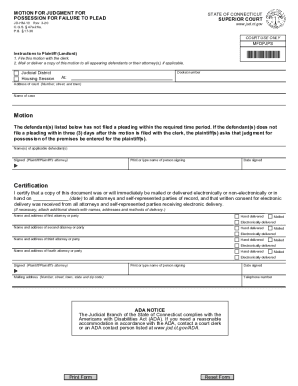
MOTION FOR JUDGMENT FOR POSSESSION FOR FAILURE TO PLEADSTATE OF CONNECTICUTSUPERIOR COURTJDHM10 Rev. 320 C.G.S. 47a26a, P.B. 1730www.jud.ct.govCOURT USE ONLYMFDPJPS*MFDPJPS*Instructions to Plaintiff.

How it works
  • Open form

    Open form follow the instructions

  • Easily sign form

    Easily sign the form with your finger

  • Share form

    Send filled & signed form or save

How to fill out the CT JD-HM-10 online

The CT JD-HM-10 form, also known as the motion for judgment for possession for failure to plead, is a crucial document in the housing session of the Connecticut Superior Court. This guide will provide you with step-by-step instructions to fill out the form accurately and effectively.

Follow the steps to complete the form accurately.

  1. Click the ‘Get Form’ button to access the CT JD-HM-10 online and open it in the editor.
  2. Enter the judicial district and docket number in the designated fields. Ensure this information matches the details related to your case.
  3. In the 'Name of case' field, clearly write the name of the legal case that the motion pertains to.
  4. List the names of the defendants who have not filed a pleading within the required timeframe in the designated area.
  5. Fill in your name or the name of your attorney in the 'Print or type name of person signing' section.
  6. Sign the form in the area marked 'Signed (Plaintiff/Plaintiff's attorney)' and date it accordingly.
  7. Proceed to the 'Certification' section and confirm that you have mailed or delivered a copy of the motion to all relevant parties.
  8. For each attorney or party, provide their name, address, and the method of delivery (hand delivered, mailed, electronically delivered). Fill out additional sheets if necessary.
  9. Print the name of the person signing the certification and sign in the area designated for the certification.
  10. Finally, include your telephone number and complete your mailing address in the provided fields.
  11. Once all relevant sections are completed, you can save changes, download, print, or share the form as required.

Take action now and file your CT JD-HM-10 online to ensure proper legal processes are followed.

Get form

Experience a faster way to fill out and sign forms on the web. Access the most extensive library of templates available.

Related content

Official Court Forms of the Connecticut Judicial...

Official Court Webforms. Forms are divided into ... JD-HM-008, Summary Process (Eviction)...

Learn more
"Imaging Osteomyelitis" by Brandon J. Smith, MD...

CT is useful for identifying necrotic bone in chronic infections. Ultrasound may be...

Learn more
HP2011 HM Hinge Operated Safety Interlock Switch...

Pdf Hp2011-Hm Manual En 201507 C369I-E-01 HP2011-HM_Manual_en_201507_C369I-E-01 Omron....

Learn more
Questions & Answers

Get answers to your most pressing questions about US Legal Forms API.

Contact support

What does sealed court records mean?

Generally, record sealing can be defined as the process of removing from general review the records pertaining to a court case. However, the records may not completely disappear and may still be reviewed under limited circumstances; in most instances, it requires a court order to unseal records once they are sealed.

Court records fall under the umbrella of information that is generally available for public inspection. However, some records and record information cannot be disclosed because they are deemed confidential either by law or by court rule.

A court of record is a court whose acts and proceedings are enrolled for perpetual memory and testimony. These records are used with a high authority and their truth cannot be questioned. ... Article 215 empowers the High Courts of te states to be courts of record.

Court Records. The main type of record the federal courts create and maintain is a case file, which contains a docket sheet and all documents filed in a case. Case files and court records can be found on PACER.gov.

These include bankruptcy courts and the U.S. Court of Military Appeals, U.S. Tax Court, and U.S. Court of Veterans' Appeals. In the context of a background check, requests for court records can be broken down in two groups: civil court records and criminal court records.

Go to the court clerk in the county where you reside, and check to see if there is a case filed against you. If it is past the Statute of Limitations, and no case has been filed, then you are home free.

Visit the National Archives Order Reproductions page. Click on "Order Reproductions" then "Court Records" Select the appropriate court (Bankruptcy, Civil, Criminal, or Court of Appeals) Follow the onscreen prompts to set up an account and place your order.

Court records fall under the umbrella of information that is generally available for public inspection. However, some records and record information cannot be disclosed because they are deemed confidential either by law or by court rule.

Court Records. The main type of record the federal courts create and maintain is a case file, which contains a docket sheet and all documents filed in a case. Case files and court records can be found on PACER.gov.

Court dockets and some case files are available on the Internet through the Public Access to Court Electronic Records system (PACER), at www.pacer.gov. ... In a few situations the public may not have full access to court records and court proceedings.

Get This Form Now!

Use professional pre-built templates to fill in and sign documents online faster. Get access to thousands of forms.

If you believe that this page should be taken down, please follow our DMCA take down process here.

Get CT JD-HM-10