Loading
Get Wi Pr-1815 2012-2026
How it works
-

Open form follow the instructions
-

Easily sign the form with your finger
-

Send filled & signed form or save
How to fill out the WI PR-1815 online
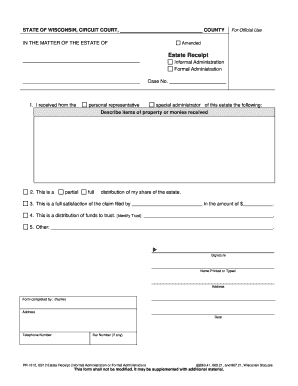
The WI PR-1815 form is essential for documenting the receipt of property or funds in estate matters. This guide provides a straightforward approach to completing the form online, ensuring that all necessary details are accurately captured.
Follow the steps to fill out the WI PR-1815 form successfully
- Click the ‘Get Form’ button to access the form and open it in your preferred editing tool.
- In the first section, indicate the name of the personal representative or special administrator from whom you received the property or funds. Clearly describe the items of property or the total amount of money received.
- Next, specify whether the distribution you are documenting is a full or partial distribution of your share of the estate by selecting the appropriate option.
- In the following section, confirm if this receipt serves as a full satisfaction of any claims by naming the claimant and stating the amount of the claim.
- If applicable, indicate if this receipt represents a distribution of funds to a trust by identifying the trust in the designated area.
- Complete any additional necessary information in the 'Other' section for specifics not previously covered.
- Finally, sign and print your name in the designated signature block. Include your address and the date you are completing this form.
- If applicable, fill in your telephone number and bar number, if you have one.
- Once all sections are complete, you can save your changes, download, print, or share the completed form as needed.
Start filling out your WI PR-1815 form online today for efficient document management.
The main difference lies in the level of court involvement; formal probate is supervised by the court and is suitable for contested estates, while informal probate, often processed with the WI PR-1815 form, bypasses extensive court supervision for uncomplicated cases. Choosing between the two effectively impacts the administration speed and complexity of settling the estate.