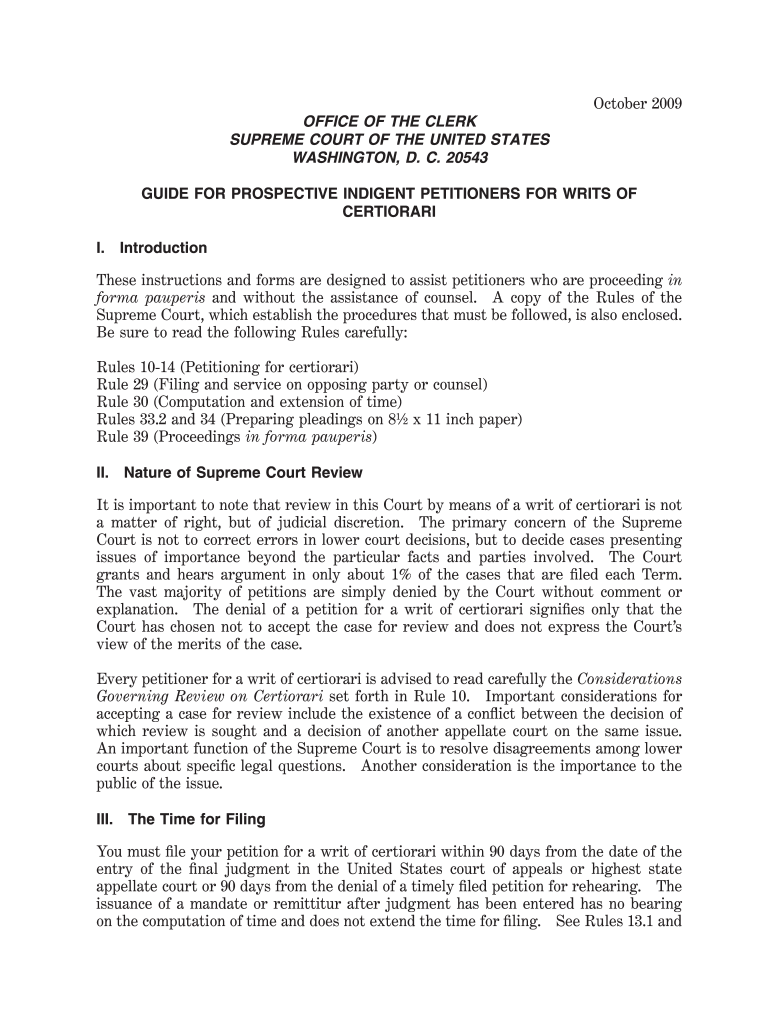
Following Rules carefully: Rules 10-14 (Petitioning for certiorari) Rule 29 (Filing and service on opposing party or counsel) Rule 30 (Computation and extension of time) Rules 33.2 and 34 (Preparing pleadings on 81 2 x 11 inch paper) Rule 39 (Proceedings in forma pauperis) II. Nature of Supreme Court Review It is important to note that review in this Court by means of a writ of certiorari is not a matter of right, but of judicial discretion. The primary concern of the Supreme Court is no.
Loading

Open form follow the instructions

Easily sign the form with your finger

Send filled & signed form or save
How to fill out the WA Indigent Petitioner Writ Guide online
This guide provides a comprehensive overview of how to complete the WA Indigent Petitioner Writ Guide online. It is crafted to support individuals who may be unfamiliar with legal processes while ensuring clarity and understanding throughout each step.
Follow the steps to fill out the WA Indigent Petitioner Writ Guide seamlessly.
- Click ‘Get Form’ button to obtain the form and open it in the editor.
- Begin by completing the motion for leave to proceed in forma pauperis form. Leave the case number blank, as it will be assigned by the Clerk later. Input your name as the petitioner and the name of the opposing party as the respondent.
- On the affidavit or declaration in support of your motion, answer each question fully. Ensure that any answers that are '0', 'none', or 'not applicable' are clearly indicated.
- Next, fill in the cover page form. Again, leave the case number blank, and complete the case caption as done in the previous steps. Indicate the court from which you are seeking review and include your contact information.
- On the provided page for the question or questions presented, state the key issues succinctly for the Court's review while ensuring clarity.
- When listing the parties, check the appropriate box and if there are additional parties, provide their details in the specified section.
- For the table of contents, clearly number the pages of the required portions of your petition. Begin numbering with the 'Opinions Below' page as page one.
- Complete the jurisdiction section by providing relevant dates that establish the timeliness of your petition for a writ of certiorari.
- Draft your statement of the case, summarizing the pertinent facts and relevant events from the lower courts.
- In the reasons for granting the petition section, articulate compelling reasons supporting your request for the Court's discretion to grant certiorari.
- Finally, after all sections are completed, you can save changes, download, print, or share the form as needed.
Get started on completing your documents online today!
Experience a faster way to fill out and sign forms on the web. Access the most extensive library of templates available.
Related content
Oct 1, 2014 — You must file your petition for a writ of certiorari within 90 days from...
by AJ Stein · 1975 · Cited by 21 — The sixth amendment to the United States...
Jan 18, 2012 — Thereafter, Maples petitioned for a writ of habeas corpus in federal...
Get answers to your most pressing questions about US Legal Forms API.
What is an example of a writ of certiorari?
An example of a writ of certiorari could involve a case where a lower court made a decision that raises significant legal questions about constitutional rights. This writ allows a higher court to review the lower court's decision, ensuring it aligns with established laws. For a clearer understanding, consider consulting the WA Indigent Petitioner Writ Guide, which outlines several real-world scenarios where this writ may be applicable.
How do I get a writ of assistance?
To obtain a writ of assistance, begin by drafting a petition that outlines your request and provides background on the situation. Reference the WA Indigent Petitioner Writ Guide for detailed instructions on the procedure and documentation needed. After you file the petition with the court, wait for the judicial review process to take its course.
What is the reason for a writ?
A writ is typically sought to correct an error in a lower court's ruling or to compel a specific action from a party involved in a legal matter. The WA Indigent Petitioner Writ Guide can help you understand various reasons people pursue writs, such as ensuring justice is served or adhering to legal precedents. Your specific circumstances will dictate the rationale behind your request.
How do you ask for a writ?
Asking for a writ involves submitting a properly formatted petition that articulates your legal basis for the request. The WA Indigent Petitioner Writ Guide simplifies this process, outlining essential information you need to present. Be sure to include any relevant supporting evidence to strengthen your case when you file your petition.
What is a petition for writ of assistance?
A petition for writ of assistance is a legal request that enables you to seek help in enforcing a court order or judgment. Typically, this writ compels someone to fulfill their court-mandated obligations. The WA Indigent Petitioner Writ Guide provides key insights on how to frame this petition effectively to ensure the court understands your needs.
How do I ask for a writ?
You can ask for a writ by drafting a formal petition that outlines your request and the underlying reason for your appeal. The WA Indigent Petitioner Writ Guide offers detailed steps on what information to include and how to format your petition. Submit this petition to the appropriate court along with any supporting documents required for review.
How do I get a writ of certiorari granted?
To get a writ of certiorari granted, you must clearly demonstrate that your case has significant legal questions that need resolution. Start by filing a petition that follows the guidelines outlined in the WA Indigent Petitioner Writ Guide. In your petition, provide necessary documentation and compelling reasons why the higher court should hear your case, ensuring proper formatting and submission.
When would you file for a writ of certiorari?
You would file for a writ of certiorari when you believe a lower court has made a legal mistake that needs correction. This situation arises often when there are conflicting legal interpretations or when a significant legal question emerges. The WA Indigent Petitioner Writ Guide can provide guidance on identifying appropriate scenarios for filing.
What is a writ of certiorari example?
An example of a writ of certiorari would be a case where the Supreme Court is asked to review a lower court’s decision on whether a law is constitutional. In such scenarios, the higher court assesses the broader implications of the decision. Utilizing the WA Indigent Petitioner Writ Guide will help you craft a precise and effective example for your petition.
How to write a petition for writ of certiorari?
Writing a petition for a writ of certiorari involves clearly stating the issues, summarizing the relevant facts, and providing persuasive arguments. You must also reference applicable legal precedents and clearly articulate why the case warrants review. The WA Indigent Petitioner Writ Guide can streamline this process by offering valuable templates and examples.
Use professional pre-built templates to fill in and sign documents online faster. Get access to thousands of forms.
If you believe that this page should be taken down, please follow our DMCA take down process here.