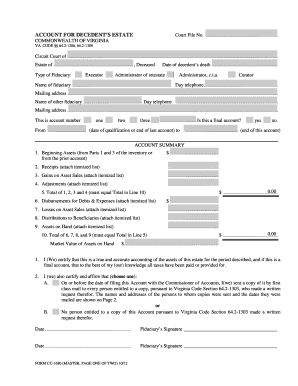
$ ............................................................................................... 1. I (We) certify that this is a true and accurate accounting of the assets of this estate for the period described, and if this is a final account, that to the best of my (our) knowledge all taxes have been paid or provided for. 2. I (we) also certify and affirm that (choose one): A. On or before the date of filing this Account with the Commissioner of Accoun.
Open form follow the instructions
Easily sign the form with your finger
Send filled & signed form or save
How to fill out the VA CC-1680 online
Completing the VA CC-1680 online can seem daunting, but with the right guidance, you can navigate the process smoothly. This guide will walk you through each section of the form, ensuring you understand what information is needed and how to properly fill it out.
Follow the steps to successfully complete the VA CC-1680 online.
- Click 'Get Form' button to access the VA CC-1680 online and open it in the editing interface.
- In the top section, enter the court file number and the name of the circuit court where the estate is being administered.
- Fill in the name of the deceased, followed by the date of their death. Select the appropriate type of fiduciary from the provided options.
- Complete the fiduciary's name and contact information, including the day telephone number and mailing address.
- If applicable, provide details for any other fiduciaries, including their names, contact numbers, and addresses.
- Indicate the account number by selecting 'one,' 'two,' or 'three.' Specify whether this is a final account by selecting 'yes' or 'no.'
- Complete the account summary section by entering all relevant financial details from the estate, including beginning assets, receipts, gains on asset sales, adjustments, disbursements, losses, distributions, and assets on hand.
- In the certification sections, provide the date and the fiduciary's signature(s) to confirm the accuracy of the accounting.
- If applicable, complete the certificate of mailing section, listing the names and addresses of all individuals to whom a copy of the account was mailed.
- After reviewing all entries for accuracy, save your changes. You may then download, print, or share the completed form as needed.
Start completing the VA CC-1680 online today to ensure a smooth filing process.
Experience a faster way to fill out and sign forms on the web. Access the most extensive library of templates available.
Related content
FORM CC-1680 (MASTER, PAGE ONE OF TWO) 07/18. ACCOUNT FOR DECEDENT'S ESTATE. Court File...
Windward Community College is a state-approved institution for veteran education benefits...
A PIONEER DO BRASIL LTDA. Garante que o aparelho desempenhará suas funções em...
Get answers to your most pressing questions about US Legal Forms API.
Does an executor have to show accounting to beneficiaries in VA?
Yes, in Virginia, an executor must show accounting to beneficiaries, fulfilling their duty of transparency. This includes providing a detailed financial account of the estate's management. Beneficiaries can request this information to ensure they understand how the estate is being handled according to VA CC-1680 guidelines.
What disqualifies an executor in Virginia?
In Virginia, several factors can disqualify someone from serving as an executor. Common disqualifications include felony convictions, lack of mental capacity, or conflicts of interest. It’s essential to be aware of these factors when reviewing potential candidates for the executor role. Understanding the stipulations of VA CC-1680 can provide further insights.
Does an executor need to provide accounting to beneficiaries?
Yes, an executor is required to provide accounting to beneficiaries, demonstrating how the estate's assets were handled. Beneficiaries have the right to view this information, which helps ensure fair distribution. By adhering to VA CC-1680, executors can fulfill their obligations while fostering a positive relationship with beneficiaries.
How to become executor of estate in Virginia?
To become an executor of an estate in Virginia, you must be nominated in the will or appointed by the court if there is no will. Eligibility criteria generally include being at least 18 years old and a resident of Virginia. After being appointed, duties include managing the estate's affairs per VA CC-1680 guidelines.
What is the final accounting to beneficiaries?
The final accounting to beneficiaries is a detailed report that summarizes the financial transactions of the estate. It outlines all receipts, disbursements, and any distributions received by the beneficiaries. This accounting is crucial for maintaining trust and transparency in the estate settlement process. You can refer to VA CC-1680 for specific requirements.
How do I prepare a final accounting for an estate?
Preparing a final accounting for an estate involves documenting all financial activities. Begin by listing all income generated, expenses incurred, and distributions made to heirs. Once you have all this information compiled, you can present it clearly and concisely. Utilizing tools related to VA CC-1680 can streamline this process.
Does an executor have to show accounting to beneficiaries in Virginia?
Yes, in Virginia, executors have a legal obligation to provide accounting to beneficiaries. This ensures transparency regarding how the estate's assets are managed. The executor must give beneficiaries an accurate breakdown of income, expenses, and distributions. Understanding the role of VA CC-1680 can help clarify these guidelines.
What is the final accounting form for probate?
The final accounting form for probate in Virginia is the VA CC-1680. This form is specifically designed for detailing the financial transactions of an estate during the administration process. Executors must accurately fill out this form to represent all income, expenses, and distributions made to beneficiaries and ensure legal compliance. Using this structured form is crucial for a clear and comprehensive overview.
How long does an executor have to settle an estate in Virginia?
In Virginia, an executor must settle an estate within a reasonable time frame, typically within a year from the date of appointment. However, complex estates may take longer, depending on the circumstances. It's essential for executors to keep beneficiaries informed and use the VA CC-1680 form for final accounting to close the estate efficiently and in compliance with state rules.
What are the final accounts for an estate?
Final accounts for an estate typically include a detailed report of income generated by the estate, expenses incurred, distributions to beneficiaries, and other relevant financial transactions. The VA CC-1680 form facilitates organization and clarity in presenting these accounts. This detailed account ensures transparency and compliance with Virginia probate regulations. It is crucial for ensuring that every beneficiary understands the financial activities linked to the estate.
Use professional pre-built templates to fill in and sign documents online faster. Get access to thousands of forms.
If you believe that this page should be taken down, please follow our DMCA take down process here.
This form is available in several versions. Select the version you need from the drop-down list below.