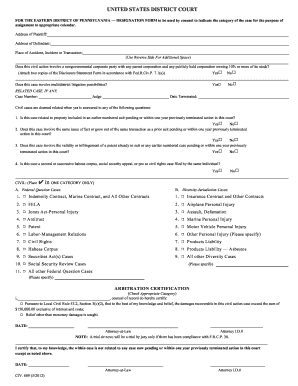
Of Plaintiff: Address of Defendant: Place of Accident, Incident or Transaction: (Use Reverse Side For Additional Space) Does this civil action involve a nongovernmental corporate party with any parent corporation and any publicly held corporation owning 10% or more of its stock? (Attach two copies of the Disclosure Statement Form in accordance with Fed.R.Civ.P. 7.1(a)) Does this case involve multidistrict litigation possibilities? RELATED CASE, IF ANY: Case Number: Judge Yes9 No9 Yes9 No9.
Loading
Open form follow the instructions
Easily sign the form with your finger
Send filled & signed form or save
How to fill out the PA CIV. 609 online
Filling out the PA CIV. 609 is an essential step for attorneys to designate the category of a civil case in the United States District Court for the Eastern District of Pennsylvania. This guide will provide you with clear and detailed instructions on how to complete the form accurately and efficiently online.
Follow the steps to successfully complete the PA CIV. 609 form.
- Click the ‘Get Form’ button to access the form and open it in your chosen editor.
- Begin by entering the addresses of the plaintiff and defendant in the designated fields. Ensure that all provided information is accurate and up to date.
- Specify the place of the accident, incident or transaction. Use the reverse side of the form if additional space is needed.
- Answer the questions regarding whether this civil action involves any nongovernmental corporate parties or multidistrict litigation. Attach the necessary Disclosure Statement Form if applicable.
- Indicate if this case is related to any earlier numbered suit by selecting 'Yes' or 'No' for each relevant question presented.
- Select one category under CIVIL. Choose between Federal Question Cases or Diversity Jurisdiction Cases and mark your choice.
- Complete the Arbitration Certification by checking the appropriate category that describes your case regarding damages.
- Finally, sign and date the form, including your Attorney I.D. number, to verify the accuracy of the information provided.
- Once all fields are completed, save your changes, download the form, print it if necessary, or share it as needed.
Complete your PA CIV. 609 form online today to ensure your case is processed effectively.
Experience a faster way to fill out and sign forms on the web. Access the most extensive library of templates available.
Related content
Rule 609. Impeachment by Evidence of a Criminal Conviction. (a) In General. For the...
Evidence that the witness has been convicted of a crime, whether by verdict or by plea of...
Esta lista reúne os mortos e desaparecidos políticos no regime militar de 1964. Os...
Get answers to your most pressing questions about US Legal Forms API.
What is the rule of evidence 609 in PA?
Rule of evidence 609 in Pennsylvania outlines the parameters for admitting prior convictions as evidence in legal proceedings. This rule seeks to balance the need for relevant information with the risk of unfair prejudice. Understanding PA CIV. 609 is essential for parties involved in court cases, and resources like UsLegalForms can provide valuable insights and guidance.
Why are prior bad acts not admissible in court?
Prior bad acts are often excluded to ensure a fair trial and avoid prejudicing the jury against a defendant. Under PA CIV. 609, evidence must be relevant and beneficial to the case. Admissibility is strictly limited to maintain the integrity of the legal process.
Can past convictions be brought up in court?
Yes, past convictions can be brought up in court, but there are strict guidelines under PA CIV. 609. The court considers the nature of the conviction, its relevance, and timing. If past offenses meet legal criteria, they may be admitted as evidence to assess a witness's credibility.
What cannot be used as evidence in court?
Certain types of evidence are inadmissible in court, including irrelevant information and hearsay. Under PA CIV. 609, evidence that may unfairly bias the jury or mislead them is also excluded. It is crucial to ensure that all evidence presented directly pertains to the case at hand.
Are prior convictions hearsay?
Generally, prior convictions are not considered hearsay under PA CIV. 609. Hearsay refers to statements made outside the courtroom that are offered to prove the truth of the matter. Previous convictions, when presented formally, are considered accepted evidence rather than hearsay.
Can previous convictions be used against you in court?
Yes, previous convictions can be used against you in court, but this depends on certain factors outlined in PA CIV. 609. The court evaluates the relevance of these convictions and how recent they are. They may determine if their admission serves the interests of justice while minimizing unfair prejudice.
What is the evidence Rule 609?
The evidence Rule 609 pertains to the admissibility of prior convictions in legal proceedings. This rule governs how and when a party can present evidence of a defendant's past offenses. Under PA CIV. 609, such evidence must meet specific criteria to ensure it is relevant and not overly prejudicial.
How to file a civil complaint in PA?
Filing a civil complaint in PA requires you to prepare a document outlining your grievances and the assistance you seek. You’ll need to include relevant facts and legal grounds under which the action arises. Often, utilizing resources like USLegalForms can simplify this process. Their templates guide you through the necessary steps and help ensure compliance with court requirements.
What is the Federal Rule of Civil Procedure 609?
The Federal Rule of Civil Procedure 609 relates to the admissibility of previous convictions in federal court. It is similar to PA CIV. 609, allowing the introduction of certain convicting evidence to assess a witness's credibility. However, federal rules can differ from state laws, affecting how each court approaches these issues. Familiarity with these rules is crucial for effective legal representation.
What is the federal law 609?
Federal law 609, similar to state rules, outlines the circumstances under which prior convictions can be used to challenge a witness's credibility in court. This law is part of the Federal Rules of Evidence and helps maintain judicial integrity by allowing jurors to make informed decisions about witness reliability. The provisions under federal law 609 align closely with PA CIV. 609, emphasizing the importance of understanding both. Lawyers benefit from familiarity with this law when dealing with federal cases.
Use professional pre-built templates to fill in and sign documents online faster. Get access to thousands of forms.
If you believe that this page should be taken down, please follow our DMCA take down process here.
This form is available in several versions. Select the version you need from the drop-down list below.