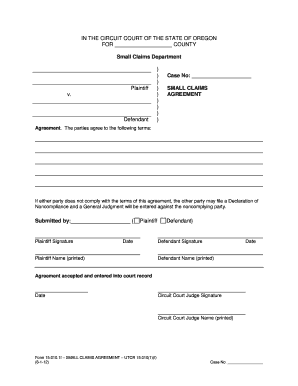
Ies agree to the following terms: If either party does not comply with the terms of this agreement, the other party may file a Declaration of Noncompliance and a General Judgment will be entered against the noncomplying party. Submitted by: Plaintiff Signature Plaintiff Date Plaintiff Name (printed) Defendant Defendant Signature Date Defendant Name (printed) Agreement accepted and entered into court record Date Circuit Court Judge Signature Circuit Court Judg.
Open form follow the instructions
Easily sign the form with your finger
Send filled & signed form or save
How to use or fill out the OR Form 15.010.1f online
Filling out the OR Form 15.010.1f, also known as the Small Claims Agreement, is a crucial step in resolving disputes through the small claims court in Oregon. This guide will provide you with clear, step-by-step instructions to help you complete the form accurately and efficiently online.
Follow the steps to complete the OR Form 15.010.1f online.
- Click the 'Get Form' button to obtain the form and open it in the designated editor.
- Locate the 'Case No' field at the top of the form. Enter the assigned case number for your small claims case.
- In the 'Plaintiff' section, input your name and signature. Ensure the name is printed clearly and includes the date of submission.
- Next, move to the 'Defendant' section. The defendant should also provide their name and signature along with the date.
- Review the agreement text thoroughly. Make sure that all terms are accurately reflected and understood by both parties involved.
- In the designated area, ensure the circuit court judge’s signature will be provided upon acceptance of the agreement in court records.
- Once you have filled out all the necessary fields, review the entire form for accuracy. Make any required changes before proceeding.
- Finally, save your changes, download a copy, print the form if necessary, or share it with the involved parties.
Complete your forms online today to ensure a smooth resolution to your small claims case.
Experience a faster way to fill out and sign forms on the web. Access the most extensive library of templates available.
Related content
Aug 1, 2022 — 15.010 SMALL CLAIMS FORMS. (1) The following small claims documents shall...
PURPOSE: The secretary of state may make rules to ensure uniform, complete, and accurate...
Datalogic Scanning, Inc. 959 Terry Street. Eugene, Oregon 97402. Telephone: (541)...
Get answers to your most pressing questions about US Legal Forms API.
How long do you have to file a notice of intention to defend in Maryland?
In Maryland, you typically have 15 days from the date you receive the complaint to file a notice of intention to defend. This timeline is crucial for preserving your rights in the case. Failing to meet this deadline could result in a default judgment against you. Using resources like OR Form 15.010.1f can help ensure you meet all requirements promptly.
How do I file a notice of intention to defend in Maryland?
To file a notice of intention to defend in Maryland, first complete the necessary form, such as OR Form 15.010.1f. Then, submit the completed document to the appropriate court within the required time frame. It's essential to keep copies for your records and to serve the other party with notice of your intent. For guidance, US Legal Forms offers resources that can assist you in navigating this process.
What is intent to defend filed?
The intent to defend is a legal document filed by a defendant in a lawsuit. This document shows that the defendant plans to contest the claims made against them. By filing this, you ensure that the court recognizes your intention to participate in the case. Utilizing forms like OR Form 15.010.1f can help simplify this process.
What qualifies as a Small Claims Court in Texas?
In Texas, Small Claims Court handles cases involving disputes over monetary amounts, generally up to $20,000. Typical cases include unpaid debts and minor contract disputes. Understanding the criteria helps you determine if your case qualifies, and utilizing forms such as the OR Form 15.010.1f can guide you through the filing process. Make sure your issue meets the court's guidelines before proceeding.
Who pays lawyer fees in Small Claims Court?
In Small Claims Court, each party typically pays their own lawyer fees, unless the court decides otherwise. If one party's behavior is considered unreasonable, the court may order them to cover the other side’s costs. Since legal representation isn't always necessary in Small Claims Court, many individuals rely on resources like OR Form 15.010.1f to prepare their case without incurring significant fees.
Is it worth going to Small Claims Court for $500?
Deciding whether to go to Small Claims Court for $500 depends on the situation. If you have strong evidence and a clear claim, pursuing the matter can be worthwhile. Consider the time and effort involved, including the completion of documents like the OR Form 15.010.1f. Remember, Small Claims Court is designed to be accessible for these smaller disputes.
How do I serve someone in Small Claims Court in Texas?
To serve someone in Small Claims Court in Texas, you need to deliver a copy of your filing to the defendant. You can hire a process server or ask a friend to help you with the delivery. It's important to ensure that the service complies with Texas law, which can be detailed in the OR Form 15.010.1f. Ensuring proper service enhances your chances of success in court.
How much does it cost to file a small claims case in Oregon?
When the claim is filed, the court charges a filing fee and a law library fee. Although the amount of these fees varies in each county, they usually are less than $100. The claim must be signed in front of a court clerk or notary public, then served on the defendant.
How much does it cost to file in small claims court in Oregon?
When the claim is filed, the court charges a filing fee and a law library fee. Although the amount of these fees varies in each county, they usually are less than $100. The claim must be signed in front of a court clerk or notary public, then served on the defendant.
What happens if you violate a court order?
Contempt of Court The violation of a court order can happen at any time during or after the divorce proceedings. ... Knew of the court order, Could comply with the court order, but violated the conditions intentionally, and. Lacks a valid cause or justification for violating the order.
Use professional pre-built templates to fill in and sign documents online faster. Get access to thousands of forms.
If you believe that this page should be taken down, please follow our DMCA take down process here.