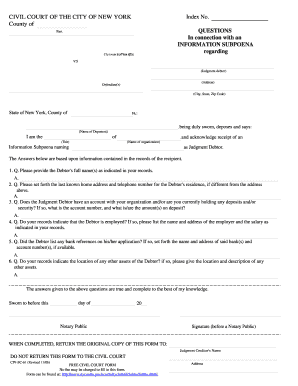
Index No. CIVIL COURT OF THE CITY OF NEW YORK County of QUESTIONS In connection with an INFORMATION SUBPOENA regarding Part C la i m an t s /Plain tiff s VS Judgment debtor Address Defendant s City State Zip Code State of New York County of ss being duly sworn deposes and says Name of Deponent I am the of Title and acknowledge receipt of an Name of organization Information Subpoena naming The Answers below are based upon information contained in the records of the recipient. 1. Q* Please provide.
Loading
Open form follow the instructions
Easily sign the form with your finger
Send filled & signed form or save
How to fill out the NY CIV-SC-61 online
Filling out the NY CIV-SC-61 form is an essential step in responding to an information subpoena in New York City. This guide provides clear, step-by-step instructions to help you accurately complete the form online.
Follow the steps to successfully complete the NY CIV-SC-61 form.
- Press the ‘Get Form’ button to obtain the NY CIV-SC-61 form and open it in the online editor.
- Begin by filling in your Index Number at the top of the form. This number is unique to your case and can be found in your court documents.
- Next, list the County where the civil case is being filed. This should match the location indicated in your court documents.
- In the 'Questions' section, detail the Information Subpoena by specifying the nature of the inquiries regarding the Judgment Debtor.
- Fill in the names of the Claimant(s) or Plaintiff(s) and the Judgment Debtor in the designated spaces, ensuring correct spelling.
- Provide the address of the Judgment Debtor, including the city, state, and zip code, ensuring that it is complete and accurate.
- Begin answering the questions listed in the body of the form. Each question asks for specific information about the Judgment Debtor; ensure that your responses reflect the most current information you have.
- For each question, carefully input the relevant details. This includes the full name, last known address, employment status, and any known bank references.
- Once all questions are answered, indicate your title and organization name. Provide your signature in the space designated for the Notary Public.
- After completing the form, review it for accuracy and completeness. Once confirmed, you can save your changes, download the document, and print it.
- Return the original copy of the completed form to the Judgment Creditor's Name as specified, and do not file this form with the Civil Court.
Complete your documents online today and ensure your responses are timely and accurate.
Experience a faster way to fill out and sign forms on the web. Access the most extensive library of templates available.
Related content
DO NOT RETURN THIS FORM TO THE CIVIL COURT. Address. CIV-SC-61 (Revised 11/06). FREE CIVIL...
The U.S. District Court for the Eastern District of New York agreed that Shady Grove's...
by AJ Beck · Cited by 109 — Coastal marine environments are contaminated globally with...
Get answers to your most pressing questions about US Legal Forms API.
What happens if the defendant doesn't show up in Small Claims Court in NY?
If the defendant does not appear in Small Claims Court in New York, the plaintiff may win the case by default. The court will review the evidence presented by the plaintiff and determine an appropriate outcome based on that information. It’s advisable to utilize the NY CIV-SC-61 guidelines to ensure proper procedure is followed and to strengthen your case.
Do you need a lawyer for Small Claims Court in NY?
In Small Claims Court in New York, hiring a lawyer is not required, but it can be beneficial. The process is designed to be accessible for individuals to represent themselves, especially with the help of resources like the NY CIV-SC-61 form. While many choose to handle their claims independently, having legal advice can clarify complex issues and improve your chances of success.
How long do you have to file a lawsuit in New York?
In New York, the time limit to file a lawsuit varies based on the type of claim. Most personal injury cases allow three years from the date of the incident, whereas small claims cases often have a limit of six years. Understanding these deadlines, particularly as they relate to the NY CIV-SC-61 guidelines, is essential for effective legal action.
What happens if someone never shows up in court?
If someone never shows up in court, the judge may proceed with the case in their absence and potentially issue a default judgment. The party present will have the opportunity to present their evidence and arguments, which can significantly influence the court's decision. Proper knowledge of legal procedures, including NY CIV-SC-61, can help ensure that all parties are notified and prepared.
What if the defendant doesn't show up in small claims court in NY?
If a defendant doesn't show up in small claims court in New York, the judge may issue a default judgment. This judgment allows the plaintiff to collect the amount claimed, which highlights the importance of properly serving defendants and adhering to processes like those described in the NY CIV-SC-61. You can increase your chances of a favorable outcome by preparing your case well.
What if you sue someone and they don't show up?
When you sue someone and they fail to appear, the court may grant a default judgment in your favor. This ruling can lead to compensation for damages or other desired legal outcomes. It is crucial to follow the correct filing procedures, such as those outlined in the NY CIV-SC-61 form, to ensure a smooth process.
What happens if someone doesn't show up to court after being served?
If someone does not show up to court after being served, the court may issue a default judgment in favor of the party that did appear. This means that the court will rule based on the evidence presented by the present party, which can significantly impact the outcome of the case. To avoid this situation, individuals are encouraged to respond promptly to a summons, especially in matters related to NY CIV-SC-61.
How do I take someone to Small Claims Court in New York?
To take someone to Small Claims Court in New York, you need to start by filing a claim using the appropriate forms, such as the NY CIV-SC-61. Gather all supporting documents, then submit your filing to the municipal court in the relevant county. A hearing will be scheduled, where both parties can present their cases. Assistance from US Legal Forms can make this process smoother and more organized for you.
Is it worth taking someone to Small Claims Court?
Taking someone to Small Claims Court can be worthwhile if you have a valid claim and the potential for recovery. This process is generally quicker and less costly than traditional court proceedings, making it accessible for many. Evaluating the strength of your case is essential before proceeding. Platforms like US Legal Forms can help you assess your options and provide the necessary forms.
What happens if a defendant doesn't show up in Small Claims Court in NY?
If a defendant fails to appear in Small Claims Court in New York, the court may issue a default judgment in favor of the plaintiff. This means that the plaintiff could win the case without the defendant's input or defense. The court may also grant the plaintiff the relief or damages requested in their claim. To avoid this, it's important to properly respond to the NY CIV-SC-61 and attend the hearing.
Use professional pre-built templates to fill in and sign documents online faster. Get access to thousands of forms.
If you believe that this page should be taken down, please follow our DMCA take down process here.