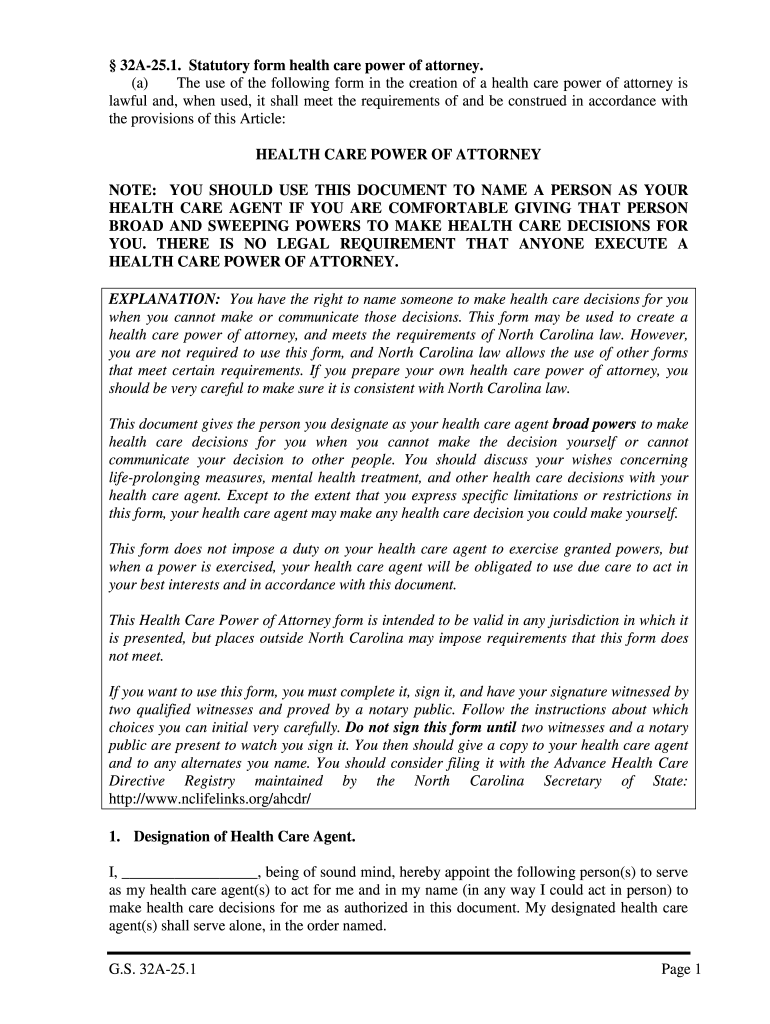
Me: Home Address: Home Telephone: Work Telephone: Cellular Telephone: B. Name: Home Address: Home Telephone: Work Telephone: Cellular Telephone: C. Name: Home Address:.
Loading

Open form follow the instructions

Easily sign the form with your finger

Send filled & signed form or save
How to fill out the NC G.S. 32A-25.1 online
The NC G.S. 32A-25.1 form is a statutory health care power of attorney that allows you to designate an individual to make health care decisions on your behalf when you are unable to do so. This guide provides a clear and supportive process for filling out the form online, ensuring you understand each component thoroughly.
Follow the steps to fill out the NC G.S. 32A-25.1 form online
- Use the ‘Get Form’ button to obtain the NC G.S. 32A-25.1 form and open it for editing.
- Begin by filling in the designation of your health care agent. Enter the name, home address, and contact information for the individual (or individuals) you wish to appoint.
- Specify the effectiveness of the appointment by identifying the physician(s) who will determine if you lack capacity to make health care decisions.
- Outline any revocation process, ensuring clarity on how you can revoke the power of attorney at any time while competent.
- In the general statement of authority granted, detail the broad powers you are granting to your health care agent, and review the specific decisions they may need to make.
- If you wish to impose any special provisions or limitations on your agent's authority, carefully initial and fill in that section.
- Address organ donation preferences and initial accordingly to grant authority for your health care agent to make decisions regarding organ donation.
- At the end of the form, sign and date in the presence of two qualified witnesses, who must also sign to validate the document.
- Finally, ensure the form is notarized to complete the legal requirements, and consider filing it with the Advance Health Care Directive Registry in North Carolina.
Complete your NC G.S. 32A-25.1 form online today for peace of mind regarding your health care decisions.
Experience a faster way to fill out and sign forms on the web. Access the most extensive library of templates available.
Related content
EXPLANATION: You have the right to name someone to make health care decisions for you when...
Subject to any restrictions set forth in Section 5 below, I grant to my health care agent...
1.3.1. Highly dynamic drive solution. Technology and motion control functions that meet...
Get answers to your most pressing questions about US Legal Forms API.
Who can override a power of attorney in North Carolina?
In North Carolina, primarily the principal can override their power of attorney by issuing a new, clear directive. If the principal is unable to act due to incapacity, the court may appoint a guardian to oversee any necessary adjustments. This is in line with the provisions of NC G.S. 32A-25.1, ensuring your wishes are respected.
What three decisions cannot be made by a legal power of attorney?
In North Carolina, a legal power of attorney cannot make decisions about divorce, vote on behalf of the principal, or make decisions about their medical treatment if the power of attorney does not include these rights. It is essential to refer to NC G.S. 32A-25.1 for a complete understanding of the limitations in place. Knowing these restrictions can help you draft a comprehensive power of attorney.
What rights does a power of attorney have in NC?
A power of attorney grants the agent the right to act on behalf of the principal in specified matters. This may include financial transactions, legal decisions, and health care choices. It is important to delineate these rights clearly in the document to comply with NC G.S. 32A-25.1 and safeguard your interests.
Who makes medical decisions if you are incapacitated in NC?
If you become incapacitated in North Carolina, the person designated in your health care power of attorney will make medical decisions on your behalf. This highlights the importance of selecting a trustworthy individual. Per NC G.S. 32A-25.1, your designated agent can ensure that your medical preferences are honored when you cannot communicate them.
Does a POA have to be filed with the court in NC?
Generally, a power of attorney does not need to be filed with the court in North Carolina. However, if you want to ensure its authority in certain situations, you may consider filing it for safe keeping. It’s wise to refer to NC G.S. 32A-25.1 for specific requirements based on your circumstances.
How do you supersede a power of attorney?
To supersede a power of attorney in North Carolina, you must create a new power of attorney document. This new document should clearly state that it revokes all previous powers of attorney. It is essential to follow the guidelines outlined in NC G.S. 32A-25.1 to prevent any confusion regarding your intentions.
Does a health care power of attorney need to be notarized in NC?
Yes, according to NC G.S. 32A-25.1, a health care power of attorney must be signed in the presence of a notary public. This notarization process ensures that the document is legally binding and recognized by health care providers. It also protects the integrity of the document against potential disputes.
Who can override a power of attorney in NC?
In North Carolina, only the principal can revoke or override a power of attorney. This process involves creating a new document that explicitly states the revocation. Under NC G.S. 32A-25.1, if the principal is incapacitated, certain individuals, such as a guardian, may have legal authority to address the power of attorney on behalf of the principal.
Do I need a lawyer for power of attorney in NC?
While you are not legally required to hire a lawyer for power of attorney in North Carolina per NC G.S. 32A-25.1, it can be beneficial. A lawyer can ensure that your document complies with state laws and properly reflects your intentions. Moreover, they can help navigate any complexities, especially if the situation involves medical or financial matters. If you prefer a straightforward path, uslegalforms offers resources to assist you in this process.
How to get power of attorney in NC for a parent with dementia?
Obtaining power of attorney for a parent with dementia involves understanding NC G.S. 32A-25.1 criteria. You need to demonstrate that your parent is still capable of understanding the implications of granting you this authority. If their mental faculties have declined, you might consider seeking guardianship instead. For clarity and proper documentation, consider using platforms like uslegalforms, which can guide you through the necessary processes.
Use professional pre-built templates to fill in and sign documents online faster. Get access to thousands of forms.
If you believe that this page should be taken down, please follow our DMCA take down process here.