Lue listed on the Inventory (AOC-E-505), list the gain as a receipt. If a sale results If in a loss as compared to the value listed on the Inventory, report the loss on Side One, Part I of this form. 4. not report, as a receipt, changes in value (when compared to the value listed in the Inventory) of items which have not been sold. Do 5. any real property willed to the estate has been sold, report the entire proceeds as a receipt. If 6. any real property not willed to the estate has been s.
Loading

Open form follow the instructions

Easily sign the form with your finger

Send filled & signed form or save
How to fill out the NC AOC-E-506 online
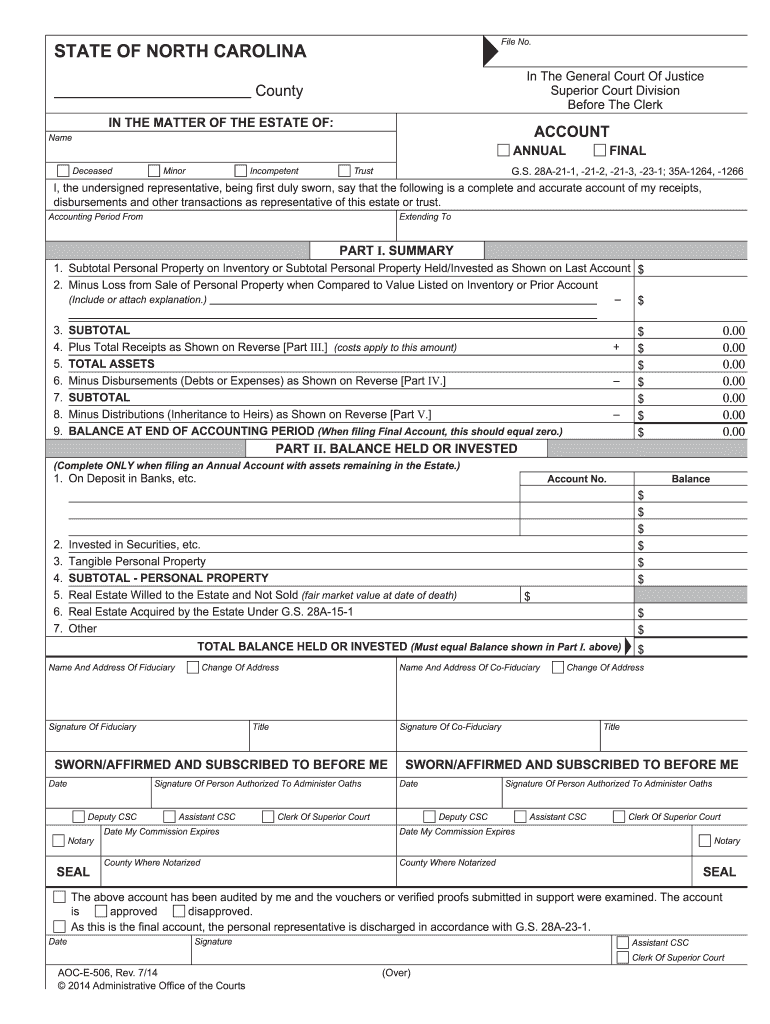
The NC AOC-E-506 form is essential for reporting the accounting of an estate or trust in North Carolina. This guide provides a clear and easy-to-follow approach to filling out the form online, ensuring accuracy and completeness in your submission.
Follow the steps to successfully complete the NC AOC-E-506 online.
- Click ‘Get Form’ button to obtain the form and launch it in your preferred editor.
- Begin with the 'File No.' section, entering the appropriate case number for your matter.
- In the 'County' field, specify the county where the estate or trust is being administered.
- Under 'IN THE MATTER OF THE ESTATE OF,' provide the name of the deceased person or the individual for whom the trust is established.
- Indicate the type of account being filed by selecting 'Final,' 'Annual,' 'Minor,' 'Incompetent,' or 'Trust' as applicable.
- Specify the 'Accounting Period' by entering the start date and end date for the report.
- Complete 'PART I. SUMMARY' by calculating and entering the subtotal for personal property, receipts, total assets, disbursements, distributions, and the final balance.
- If filing an Annual Account, fill out 'PART II. BALANCE HELD OR INVESTED' with details about any assets remaining in the estate.
- Move to 'PART III. RECEIPTS' and document the amounts received by the estate during the accounting period, ensuring to follow included notes for clarification.
- Proceed to 'PART IV. DISBURSEMENTS' and list all expenses and debts paid during the accounting period, attaching proof where necessary.
- In 'PART V. DISTRIBUTIONS,' record any distributions made to heirs, providing supporting documentation as noted.
- Review all completed sections for accuracy before saving the form. Once verified, you can download, print, or share the filled document as required.
Complete your NC AOC-E-506 online today for accurate estate reporting.
Experience a faster way to fill out and sign forms on the web. Access the most extensive library of templates available.
Related content
If any real property not willed to the estate has been sold in a special proceeding to...
Apr 5, 2022 — For accountings use AOC-. E-506. Special Fiduciary vs. Temporary Guardian...
Mar 1, 2012 — Technical Guidance. DATE. 3/1/2012. Page 2. Version: 1.0. March 1, 2012...
Get answers to your most pressing questions about US Legal Forms API.
What does NC AOC stand for?
NC AOC stands for North Carolina Administrative Office of the Courts. This office is vital for maintaining the integrity of the state’s judicial process. By providing various forms and resources, including the NC AOC-E-506, it helps citizens navigate legal requirements effectively, ensuring clarity and compliance in legal matters.
What does the Administrative Office of the courts do?
The Administrative Office of the Courts manages resources and strategies for the North Carolina court system. Their responsibilities include providing support to judges, staff, and the public. A key part of their work involves facilitating forms, like the NC AOC-E-506, that assist in legal processes, thus fostering a more accessible and efficient judicial system.
What does AOC stand for in court?
In a courtroom context, AOC stands for Administrative Office of the Courts. This office plays a critical role in administering the court system, ensuring all legal proceedings run smoothly. They offer essential documents, including the NC AOC-E-506, which helps streamline financial reporting within probate processes.
What is the AOC in North Carolina?
The AOC in North Carolina refers to the Administrative Office of the Courts. This organization provides support and administrative assistance to the judicial system across the state. Along with overseeing forms like the NC AOC-E-506, the AOC aims to improve access to the courts and ensure efficient case management, which benefits both the public and judiciary.
Can an estate be settled without probate in NC?
Yes, an estate can often be settled without going through probate in North Carolina under certain conditions, such as when the estate is small or when assets transfer directly to beneficiaries. However, it’s essential to understand the limitations and legal requirements involved. Utilizing resources like the NC AOC-E-506 form can help clarify these processes, ensuring that all necessary steps are taken correctly.
What is the final accounting in probate in NC?
Final accounting in probate in North Carolina is the last financial report prepared by the executor or administrator of an estate. It reflects all transactions that occurred during the probate process, including disbursements, income, and outstanding debts. The NC AOC-E-506 form is crucial because it outlines these summaries and ensures proper distribution of the estate's assets to beneficiaries.
What is the final accounting form for probate?
The final accounting form for probate in North Carolina is the NC AOC-E-506. This form is essential in documenting all receipts and disbursements related to the estate during the probate process. Utilizing the NC AOC-E-506 helps provide clear financial transparency and can make it easier to close the estate properly.
How much does an estate have to be worth to go to probate in NC?
In North Carolina, there is no minimum value for an estate to go through probate; however, estates with assets exceeding $20,000 typically must file for probate. This process ensures the deceased's debts are settled and assets are properly distributed. It is often advisable to consult legal professionals or resources like US Legal Forms to navigate the probate process effectively.
What is the form for final accounting for an estate in NC?
The form used for final accounting of an estate in North Carolina is the NC AOC-E-506. This document requires you to outline all financial activities of the estate from its inception to its closure. Accurate completion of the NC AOC-E-506 helps ensure that all parties involved understand the estate's financial status.
What is the final accounting of an estate in NC?
The final accounting of an estate in North Carolina is a detailed report that outlines all financial transactions related to the estate. It includes income, expenses, and distributions made to beneficiaries, and it is critical for closing the estate. The completed NC AOC-E-506 form serves as the official document submitted to the court.
Use professional pre-built templates to fill in and sign documents online faster. Get access to thousands of forms.
If you believe that this page should be taken down, please follow our DMCA take down process here.