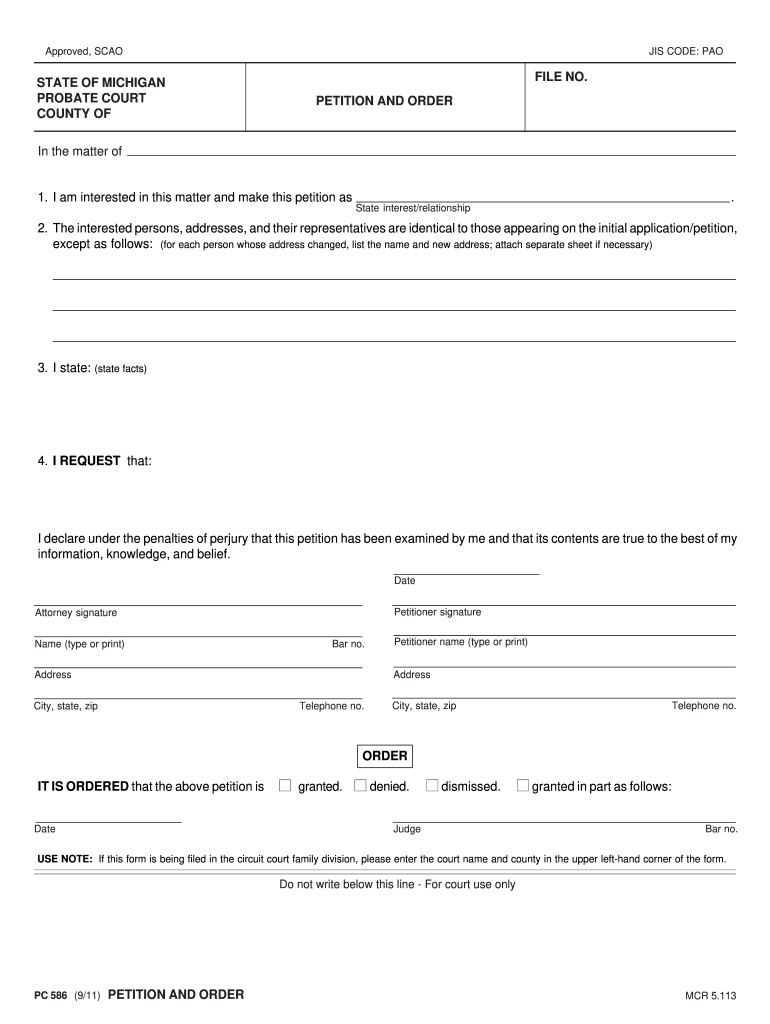
Approved SCAO STATE OF MICHIGAN PROBATE COURT COUNTY OF JIS CODE PAO FILE NO. PETITION AND ORDER In the matter of 1. Address Petitioner name type or print City state zip Telephone no. ORDER IT IS ORDERED that the above petition is granted. denied. dismissed. Judge granted in part as follows USE NOTE If this form is being filed in the circuit court family division please enter the court name and county in the upper left-hand corner of the form. Do not write below this line - For court use only PC.
Loading

Open form follow the instructions

Easily sign the form with your finger

Send filled & signed form or save
How to fill out the MI PC 586 online
Filling out the MI PC 586 form online can streamline your petition process in the probate court. This guide provides clear and supportive instructions to help you successfully complete each section of the form.
Follow the steps to fill out the MI PC 586 form online.
- Press the ‘Get Form’ button to access the MI PC 586 form and open it in your browser.
- Begin by identifying yourself in the first section: Indicate your interest in the matter and fill in the appropriate relationship or role you have regarding the petition.
- In the next section, provide the names and addresses of interested persons and their representatives. If any addresses have changed, list the updated information accordingly, using a separate sheet if necessary.
- State the relevant facts in the designated area. Be concise and clear in presenting your information.
- In the request section, clearly articulate your petition's purpose. This could include specific actions you wish the court to take.
- You must declare that you have reviewed the petition’s contents and affirm its accuracy. Date and sign the form as the petitioner. If applicable, include the attorney's signature, name, and bar number.
- Complete the petitioner’s name and address fields, along with the city, state, zip code, and telephone number.
- After filling out all the necessary fields, review your entries for accuracy and completeness. Once confirmed, you can save changes to the document, download a copy, print it, or share it as needed.
Complete your MI PC 586 form online today for a seamless submission experience.
Experience a faster way to fill out and sign forms on the web. Access the most extensive library of templates available.
Related content
I REQUEST that: I declare under the penalties of perjury that this petition has been...
The course will first introduce dynamic programming techniques for Markov decision...
o Windows XP) ou selecione [Meu Computador]. (para o Windows 2000) ou ... 586 I Land On...
Get answers to your most pressing questions about US Legal Forms API.
How to get letters of testamentary in Michigan?
To obtain letters of testamentary in Michigan, you need to file the last will and a petition for probate with the court. This petition must assert your appointment as the executor named in the will. Once the court approves your request, you will receive the letters, as outlined in MI PC 586, granting you authority to manage the estate as stated in the will.
How to get a letter of Authority in Michigan?
Getting a letter of authority in Michigan involves filing a petition with the probate court, requesting permission to act on behalf of the estate. Ensure you provide relevant documents, including the will and death certificate. Once the court issues the letter under MI PC 586, you are empowered to perform necessary legal and financial actions regarding the estate.
How to apply to be the executor of an estate?
To apply as an executor of an estate in Michigan, you must submit the will and a petition to the probate court for validation. It's crucial to provide information about your suitability for the role, such as your relationship to the deceased and willingness to take on the responsibilities. Following the procedures laid out in MI PC 586 will help streamline your application process.
How do I file for executor of estate in Michigan?
Filing for executor status in Michigan requires you to submit a petition for probate, along with the original will to the probate court. Make sure to include any required documents that showcase your relationship to the decedent. Adhering to MI PC 586 is essential to ensure that your application is processed without issues, and you can manage the estate effectively.
How to file for executor of estate in Michigan?
To file as an executor of an estate in Michigan, begin by filing the deceased’s will with the probate court, alongside a petition to open the estate. You will also need to complete necessary forms that specify your eligibility and intention to serve. Following MI PC 586 guidelines ensures a smoother process, and using resources like uslegalforms can offer the templates and guidance you need.
What are the cons of being an executor of a will?
Being an executor of a will comes with responsibilities that can be time-consuming and stressful. You may have to handle debts, disputes among beneficiaries, and complex estate management tasks. Moreover, under MI PC 586, you might encounter legal liability if you fail to perform your duties correctly, which adds pressure to your position.
What makes a letter of Authority valid?
A letter of authority is valid when it is issued by the probate court and signed by a judge. It should clearly identify the executor or personal representative authorized to handle the estate. Under MI PC 586, ensure that the letter includes the estate's case number and the specific powers granted to you, allowing you to act on behalf of the estate.
How do I request a letter of Authority?
To request a letter of authority in Michigan, you must file a petition with the probate court, detailing your relationship to the deceased and your role in the estate. The court will usually require supporting documents, alongside completed forms. Following the procedures under MI PC 586 ensures you can effectively manage the estate and fulfill your responsibilities.
How to get letters of authority in Michigan?
In Michigan, obtaining letters of authority involves applying for them through the probate court where the estate is filed. You will need to complete necessary forms and provide information regarding the deceased and potential heirs. Once the court reviews your application and approves it, you will receive letters of authority per MI PC 586, granting you the power to act on behalf of the estate.
How to file a claim against an estate in Michigan?
To file a claim against an estate in Michigan, you need to prepare your claim in writing and include pertinent details such as the amount owed and the reason for the claim. Submitting the claim requires you to file it with the probate court handling the estate. Remember to adhere to deadlines outlined in MI PC 586, as late claims may not be considered. Engaging a legal expert can help clarify the process.
Use professional pre-built templates to fill in and sign documents online faster. Get access to thousands of forms.
If you believe that this page should be taken down, please follow our DMCA take down process here.