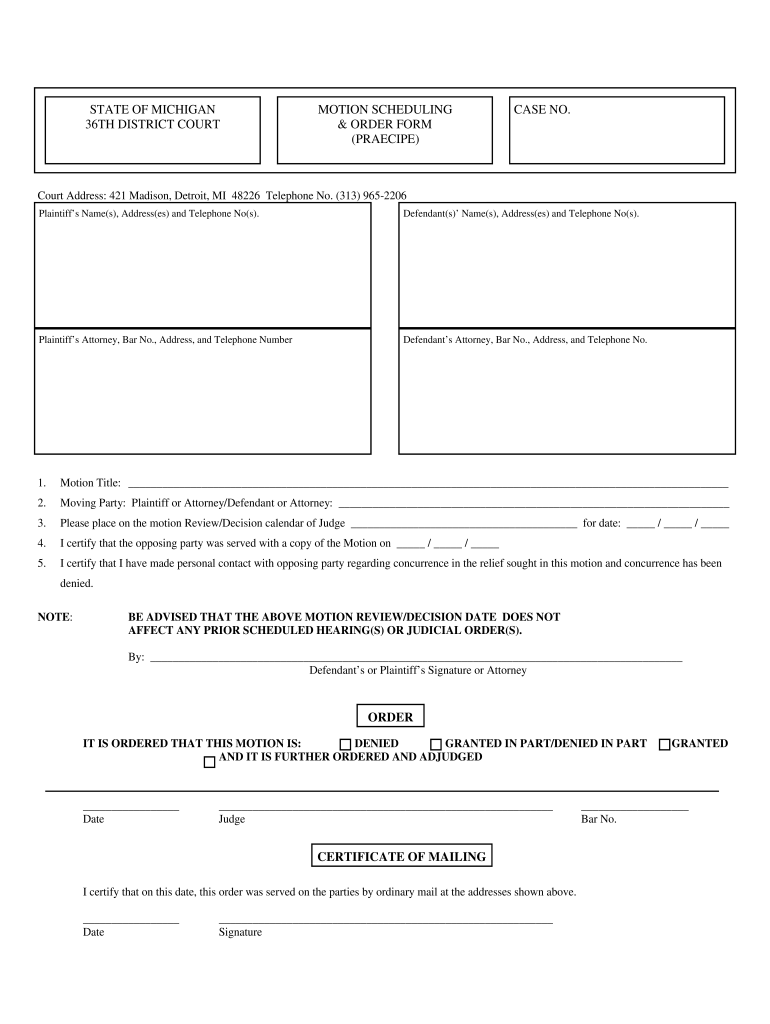
Telephone No(s). Defendant(s) Name(s), Address(es) and Telephone No(s). Plaintiff s Attorney, Bar No., Address, and Telephone Number Defendant s Attorney, Bar No., Address, and Telephone No. 1. Motion Title: 2. Moving Party: Plaintiff or Attorney/Defendant or Attorney: 3. Please place on the motion Review.
Loading

Open form follow the instructions

Easily sign the form with your finger

Send filled & signed form or save
How to fill out the MI Motion Scheduling & Order Form online
This guide provides clear instructions on how to complete the MI Motion Scheduling & Order Form online. Whether you are familiar with legal documents or approaching this for the first time, our step-by-step guidance will support you in filling out the form accurately.
Follow the steps to fill out the form correctly.
- Click the ‘Get Form’ button to access the MI Motion Scheduling & Order Form and open it in your preferred editor.
- Enter the case number in the designated field to identify your specific court case.
- Provide the court's address, including the full address and telephone number, as indicated in the form.
- Fill in the plaintiff’s name(s), address(es), and telephone number(s) as necessary. Ensure accuracy to assist in communications.
- Input the defendant(s)’ name(s), address(es), and telephone number(s) in the following section.
- Specify the name, bar number, address, and telephone number of the plaintiff’s attorney in the respective fields.
- Provide the name, bar number, address, and telephone number of the defendant’s attorney directly underneath.
- In the motion title section, clearly outline the title of the motion you are filing.
- Identify the moving party by selecting either Plaintiff or Attorney/Defendant or Attorney in the provided option.
- Select the review/decision calendar date for the associated judge and ensure that it complies with the court rules regarding notice requirements.
- Certify that the opposing party was served with a copy of the motion on the specified date.
- Certify that you have made personal contact with the opposing party regarding concurrence in the relief sought, noting if concurrence was denied.
- Sign the form in the space for the party or their attorney to validate the document.
- After completing the motion, save any changes. You may download, print, or share the form as needed.
Start completing your MI Motion Scheduling & Order Form online today!
Experience a faster way to fill out and sign forms on the web. Access the most extensive library of templates available.
Related content
STATE OF MICHIGAN. 36TH DISTRICT COURT. MOTION SCHEDULING. & ORDER FORM. (PRAECIPE). CASE...
The scheduling order must limit the time to join other parties, amend the pleadings...
The order in which the pulselengths are cycled is shown in the table below. "*" in...
Get answers to your most pressing questions about US Legal Forms API.
What is the 7 day rule in Michigan?
In Michigan, the 7 day rule is essential for ensuring parties respond to motions promptly. Typically, parties have seven days from service of a motion to file their response with the court. Adhering to this rule promotes a fair process and effective case management, making the MI Motion Scheduling & Order Form an excellent tool to help you stay on track.
What is the 7 year rule in Michigan?
The 7 year rule in Michigan often pertains to the timeframe in which certain judgments can affect your credit. Specifically, favorable resolution or dismissal of cases can be vital for your financial health. Educating yourself on how the MI Motion Scheduling & Order Form can aid in addressing these judgments ensures you remain informed and proactive.
How do I fill out a Motion form?
Filling out a Motion form requires clear attention to detail. Start with the MI Motion Scheduling & Order Form, entering your case number, the names of the parties, and the relief sought. Be specific in your motion, providing supporting facts that justify your request. Finally, review your completed form for accuracy before submission.
What is the 7 day rule in court?
The 7 day rule in court typically refers to the requirement that parties must respond to motions within seven days. This ensures timely communication and helps keep cases moving efficiently. To navigate this, utilizing the MI Motion Scheduling & Order Form can assist you in meeting deadlines and organizing your responses effectively.
How do I file a motion to set aside judgment in Michigan?
To file a motion to set aside judgment in Michigan, start by completing the MI Motion Scheduling & Order Form tailored for this request. Ensure you provide a clear explanation for your motion, detailing the grounds for setting aside the judgment. After filing with the court and embedding all relevant documentation, serve notices to other parties to uphold due process.
How to file a Motion in Michigan?
Filing a motion in Michigan involves a series of straightforward steps. First, complete the MI Motion Scheduling & Order Form, ensuring all necessary details are accurately filled out. Next, submit the form to the appropriate court clerk, including any required fees. Finally, serve a copy of the motion to all involved parties to ensure they receive proper notice.
What are the three grounds for the motion for reconsideration?
The three grounds for a motion for reconsideration include: new evidence that was not available during the original ruling, a change in law that significantly impacts the case, and clear errors in the court's reasoning. Understanding these grounds is essential for anyone considering filing a motion for reconsideration. The MI Motion Scheduling & Order Form can help streamline this process, ensuring that your petition is submitted correctly and timely.
What does motion for clarification mean?
A motion for clarification is a legal document that seeks to clarify ambiguous or unclear language in a prior court order. This can prevent misunderstandings and misinterpretations among the parties involved. For those using the MI Motion Scheduling & Order Form, this motion serves as a valuable tool to foster transparency in legal proceedings.
What is a motion for clarification in Michigan?
A motion for clarification in Michigan is a request made to the court to provide clearer understanding of a previously issued order or ruling. This motion helps ensure that all parties involved understand the judge's intentions and decisions. Utilizing the MI Motion Scheduling & Order Form can aid in efficiently submitting this motion, facilitating smooth communication within legal processes.
What is the 56 day rule in Michigan?
The 56 day rule in Michigan refers to the timeline by which a party must serve a motion for summary disposition after the filing of the complaint. Specifically, it emphasizes that the opposing party must have at least 56 days to respond. Understanding this rule is crucial for effective MI Motion Scheduling & Order Form, ensuring all parties adhere to the correct deadlines.
Use professional pre-built templates to fill in and sign documents online faster. Get access to thousands of forms.
If you believe that this page should be taken down, please follow our DMCA take down process here.