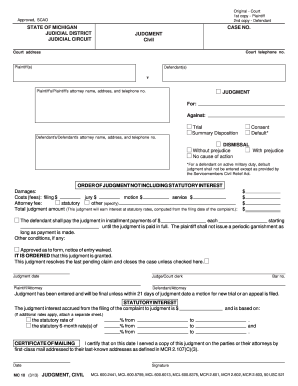
ORDER OF JUDGMENT NOT INCLUDING STATUTORY INTEREST Damages Costs fees filing jury motion service Attorney fee statutory other specify Total judgment amount This judgment will earn interest at statutory rates computed from the filing date of the complaint. The defendant shall pay the judgment in installment payments of each starting until the judgment is paid in full. The plaintiff shall not issue a periodic garnishment as long as payment is made. Original - Court 1st copy - Plaintiff 2nd copy - .
Open form follow the instructions
Easily sign the form with your finger
Send filled & signed form or save
How to fill out the MI MC 10 online
The MI MC 10 is an essential form used in civil court proceedings in Michigan. This guide provides a comprehensive approach to filling out the MI MC 10 online, ensuring clarity and ease for users, regardless of their legal experience.
Follow the steps to complete the MI MC 10 form online:
- Press the ‘Get Form’ button to retrieve the MI MC 10 form and open it in the available editor.
- Enter the judicial district and judicial circuit in the designated fields at the top of the form.
- Fill in the case number, ensuring you provide the correct identification for your civil matter.
- Input the names of the plaintiff(s) and defendant(s) in the appropriate sections.
- Provide the contact information for the plaintiff's or their attorney’s name, address, and telephone number.
- Indicate whether the judgment is for or against the defendant, and select the type of trial (summary disposition or consent) or mention if it's a default judgment.
- For the dismissal section, specify whether it is without prejudice, with prejudice, or no cause of action if applicable.
- List the damages and costs in the corresponding fields, including breakdowns for filing fees, jury fees, motion fees, and service fees.
- Calculate and record the total judgment amount, noting that this amount will accrue interest from the filing date of the complaint.
- If applicable, outline any installment payment plans for the defendant, specifying the payment amount and schedule.
- Check the box to indicate if this judgment resolves the last pending claim and closes the case.
- Insert the judgment date and provide the signatures of the judge/court clerk, plaintiff/attorney, and defendant/attorney.
- Complete the statutory interest section if applicable, detailing any accrued interest and the relevant statutory rates.
- Finally, sign and date the certificate of mailing, certifying that you have sent a copy of the judgment to all involved parties.
Complete the MI MC 10 form online for efficient processing of your civil court case.
Experience a faster way to fill out and sign forms on the web. Access the most extensive library of templates available.
Related content
Judgment has been entered and will be final unless a motion for new trial or an appeal is...
[MI-MC-2] Cedarville 0.6 SE (LaSalle Island) [2011-2015], [MI-MC-1] Cedarville 1.5 SSW...
-Auto power-off function-. The calculator switches the power off automatically if there...
Get answers to your most pressing questions about US Legal Forms API.
Can I get a MC number without a truck?
Yes, you can apply for an MI MC 10 number without owning a truck at this stage. However, you'll need to demonstrate your intention to operate as a motor carrier and have a plan for acquiring a vehicle. Support from USLegalForms can provide you with the necessary documents and guidance as you prepare for your future fleet.
How long does it take to get an MC number?
The processing time for obtaining an MI MC 10 number can vary, but generally, it takes about 20 to 30 days. This timeframe may be affected by any errors in your application or the current workload of the FMCSA. To speed up the process, ensure that your application is fully complete and consider using services from USLegalForms to avoid common pitfalls.
What is needed to get a MC number?
To obtain an MI MC 10 number, you need to complete specific application forms and provide essential documentation, such as proof of insurance and a valid USDOT number. Additionally, your business must comply with federal regulations. Using a service like USLegalForms can streamline this process and ensure you have all required documents correctly prepared.
How long does Judgement stay on credit report?
How Long Do Judgments Stay on a Credit Report? Unpaid judgments remain on your credit reports for seven years or the governing statute of limitations, whichever is longer. Before July 2018, once a judgment was paid, the court had to remove it from the record seven years after the date it was entered.
Does a satisfied judgment hurt credit?
Paying down or paying off the amount associated with the judgment will have no impact on the credit score. While the judgment may now be reported as satisfied on his credit report, the fact that he even had a judgment in the past (satisfied or not) still negatively impacts his credit score.
Can Judgement be removed from credit report?
The credit agencies will remove the judgment from your credit report if you can show that you did, in fact, pay your debt on time. ... Most judgments remain on credit reports for seven years and six months. If this period of time has passed, you should contact the credit agencies and make sure they remove the judgment.
How long does a satisfied Judgement stay on credit report?
While a satisfied judgment is better for your credit than an unsatisfied one, it still stays on your report for seven years from the date it was filed. Many people think that once it's paid, it will be removed from their report; however, that is not the case.
What happens when you get a Judgement against you?
A judgment is an official result of a lawsuit in court. In debt collection lawsuits, the judge may award the creditor or debt collector a judgment against you. You are likely to have a judgment entered against you for the amount claimed in the lawsuit if you: Ignore the lawsuit, or.
Do all Judgements show up on credit report?
Judgment. Currently, civil judgments do not appear on your credit reports at all. Yet this change was due to a settlement the credit bureaus made (more on that below). The FCRA still allows judgments to remain on credit reports for seven years from the filing date.
How do I get a court Judgement removed from my credit report?
Write to the Credit Bureau. The first step is to obtain a letter or document from your credit provider confirming that you have fully satisfied the judgment debt. ... Get a Signed Consent Order. ... Apply to the Court Seeking to Set Aside Judgment. ... Key Takeaways.
Use professional pre-built templates to fill in and sign documents online faster. Get access to thousands of forms.
If you believe that this page should be taken down, please follow our DMCA take down process here.