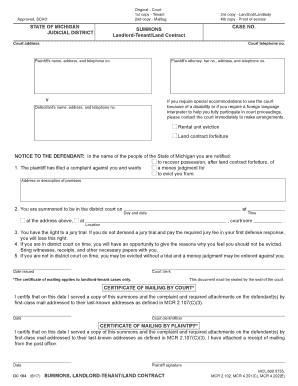
Ant/Land Contract Court address Court telephone no. Plaintiff s name, address, and telephone no. Plaintiff s attorney, bar no., address, and telephone no. V If you require special accommodations to use the court because of a disability or if you require a foreign language interpreter to help you fully participate in court proceedings, please contact the court immediately to make arrangements. Defendant s name, address, and telephone no. Rental unit eviction Land contract forfeiture.
Open form follow the instructions
Easily sign the form with your finger
Send filled & signed form or save
How to fill out the MI DC 104 online
Filling out the MI DC 104 is a crucial step in the eviction process within the state of Michigan. This guide will walk you through each section of the form, ensuring you can complete it accurately and submit it effectively.
Follow the steps to complete the MI DC 104 online.
- Press the ‘Get Form’ button to obtain the MI DC 104 form and open it in your chosen browser.
- Review the introductory information on the form, including the case number, court address, and contact details. Fill in the case number accurately and ensure the court address is correct.
- In the section for the plaintiff, provide the name, address, and telephone number. If the plaintiff is being represented by an attorney, include their bar number and contact details.
- Enter the defendant's name, address, and telephone number in the designated field.
- Complete the eviction or land contract forfeiture sections. Clearly state the premises from which the defendant is being evicted and the reasons for the eviction if necessary.
- Indicate the date and time the defendant is summoned to appear in court, as well as the courtroom location. Ensure this information is accurate to avoid confusion.
- Familiarize yourself with the rights outlined in the notice, particularly regarding the right to a jury trial. This section provides critical information to the defendant regarding their options.
- Review the notice's instructions carefully, ensuring the defendant is aware of the requirements for appearing in court and the consequences of not attending.
- Finalize the form by providing the date it was issued, followed by the court clerk's signature.
- If applicable, complete the certificates of mailing section, ensuring that you certify the service of the summons to the defendant along with your signature.
- After all sections are filled, save your changes, and consider downloading or printing the document for your records or sharing it as needed.
Start your process today by filling out the MI DC 104 online.
Experience a faster way to fill out and sign forms on the web. Access the most extensive library of templates available.
Related content
I served a copy of this summons and the complaint and required attachments on the...
by JLF Petriz · 2015 · Cited by 6 — lineares positivas entre a MI e SegIAM TM (r =...
This handbook provides background on Brüel&Kjær microphones, the theory behind their...
Get answers to your most pressing questions about US Legal Forms API.
What happens if you don't show up for eviction court in Michigan?
If you do not attend your eviction court hearing in Michigan, the judge will likely rule in favor of the landlord. This means you could lose your tenancy without having a chance to defend yourself. It's critical to understand the implications and seek information from MI DC 104 on how to prepare for your court date to protect your rights.
Are landlords responsible for nuisance tenants in Michigan?
In Michigan, landlords have a responsibility to address issues caused by nuisance tenants that disturb others in the community. This includes taking appropriate actions to ensure that the property remains a safe and peaceful environment for all residents. If you experience issues with a nuisance tenant, utilizing resources such as MI DC 104 can guide you on how to address these problems effectively.
What constitutes illegal eviction in Michigan?
In Michigan, illegal eviction occurs when a landlord takes actions to remove a tenant without a court order, such as changing locks or shutting off utilities. Such actions violate tenant rights and can lead to legal consequences for the landlord. Familiarizing yourself with your rights and resources, including MI DC 104, is crucial to ensure you are protected against illegal eviction.
Can a landlord evict you without a court order in Michigan?
No, a landlord cannot legally evict you in Michigan without obtaining a court order. This rule is in place to ensure fairness and legality in the eviction process. If you are facing potential eviction, understanding the proper legal channels—such as those outlined in MI DC 104—can help you protect your tenancy.
How long does it take for a landlord to evict you in Michigan?
The eviction process in Michigan typically takes two to three weeks from the time the landlord files for eviction. This timeline can vary based on the court’s schedule and whether you respond to the court notice. It's important to be aware of your rights during this period, and exploring MI DC 104 can give you valuable insights into the process and what to expect.
Can a landlord evict you without going to court in Michigan?
In Michigan, a landlord cannot evict you without going through the court system. The eviction process starts with the landlord filing a complaint in court and obtaining a judgment. This legal step is essential to protect both tenant and landlord rights. If you find yourself facing eviction, consider looking into MI DC 104 to understand your options.
How do you write a polite eviction notice?
When writing a polite eviction notice, start with a clear and respectful introduction, mentioning the specific reasons for the eviction. Use the MI DC 104 form to ensure you include all necessary information while maintaining a courteous tone. Thank the tenant for their cooperation, and provide clear instructions about the next steps and timeline. This approach fosters goodwill and clarity, which can help facilitate a smoother process.
How do I get someone out of my house in Michigan?
To get someone out of your house in Michigan, first, provide a written eviction notice using the MI DC 104 form, stating the reason for the eviction and the deadlines. If the person does not leave voluntarily, you must file an eviction action in the local court. It's important to understand that self-help methods, such as changing locks or removing belongings, are illegal in Michigan. Always proceed through the legal process to avoid complications.
How do I legally evict a tenant in Michigan?
To legally evict a tenant in Michigan, start by providing proper notice using the MI DC 104 form. If the tenant does not comply, you will need to file a complaint with the local court to initiate the eviction process. Be prepared to present your case, including any documentation, to the judge, as legal compliance is crucial to ensure a successful eviction.
How to write an eviction notice in Michigan?
To write an eviction notice in Michigan, begin by clearly stating the reason for the eviction. Use the MI DC 104 form, as it is specifically designed for this purpose; it includes essential details like the tenant's name, address, and the date by which they must vacate. Be polite yet firm in your language, and ensure to follow Michigan's laws regarding notice periods, typically requiring a seven-day notice for non-payment of rent.
Use professional pre-built templates to fill in and sign documents online faster. Get access to thousands of forms.
If you believe that this page should be taken down, please follow our DMCA take down process here.
This form is available in several versions. Select the version you need from the drop-down list below.