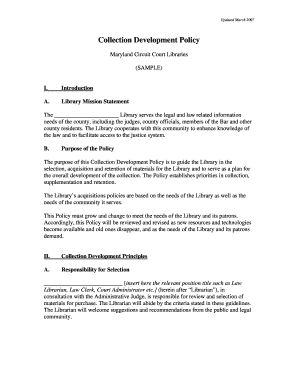
Law related information needs of the county, including the judges, county officials, members of the Bar and other county residents. The Library cooperates with this community to enhance knowledge of the law and to facilitate access to the justice system. B. Purpose of the Policy The purpose of this Collection Development Policy is to guide the Library in the selection, acquisition and retention of materials for the Library and to serve as a plan for the overall development of the collection. T.

How it works
  • Open form

    Open form follow the instructions

  • Easily sign form

    Easily sign the form with your finger

  • Share form

    Send filled & signed form or save

How to fill out the MD Collection Development Policy online

Filling out the MD Collection Development Policy online is an essential step for ensuring that your library effectively meets the information needs of the community it serves. This guide provides clear and supportive instructions to help you navigate the process successfully.

Follow the steps to complete the MD Collection Development Policy form.

  1. Click the ‘Get Form’ button to access the MD Collection Development Policy document. This action will allow you to open the form in your preferred online editor.
  2. Begin filling out the library's mission statement in the designated field. This should clearly articulate how the library serves the legal and law-related information needs of the community.
  3. In the next section, describe the purpose of the policy. Ensure that this explanation outlines how the policy will guide the selection and retention of library materials to suit community needs.
  4. Proceed to the section on collection development principles. Specify the individual responsible for material selection, and fill in their relevant title. This person will be key in evaluating and acquiring necessary resources.
  5. Review and list the selection criteria the Librarian will use when deciding on new materials. Include factors such as potential use, patron requests, and the material's overall quality and relevance.
  6. Detail the guidelines for current versus retrospective materials. Specify the circumstances under which the library may choose to update its collection with historically significant materials.
  7. Indicate the approach toward supplementation of both heavily used primary and secondary materials. Use the specific language from the policy to ensure clarity.
  8. Describe the preferred formats for acquiring materials, and include a rationale for how format selection will benefit users.
  9. Fill in the guidelines related to language selection, ensuring that you specify any preferences tied to the library’s audience.
  10. After completing all sections, review your entries to ensure accuracy and comprehensiveness. Once satisfied, save your changes, and choose whether to download, print, or share the completed form.

Complete your MD Collection Development Policy online today to enhance your library's collection and serve your community effectively.

Get form

Experience a faster way to fill out and sign forms on the web. Access the most extensive library of templates available.

Related content

Collection Development Guidelines of the National...

The NLM and Coordinated Collection Development Selection Guidelines by Subject, Selection...

Learn more
General Collection Development Statements and...

Aug 14, 2025 — This guides includes both general and subject-specific collection...

Learn more
Paperwork Reduction Act (PRA) Guide

Apr 27, 2011 — The Paperwork Reduction Act (PRA) of 1995 gives the Office of Management...

Learn more
Questions & Answers

Get answers to your most pressing questions about US Legal Forms API.

Contact support

What is the collection development policy?

A collection development policy is a strategic document that guides libraries in building and managing their collections. It outlines the selection criteria, acquisition processes, and evaluation methods that align with the MD Collection Development Policy. Such a policy ensures that the collection meets the needs of the community it serves, remains current, and reflects diverse perspectives.

A collection development policy should include the library's mission statement, selection criteria, areas of focus, and guidelines for weeding and evaluation. Moreover, incorporating aspects of the MD Collection Development Policy can enhance clarity and consistency in decision-making. A well-defined policy also helps communicate the library's goals to the community and stakeholders.

The Science Museum Group’s collection development policy emphasizes the importance of representing scientific heritage through a thoughtful selection of materials. By integrating principles from the MD Collection Development Policy, this approach ensures that collections remain relevant, educational, and accessible to diverse audiences. It outlines specific criteria for acquisitions, focusing on both traditional and digital resources.

The collection development policy CDP helps libraries define their goals, strategies, and practices in acquiring and managing resources. It's essential that this policy aligns with the MD Collection Development Policy to ensure that libraries serve their communities effectively. A well-crafted CDP will outline selection criteria, subject areas of focus, and plans for collection evaluation.

The collection development policy of the San Francisco Public Library (SFPL) focuses on creating a diverse collection that reflects the community's needs. It prioritizes inclusion, accessibility, and the promotion of literacy in line with the MD Collection Development Policy principles. This policy also emphasizes openness to different voices and the importance of community engagement in collection choices.

The process of collection development in a library involves assessing user needs, selecting appropriate materials, acquiring them, and providing access to users. This comprehensive approach, as highlighted in the MD Collection Development Policy, helps ensure a diverse and balanced library collection. Regular evaluation is also crucial in this process to adapt to changing user interests and information trends.

A library collection management policy outlines the principles and guidelines for building and maintaining a library's collection. The MD Collection Development Policy acts as a foundational document that helps library staff make informed decisions about acquisitions, weeding, and the preservation of library materials. This policy ensures alignment with the library's mission and the information needs of its community.

The six stages of collection development include selection, acquisition, organization, access, evaluation, and maintenance. In the context of the MD Collection Development Policy, each stage ensures a systematic method for building a comprehensive library collection. By following these stages, libraries can enhance the relevance and quality of their materials to meet user needs effectively.

Basic elements of a collection development policy include the library’s objectives, selection criteria, resource allocation, and evaluation methods. Additionally, the policy may outline procedures for weeding and reviewing the collection. A clear MD Collection Development Policy ensures that these elements are systematically applied for effective management.

The steps in collection development involve needs assessment, selection of materials, acquisition processes, and evaluation of resources. Each step requires thoughtful consideration and engagement with community needs. Implementing a clear MD Collection Development Policy ensures these steps align with the library's mission and vision.

Get This Form Now!

Use professional pre-built templates to fill in and sign documents online faster. Get access to thousands of forms.

If you believe that this page should be taken down, please follow our DMCA take down process here.

Get MD Collection Development Policy