Fair Market Value $ Equity $ - Mortgage $ b) Motor Vehicles Fair Market Value $ - Motor Vehicle Loan $ Equity $ Fair Market Value $ - Motor Vehicle Loan $ Equity $ c) IRA, Keogh, Pension, Profit Sharing, Other Retirement Plans: Financial Institution or Plan Name and Account Number $ $ $ d) Tax Deferred Annuity Plan(s) $ e) Life Insurance: Present Cash Value $ f) Savings & Checking Accounts, Money Market Accounts, Certificates of Deposit-which are held individually, jointly, i.
Loading
Open form follow the instructions
Easily sign the form with your finger
Send filled & signed form or save
How to fill out the MA CJ-D 301 S online
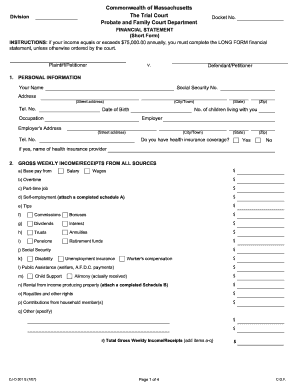
This guide provides clear, step-by-step instructions for completing the MA CJ-D 301 S financial statement online. Designed for individuals with varying levels of legal experience, this document aims to simplify the process and enhance your understanding of each section.
Follow the steps to easily complete the financial statement online.
- Press the ‘Get Form’ button to access the MA CJ-D 301 S financial statement, which you will open in the online editor.
- Begin filling out the personal information section, including your full name, Social Security number, address, telephone number, date of birth, occupation, number of children living with you, and employer information.
- Provide details on your gross weekly income. Report your earnings from various sources such as salary, wages, overtime, and any self-employment income. Make sure to include all relevant figures.
- List your itemized deductions from gross income. This includes federal and state taxes, F.I.C.A. and Medicare deductions, medical insurance, and union dues.
- Calculate your adjusted net weekly income by subtracting the total deductions from your gross income.
- Detail any other deductions from your salary or wages, such as contributions to a credit union, retirement plans, or other specified deductions.
- Determine your net weekly income by subtracting total deductions from your adjusted net weekly income.
- Report your gross yearly income from the prior year, ensuring to attach copies of W-2 and 1099 forms.
- Fill out your weekly expenses by listing all expenses, such as rent or mortgage, utilities, food, transportation, childcare, and any other relevant expenses.
- Provide information about your assets and liabilities. This includes the fair market value of real estate, vehicles, savings accounts, and any outstanding debts.
- Finally, review all provided information for accuracy, sign the certification, and ensure that all necessary attached documents are included.
- Once completed, save your changes, and proceed to download, print, or share the finished financial statement as needed.
Complete your MA CJ-D 301 S financial statement online today!
Experience a faster way to fill out and sign forms on the web. Access the most extensive library of templates available.
Related content
Probate and Family Court Financial statement (short form) (CJD 301S). You must file this...
... CJ-D 301 S (7/07) STATEMENT BY … Financial Information Request - Mass.gov. The...
Para acomodar as correntes de alta inrush normalmente associadas à partida de...
Get answers to your most pressing questions about US Legal Forms API.
How to look up probate records in Massachusetts?
You can look up probate records in Massachusetts online through the state's trial court website or by visiting the probate court in the relevant county. These records include filed documents related to estates, wills, and Letters of testamentary. For a smoother experience, especially with the MA CJ-D 301 S process, consider using tools from platforms like USLegalForms, which offer guidance on navigating probate records and obtaining necessary forms.
How do I get a letter of testamentary in Massachusetts?
To obtain a letter of testamentary in Massachusetts, you must file a petition with the probate court along with the decedent's will and any required supporting documents. The court will review your petition and, if approved, will issue the letter, allowing you to act on behalf of the estate. Using resources like USLegalForms can simplify this process by providing templates and guidance to ensure compliance with the MA CJ-D 301 S requirements.
What is a Letter of testamentary in Massachusetts?
A Letter of testamentary in Massachusetts is a court document that grants an executor the authority to manage a deceased person's estate. This letter is essential for settling outstanding debts, distributing assets, and fulfilling any final obligations. Understanding the significance of the MA CJ-D 301 S can streamline the process of obtaining this crucial document.
What is the rule 401 financial statement in Massachusetts?
The rule 401 financial statement is a required financial disclosure in Massachusetts that provides important information about an individual's financial condition. This form must be completed accurately to comply with state rules, especially in cases involving divorce or child support. The MA CJ-D 301 S process may also involve the submission of Rule 401 statements to ensure transparency and fairness in legal proceedings.
What is the long form financial statement?
The long form financial statement is a detailed document that outlines a person's financial situation, including assets, liabilities, income, and expenses. In Massachusetts, this form is often required in various legal proceedings, including those related to the MA CJ-D 301 S process. By providing a thorough overview of your financial status, it helps the court make informed decisions regarding probate matters.
How to fill out a divorce financial statement?
When filling out a divorce financial statement, you should list all sources of income, current debts, and assets. Be thorough and clear in documenting your financial circumstances, as this statement will significantly impact your divorce proceedings. Utilization of the MA CJ-D 301 S format can help ensure that all necessary information is presented properly to the court.
How do I fill out an affidavit of inheritance?
To fill out an affidavit of inheritance, you need to gather information on the decedent’s estate, including all heirs and their respective shares. Be meticulous in listing each heir's details and the property or assets they are entitled to inherit. Completing the MA CJ-D 301 S accurately is crucial to validate the inheritance process and to protect the rights of all heirs involved.
How to fill out a VA small estate affidavit?
Filling out a VA small estate affidavit requires providing detailed information about the decedent and their assets. You should include the names of heirs and any outstanding debts or claims. Using the MA CJ-D 301 S ensures that you follow the requirements set by the state, facilitating a smoother process for your estate transfer.
How do I fill out an affidavit of financial information?
To fill out an affidavit of financial information, start by collecting your financial documents, including income statements and debts. Clearly state your income, expenses, assets, and liabilities in the correct sections of the affidavit. A comprehensive and accurate completion of the MA CJ-D 301 S helps clarify your financial situation, making it easier for the court to assess your case.
What is the limit for small estate affidavit in Virginia?
In Virginia, the limit for a small estate affidavit is currently $50,000, which pertains to the net value of the estate. This means if the total assets are under this limit, you can use the MA CJ-D 301 S affidavit to facilitate the transfer of property without formal probate. Always verify current laws, as these limits can change.
Use professional pre-built templates to fill in and sign documents online faster. Get access to thousands of forms.
If you believe that this page should be taken down, please follow our DMCA take down process here.
This form is available in several versions. Select the version you need from the drop-down list below.