Loading
Form preview
  • US Legal Forms
  • Form Library
  • Legal Forms
  • Multi-State Legal Forms
  • Conditional Waiver And Release On Progress Payment 2012

Get Conditional Waiver And Release On Progress Payment 2012-2026

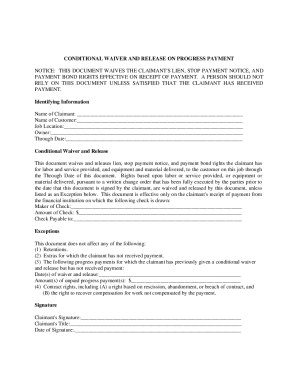
Text of the "Notice to Claimant" in at least as large a type as the largest type otherwise in the form: UNCONDITIONAL WAIVER AND RELEASE ON PROGRESS PAYMENT NOTICE TO CLAIMANT: THIS DOCUMENT WAIVES AND RELEASES LIEN, STOP PAYMENT NOTICE, AND PAYMENT BOND RIGHTS UNCONDITIONALLY AND STATES THAT YOU HAVE BEEN PAID FOR GIVING UP THOSE RIGHTS. THIS DOCUMENT IS ENFORCEABLE AGAINST YOU IF YOU SIGN IT, EVEN IF YOU HAVE NOT BEEN PAID. IF YOU HAVE NOT BEEN PAID, USE A CONDITIONAL WAIVER AND RELE.

How it works

  1. Open form

    Open form follow the instructions

  2. Easily sign form

    Easily sign the form with your finger

  3. Share form

    Send filled & signed form or save

How to fill out the Conditional Waiver and Release on Progress Payment online

The Conditional Waiver and Release on Progress Payment is a crucial document designed to protect the rights of claimants in the construction industry by waiving lien rights upon receiving payment. This guide provides step-by-step instructions for users to complete this form correctly and efficiently online.

Follow the steps to effectively complete the form.

  1. Press the ‘Get Form’ button to access the Conditional Waiver and Release on Progress Payment form and open it in your preferred editor.
  2. Fill in the identifying information required at the top of the form. This includes the name of the claimant, the name of the customer, the job location, the owner's name, and the date covered by this waiver.
  3. In the Conditional Waiver and Release section, clearly indicate the specific labor, services, equipment, and materials provided up to the specified date. Ensure that you check all relevant items related to your work.
  4. Complete the payment details by providing the maker of the check, the total amount of the check, and the name of the payee as specified. Double-check the accuracy of these figures.
  5. List any exceptions to the waiver in the designated area, specifying any unpaid amounts or rights that you wish to maintain. This is important for maintaining your rights related to any outstanding payments.
  6. Sign the document where indicated, including stating your title and the date of signing. This step is essential for the validity of the waiver.
  7. Once you have filled out all necessary sections, you can choose to save your changes, download the completed form, print it out for your records, or share it as required.

Complete your Conditional Waiver and Release on Progress Payment online today to protect your interests.

Get form

Experience a faster way to fill out and sign forms on the web. Access the most extensive library of templates available.
Get form

Related content

Conditional Waiver and Release on Progress Payment
Jul 1, 2012 — Conditional Waiver and Release. This document waives and releases lien...
Learn more
CONDITIONAL WAIVER AND RELEASE UPON ...
It is to be used by a party who applies for a progress payment when the progress check has...
Learn more
Energy Products and Contract Price Description of...
Requiring your contractor to furnish a conditional waiver and release pursuant to Arizona...
Learn more

Related links form

AK AP-155 2012 AK AP-215 2007 AK AP-220 2015 AK AP-311 2005

Questions & Answers

Get answers to your most pressing questions about US Legal Forms API.

Contact support

The term 'conditional release' refers to a legal mechanism that permits a party to release certain rights or claims based on specific conditions being satisfied. This mechanism is crucial in various contracts, especially in the context of payments and obligations. By understanding the meaning of conditional release, you can effectively utilize these documents, such as the conditional waiver and release on progress payment, to safeguard your interests in real estate transactions.

Unconditional release waivers signify that a party relinquishes their right to claim payment without any conditions attached. This means that once the waiver is signed, the party cannot reclaim the payment, regardless of future disputes. These waivers can be useful but require careful consideration, especially when you successfully navigate the complexities of conditional waivers and releases.

A conditional payment refers to funds that are pledged to a party only under specific terms or conditions. This payment type creates a safeguard for both the payer and payee, ensuring that tasks or obligations are fulfilled before finalizing the transaction. In the context of a conditional waiver and release on progress payment, this guarantees that the work is acceptable before payment is made.

The main difference between conditional release and unconditional release lies in the stipulations attached. A conditional release requires certain conditions to be met before funds or rights are relinquished, while an unconditional release takes effect immediately regardless of any outstanding requirements. Understanding these differences helps you choose the appropriate waiver and release strategy, particularly when dealing with a conditional waiver and release on progress payment.

A conditional release in real estate is an agreement that allows a party to release a claim or right upon the fulfillment of certain conditions. This type of release protects the interests of both the payer and payee by ensuring clarity before finalizing payment. In transactions involving a conditional waiver and release on progress payment, the agreement remains valid until the stipulated conditions are satisfied.

A conditional waiver and release on final payment is a legal document that relinquishes a party's right to claim an amount, but under specific conditions. This typically occurs when the contractor or subcontractor acknowledges receipt of the final payment. Essentially, it provides assurance that all obligations are settled once the payment is completed.

In real estate, 'conditional' refers to terms that depend on specific events or requirements being met. For instance, a conditional waiver and release on progress payment means that the release of a payment is contingent upon certain conditions. This ensures that all parties involved fulfill their obligations before the payment is finalized.

In Illinois, a conditional waiver and release on progress payment outlines the agreement between parties regarding payment for ongoing work on a construction project. This document ensures that the recipient agrees to waive their claim for payment up to the indicated amount once they receive the payment. It helps maintain clear communication and transparency in financial transactions.

A conditional release for a payment is a formal agreement that releases a party's right to claim a lien for an agreed payment amount. This type of release is often used in construction projects, providing assurance that the recipient will not pursue further claims related to the payment. It's a vital document that helps streamline the payment process.

Filling out a conditional waiver and release on progress payment involves several key steps. First, you should clearly identify the parties involved, including the recipient and payer. Next, include the specific amount of the payment and reference the project or contract. Finally, ensure that both parties sign and date the document to validate its effectiveness.

Get This Form Now!

Use professional pre-built templates to fill in and sign documents online faster. Get access to thousands of forms.
Get form
If you believe that this page should be taken down, please follow our DMCA take down processhere.
Get Conditional Waiver and Release on Progress Payment
Get form
  • Adoption
  • Bankruptcy
  • Contractors
  • Divorce
  • Home Sales
  • Employment
  • Identity Theft
  • Incorporation
  • Landlord Tenant
  • Living Trust
  • Name Change
  • Personal Planning
  • Small Business
  • Wills & Estates
  • Packages A-Z
  • Affidavits
  • Bankruptcy
  • Bill of Sale
  • Corporate - LLC
  • Divorce
  • Employment
  • Identity Theft
  • Internet Technology
  • Landlord Tenant
  • Living Wills
  • Name Change
  • Power of Attorney
  • Real Estate
  • Small Estates
  • Wills
  • All Forms
  • Forms A-Z
  • Form Library
  • Legal Hub
  • About Us
  • Help Portal
  • Legal Resources
  • Blog
  • Affiliates
  • Contact Us
  • Delete My Account
  • Site Map
  • Industries
  • Forms in Spanish
  • Localized Forms
  • State-specific Forms
  • Forms Kit
  • Real Estate Handbook
  • All Guides
  • Notarize
  • Incorporation services
  • For Consumers
  • For Small Business
  • For Attorneys
  • USLegal
  • FormsPass
  • pdfFiller
  • signNow
  • altaFlow
  • DocHub
  • Instapage
Form Packages
  • Adoption
  • Bankruptcy
  • Contractors
  • Divorce
  • Home Sales
  • Employment
  • Identity Theft
  • Incorporation
  • Landlord Tenant
  • Living Trust
  • Name Change
  • Personal Planning
  • Small Business
  • Wills & Estates
  • Packages A-Z
Form Categories
  • Affidavits
  • Bankruptcy
  • Bill of Sale
  • Corporate - LLC
  • Divorce
  • Employment
  • Identity Theft
  • Internet Technology
  • Landlord Tenant
  • Living Wills
  • Name Change
  • Power of Attorney
  • Real Estate
  • Small Estates
  • Wills
  • All Forms
  • Forms A-Z
  • Form Library
Customer Service
  • Legal Hub
  • About Us
  • Help Portal
  • Legal Resources
  • Blog
  • Affiliates
  • Contact Us
  • Delete My Account
  • Site Map
  • Industries
  • Forms in Spanish
  • Localized Forms
  • State-specific Forms
  • Forms Kit
Legal Guides
  • Real Estate Handbook
  • All Guides
Prepared for you
  • Notarize
  • Incorporation services
Our Customers
  • For Consumers
  • For Small Business
  • For Attorneys
Our Sites
  • USLegal
  • FormsPass
  • pdfFiller
  • signNow
  • altaFlow
  • DocHub
  • Instapage
Social Media
Call us now toll free:
+1 833 426 79 33
As seen in:
© Copyright 1999-2026 airSlate Legal Forms, Inc. 3720 Flowood Dr, Flowood, Mississippi 39232
  • Your Privacy Choices
  • Terms of Service
  • Privacy Notice
  • Content Takedown Policy
  • Bug Bounty Program