Loading
Form preview
  • US Legal Forms
  • Other Templates
  • Legal Forms
  • Multi-State Legal Forms
  • Bankruptcy B256 2007

Get Bankruptcy B256 2007

Ve on the party or attorney designated in the subpoena a written objection to inspecting, copying, testing or sampling any or all of the materials or to inspecting the premises or to producing electronically stored information in the form or forms requested. The objection must be served before the earlier of the time specified for compliance or 14 days after the subpoena is served. If an objection is made, the following rules apply: (i) At any time, on notice to the commanded person, the ser.

How it works

  1. Open form

    Open form follow the instructions

  2. Easily sign form

    Easily sign the form with your finger

  3. Share form

    Send filled & signed form or save

How to fill out the Bankruptcy B256 online

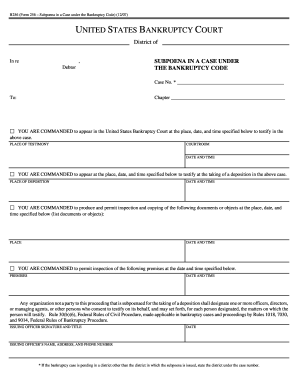
The Bankruptcy B256 is an important form that outlines subpoenas in bankruptcy cases. This guide is designed to assist users, regardless of their legal background, in filling out this form accurately and effectively online.

Follow the steps to complete the Bankruptcy B256 online.

  1. Click the ‘Get Form’ button to obtain the form and open it in the online editor.
  2. Enter the case name and case number in the designated fields at the top of the form. Make sure that the details match the court records to avoid any discrepancies.
  3. Specify the chapter of the bankruptcy under which the case is filed, such as Chapter 7 or Chapter 13, in the appropriate section.
  4. Fill in the information for the subpoenas, including details on the date, time, and location where testimony or depositions are to take place.
  5. If you are requesting the production of documents or inspection of premises, clearly list the documents or items and specify the date and time for compliance.
  6. Sign and date the form where required. Ensure the signature is from the appropriate issuing officer, as this validates the subpoena.
  7. Complete the Proof of Service section after you have served the subpoena. Include details such as the date, place, name of the person served, and manner of service.
  8. Review all entries for accuracy and completeness, then proceed to save your changes, download the document, or print it for filing.

Start filling out your Bankruptcy B256 online today to ensure compliance and expedite your legal processes.

Get form

Experience a faster way to fill out and sign forms on the web. Access the most extensive library of templates available.

Related content

UNITED STATES BANKRUPTCY COURT
Page 1. B256 (Form 256 – Subpoena to Testify at a Deposition in a Bankruptcy Case or...
Learn more
tithing in a chapter 13 plan: the requirement of...
Abstract: A recurring dilemma faced by bankruptcy courts occurs when a debtor makes...
Learn more
Orbea 2014
A few years later, the economic crisis brought Orbea to the brink of bankruptcy. ... CODE:...
Learn more

Related links form

WA DoR Combined Excise Tax Return 2012 WA DoR REV 41 0112 2014 WA DoR REV 41 0112 2013 WA DoR REV 41 0112 2010

Questions & Answers

Get answers to your most pressing questions about US Legal Forms API.

Contact support

The first step to declaring bankruptcy is to assess your financial situation thoroughly. This includes reviewing your debts, income, and assets to understand your overall financial health. After you have done this, you can consult resources like Bankruptcy B256 or seek professional advice to help you through the filing process. Taking this proactive approach ensures you are well-prepared for what comes next.

The initial stage of bankruptcy involves gathering your financial information and determining which type of bankruptcy to file. This process requires a comprehensive overview of your assets, debts, and income. Understanding your circumstances in light of the Bankruptcy B256 guidelines can streamline this initial step, making it easier to move forward.

Certain debts cannot be discharged through bankruptcy, such as most student loans, child support, and some tax obligations. Additionally, debts incurred through fraud or wrongful conduct typically remain your responsibility. It is essential to review your financial obligations carefully; utilizing resources like Bankruptcy B256 can help clarify what debts you may still owe post-bankruptcy.

There are several factors that may disqualify you from filing for bankruptcy. If you previously filed for bankruptcy and did not wait the required timeframe, you might not be eligible. Additionally, if you have committed fraud or other serious violations in your bankruptcy process, it could lead to disqualification. Seeking guidance through the Bankruptcy B256 framework can provide clarity on your eligibility.

When you declare bankruptcy, you may lose certain assets, depending on the type of bankruptcy filed. For instance, in Chapter 7 bankruptcy, non-exempt property may be sold to repay creditors. However, many personal belongings like home equipment and retirement accounts may still be protected. Understanding your specific situation is crucial, and exploring options like Bankruptcy B256 can help you navigate this process.

Section 502 B 6 of the Bankruptcy Code addresses the limits on the claims that landlords can file in bankruptcy cases when the lease has been rejected. Specifically, it limits damages a landlord can claim for lease termination to the rent reserved under the lease agreement for the greater of one year or 15% of the remaining term of the lease. Understanding the nuances of such provisions, including those related to Bankruptcy B256, can help you navigate your bankruptcy case more effectively.

Chapter 11 and Chapter 13 serve different purposes in bankruptcy, and neither is inherently worse. Chapter 11 is often used by businesses for reorganization, while Chapter 13 is designed for individuals with a regular income to repay debts over time. Understanding how each option fits your situation is important, and the provisions of Bankruptcy B256 can inform your choice, helping you make the best decision for your financial future.

Bankruptcy B256 can help you erase most of your unsecured debts, such as credit card balances and medical bills. However, it does not eliminate all debts, including student loans, tax liabilities, and child support obligations. Understanding the specific provisions of Bankruptcy B256 is crucial, and resources like US Legal Forms can guide you through this process, ensuring you know what debts you can discharge.

When writing a letter of bankruptcy, start with a clear introduction, stating the purpose of your letter. Include details about your financial situation and the reasons necessitating your bankruptcy filing. Utilizing templates from US Legal Forms can simplify this process and ensure you cover all essential aspects of your Bankruptcy B256.

A letter of explanation for bankruptcy is a document that outlines the circumstances leading to your financial difficulties. This letter helps creditors understand your situation better and may accompany your Bankruptcy B256 filing. It's crucial to be honest and clear in your communication to enhance your chances of a favorable consideration.

Get This Form Now!

Use professional pre-built templates to fill in and sign documents online faster. Get access to thousands of forms.
If you believe that this page should be taken down, please follow our DMCA take down processhere.
Get Bankruptcy B256
  • Adoption
  • Bankruptcy
  • Contractors
  • Divorce
  • Home Sales
  • Employment
  • Identity Theft
  • Incorporation
  • Landlord Tenant
  • Living Trust
  • Name Change
  • Personal Planning
  • Small Business
  • Wills & Estates
  • Packages A-Z
  • Affidavits
  • Bankruptcy
  • Bill of Sale
  • Corporate - LLC
  • Divorce
  • Employment
  • Identity Theft
  • Internet Technology
  • Landlord Tenant
  • Living Wills
  • Name Change
  • Power of Attorney
  • Real Estate
  • Small Estates
  • Wills
  • All Forms
  • Forms A-Z
  • Other Templates
  • Legal Hub
  • About Us
  • Help Portal
  • Legal Resources
  • Blog
  • Affiliates
  • Contact Us
  • Delete My Account
  • Site Map
  • Industries
  • Forms in Spanish
  • Localized Forms
  • State-specific Forms
  • Forms Kit
  • Real Estate Handbook
  • All Guides
  • Notarize
  • Incorporation services
  • For Consumers
  • For Small Business
  • For Attorneys
  • USLegal
  • FormsPass
  • pdfFiller
  • signNow
  • altaFlow
  • DocHub
  • Instapage
Form Packages
  • Adoption
  • Bankruptcy
  • Contractors
  • Divorce
  • Home Sales
  • Employment
  • Identity Theft
  • Incorporation
  • Landlord Tenant
  • Living Trust
  • Name Change
  • Personal Planning
  • Small Business
  • Wills & Estates
  • Packages A-Z
Form Categories
  • Affidavits
  • Bankruptcy
  • Bill of Sale
  • Corporate - LLC
  • Divorce
  • Employment
  • Identity Theft
  • Internet Technology
  • Landlord Tenant
  • Living Wills
  • Name Change
  • Power of Attorney
  • Real Estate
  • Small Estates
  • Wills
  • All Forms
  • Forms A-Z
  • Other Templates
Customer Service
  • Legal Hub
  • About Us
  • Help Portal
  • Legal Resources
  • Blog
  • Affiliates
  • Contact Us
  • Delete My Account
  • Site Map
  • Industries
  • Forms in Spanish
  • Localized Forms
  • State-specific Forms
  • Forms Kit
Legal Guides
  • Real Estate Handbook
  • All Guides
Prepared for you
  • Notarize
  • Incorporation services
Our Customers
  • For Consumers
  • For Small Business
  • For Attorneys
Our Sites
  • USLegal
  • FormsPass
  • pdfFiller
  • signNow
  • altaFlow
  • DocHub
  • Instapage
Social Media
Call us now toll free:
+1 833 426 79 33
As seen in:
© Copyright 1999-2026 airSlate Legal Forms, Inc. 17 Station Street, Ste. 203, Brookline, MA 02445
  • Your Privacy Choices
  • Terms of Service
  • Privacy Notice
  • Content Takedown Policy
  • Bug Bounty Program
Bankruptcy B256
This form is available in several versions.
Select the version you need from the drop-down list below.
2013 Bankruptcy B256
Select form
  • 2013 Bankruptcy B256
  • 2007 Bankruptcy B256
  • 1991 Bankruptcy B256
Select form