Loading
Form preview
  • US Legal Forms
  • Other Templates
  • Legal Forms
  • Iowa Legal Forms
  • Ia Eform 3.1

Get Ia Eform 3.1

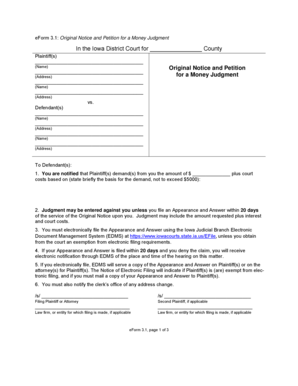
And Petition for a Money Judgment (Address) (Name) (Address) vs. Defendant(s) (Name) (Address) (Name) (Address) To Defendant(s): 1. You are notified that Plaintiff(s) demand(s) from you the amount of $.

How it works

  1. Open form

    Open form follow the instructions

  2. Easily sign form

    Easily sign the form with your finger

  3. Share form

    Send filled & signed form or save

How to fill out the IA eForm 3.1 online

Filling out the IA eForm 3.1 is an important step in initiating a money judgment request in the Iowa District Court. This guide provides clear and detailed instructions to help users successfully complete the form online, ensuring all necessary information is captured accurately.

Follow the steps to complete the IA eForm 3.1 online.

  1. Click the ‘Get Form’ button to access the form. This action will open the IA eForm 3.1 for you to fill out in your chosen format.
  2. Enter the name of the county in which the court case is being filed in the designated area at the top of the form.
  3. In the Plaintiff(s) section, provide the names and addresses of all plaintiffs. Ensure that this information is complete and accurate.
  4. In the Defendant(s) area, similarly, enter the names and addresses of all defendants involved in the case.
  5. In the designated field, specify the amount being demanded from the defendant along with a brief basis for this demand. This amount cannot exceed $5000.
  6. Make sure to read the notification statements regarding the requirements for filing an Appearance and Answer within 20 days after service.
  7. Indicate whether you are electronically filing your Appearance and Answer and ensure you have plans in place to notify the clerk’s office of any address changes if applicable.
  8. Once all sections are completed, review the form for accuracy. You can save your changes, download, print, or share the form as needed.

Start completing your IA eForm 3.1 online today to ensure a smooth filing process.

Get form

Experience a faster way to fill out and sign forms on the web. Access the most extensive library of templates available.
Get form

Related content

CHAPTER 3 STANDARD FORMS OF PLEADINGS FOR ...
Jun 1, 2018 — Form 3.1. Original Notice and Petition for a Money Judgment. Form 3.2...
Learn more
AI rules for the metaverse | The TechTank Podcast
In this episode of TechTank, co-host Nicol Turner Lee and Tom Wheeler discuss how the...
Learn more
PhoCheck+ 1, 2, 3 & 5000Ex U ser M anual V1.1
T he 12 / 24 hour tim e form at is also adjustable. Ion Science recom m end that you set...
Learn more

Related links form

HI DoT G-49 2008 HI DoT GEW-TA-RV-5 2014 HI DoT GEW-TA-RV-5 2009 HI DoT HW-14 2018

Questions & Answers

Get answers to your most pressing questions about US Legal Forms API.

Contact support

In Iowa, a small claims judgment is valid for 10 years. During this time, the winning party can take necessary actions to collect the awarded amount. Knowing the duration of the judgment can help parties strategize their next steps effectively. If you need more information on enforcing a judgment, the IA eForm 3.1 on USLegalForms provides useful resources.

In Iowa, you generally have 20 days from the date you receive the lawsuit to file your answer. This timeline is vital to ensure your case proceeds without delays. If you fail to meet this deadline, the court may grant a default judgment against you. Using the IA eForm 3.1 can help streamline your filing process within this timeframe.

To file an appearance and answer in Iowa, first, gather your case details and complete the IA eForm 3.1. Make sure to review your form for accuracy and completeness. Next, file your form with the court clerk and serve copies to all involved parties. This procedure ensures you are officially recognized in the legal process.

An appearance and answer form is a legal document that notifies the court of your intention to respond to a lawsuit. By filing this form, you officially enter the case and provide your side of the story. The IA eForm 3.1 serves as a standard format for this submission, ensuring that you include all necessary information. It is important to complete this step to protect your rights.

In Iowa, the maximum amount you can claim in small claims court is $6,500. This limit allows individuals to resolve disputes over smaller amounts without the need for formal legal representation. Understanding this cap can help you decide if small claims court is the right venue for your case. For assistance in filing, consider using the IA eForm 3.1, which simplifies the process.

To file an appearance and answer in Iowa, start by completing the IA eForm 3.1, which provides a user-friendly template for your submission. Ensure you fill out all necessary sections accurately. Once completed, file your form with the appropriate court, and do not forget to serve a copy to the opposing party. This process is crucial to ensure your rights are preserved.

Representing yourself in small claims court is entirely feasible, and many find success doing so. Preparation is key; gathering evidence and understanding your case helps you present it clearly. The IA eForm 3.1 offers guidance and structure, making it easier to compile your documentation. By following best practices and being organized, you can effectively advocate for your claim.

Taking someone to small claims court can be a practical option when a monetary dispute arises. It provides a way for individuals to resolve disagreements without the complexity of a traditional court setting. With the use of the IA eForm 3.1, you can easily prepare the necessary documentation to file your case. This form simplifies the process, making it more accessible and less intimidating.

In small claims court, typically, each party covers their own lawyer fees unless the court orders otherwise. In many cases, individuals choose to represent themselves to avoid these costs. If you decide to use the IA eForm 3.1 to file, it can streamline your process and help you potentially save on legal fees.

To take someone to small claims court in Iowa, start by gathering your evidence and filing the IA eForm 3.1. This form serves as your claim submission and outlines your case. Ensure you serve the defendant with a copy of the claim, allowing them an opportunity to respond. Following this process will prepare you for a smooth court appearance.

Get This Form Now!

Use professional pre-built templates to fill in and sign documents online faster. Get access to thousands of forms.
Get form
If you believe that this page should be taken down, please follow our DMCA take down processhere.
Get IA eForm 3.1
Get form

Form categories

Real Estate
  • Home Sale
  • Deeds
  • Leases
  • Landlord Tenant
  • First Refusal Agreement
  • Lis Pendens
  • View all Real Estate
Business & Commercial
  • Small Business
  • Contracts
  • Construction
  • Employment
  • Limited Liability Company
  • Partnerships
  • View all Business & Commercial
Estate Planning
  • Personal Planning
  • Last Will and Testament
  • Living Trust
  • Power of Attorney
  • Living Will (Healthcare Directive)
  • Probate
  • Trusts
  • Small Estate
  • View all Estate Planning

Other Legal Areas

  • Civil Actions
  • Civil Procedure
  • Animals
  • Affidavits
  • Bill of Sale
  • Oil Gas and Minerals
  • Name Change
  • Other
Family Law
  • Divorce
  • Annulment
  • Adoption
  • Marriage
  • Child Justice
  • View all Family Law
  • Forms Catalog
  • Other Templates

Company

  • About Us
  • Pricing
  • Legal Hub
  • Affiliate Program

Knowledge Base

  • Help Portal
  • Legal Resources
  • Blog
  • Industries
  • Legal Guides
  • Sitemap

Services

  • Notarize
  • Form Selector

Support

  • Contact Us
  • Delete My Account

Products

  • USLegal
  • FormsPass
  • pdfFiller
  • signNow
  • altaFlow
  • DocHub
  • Instapage
Social Media
Call us now toll free:
+1 833 426 79 33
As seen in:
© 2026 US Legal Forms. All rights reserved.
  • Your Privacy Choices
  • Terms of Service
  • Privacy Notice
  • Content Takedown Policy
  • Bug Bounty Program