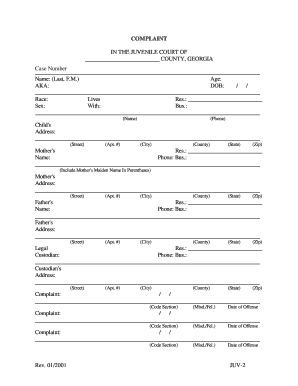
DOB: / / Race: Lives Res.: Sex: With: Bus.: (Name) (Phone) Child's Address: (Street) (Apt. #) (City) (County) (State) (Zip) Mother's Res.: Name: Phone: Bus.:.

How it works
  • Open form

    Open form follow the instructions

  • Easily sign form

    Easily sign the form with your finger

  • Share form

    Send filled & signed form or save

How to fill out the GA JUV-2 online

The GA JUV-2 is a vital document used in the juvenile court system in Georgia. This guide will provide you with clear and detailed instructions on how to fill out the GA JUV-2 online effectively.

Follow the steps to complete the GA JUV-2 form online.

  1. Click 'Get Form' button to obtain the form and open it in your editor.
  2. Begin by filling out the top section with the case number, the parties involved, and the necessary identifying details for the individual named in the complaint, such as name, age, date of birth, race, sex, and residence.
  3. Next, provide the child's address, including street, apartment number, city, county, state, and zip code.
  4. Input the mother's information, including her name, phone number, and business phone number, as well as her address, while also noting her maiden name in parentheses.
  5. Repeat the process for the father's information, including his name, phone number, and address.
  6. Complete the custodian section, providing their name, phone number, and address.
  7. Describe the complaint, identifying the code section and whether it is a misdemeanor or felony, and include the date of the offense.
  8. If applicable, provide details for any additional complaints, following the same format as the previous step.
  9. Indicate whether the individual was taken into custody, specifying the name of the person and agency involved. Provide the placement date and time.
  10. Note the person notified, the date, method of notification, and time. Also, provide the place and date of detention, if applicable.
  11. List the names and ages of any co-perpetrators and the details of victims, including names, phone numbers, and addresses.
  12. In the details of the offense section, provide a complete description of the incidents being reported.
  13. Finish by listing the investigating agency, officer details, and including any report numbers.
  14. Finally, the complainant must sign, provide their name, address, date, and phone number.
  15. Once you have completed the form, you can save changes, download, print, or share the document.

Complete your GA JUV-2 document online today to ensure a smooth filing process.

Get form

Experience a faster way to fill out and sign forms on the web. Access the most extensive library of templates available.

Related content

JUV-2 Dependency Complaint

JUV-2 Dependency Complaint. DEPENDENCY. COMPLAINT. IN THE JUVENILE COURT OF. MUSCOGEE...

Learn more
Transição e reinserção na escola e na...

Este módulo, o segundo de uma série de duas partes, aborda considerações e...

Learn more
methanol in the l1551 circumbinary torus glenn j...

by GJ White · 2006 · Cited by 9 — ABSTRACT. We report observations of gaseous methanol...

Learn more
Questions & Answers

Get answers to your most pressing questions about US Legal Forms API.

Contact support

At what age are you no longer considered a juvenile in Georgia?

In Georgia, an individual is considered a juvenile until they reach the age of 17. Once they turn 17, they are treated as an adult in the eyes of the law according to GA JUV-2. Understanding this age limit is essential for both minors and their parents, as it influences jurisdiction and legal strategy. Families can benefit from consulting resources or platforms like uslegalforms to clarify their rights and responsibilities.

The justice system involves steps such as investigation, arrest, charging, initial hearings, trials, sentencing, and appeals. Each step serves to uphold justice and protect the rights of all parties involved. When it comes to minors facing charges, GA JUV-2 outlines how these steps may differ significantly from adult cases. Familiarity with this process helps in navigating through the complexities.

The juvenile justice process includes reporting a crime, intake, adjudication, disposition, and probation or treatment. Following the adjudication, the court determines the appropriate consequences aimed at rehabilitation. In relation to GA JUV-2, understanding these steps can prepare families for what to expect. Proper guidance can significantly influence the outcome of a juvenile's case.

A defendant typically moves through the processes of arrest, initial appearance, arraignment, pre-trial motions, trial, and finally, sentencing. Each of these steps has significant implications for the outcome of a case. Moreover, in the context of GA JUV-2, these steps can adapt based on whether the individual is a juvenile or an adult. Being aware of these stages provides clarity to defendants and their families.

The criminal justice process generally includes steps like investigation, arrest, charging, and court appearances, among others. Following these, the case may proceed to trial and sentencing. Understanding the broader context of GA JUV-2 can illuminate how juvenile cases differ from adult cases at several stages. Each step is crucial for ensuring justice.

Juvenile courts primarily handle delinquency cases, involving minors accused of criminal behavior; status offenses, which are actions considered illegal only due to the minor's age, such as truancy; and dependency cases, where children are neglected or abused. Being familiar with GA JUV-2 allows families to understand how each type of case is processed. Each category has its unique set of procedures.

The juvenile justice process typically begins with law enforcement intervention, followed by intake, where authorities decide whether to file a petition. Next, there’s an adjudication hearing, where the court evaluates the evidence against the juvenile. If found guilty, the court determines a disposition, which may include rehabilitation services or probation. Understanding GA JUV-2 helps navigate these crucial steps.

Filing for full custody in Georgia requires you to show that it is in the child's best interest. You should prepare your petition, including evidence to support your request for full custody. Using the GA JUV-2 resources available through USLegal can guide you through the process and help you present a compelling case.

The duration of a child custody case in Georgia varies based on several factors, including the complexity of the case and court schedules. Generally, it can take several months to reach a final decision. Understanding the GA JUV-2 process can help set clear expectations and timelines for your case.

To file for custody in Georgia, you must complete the appropriate forms and submit them to the court. This process involves providing information about your relationship with the child and addressing any existing custody arrangements. Utilizing the GA JUV-2 forms from USLegal can simplify your filing, ensuring you include all required details.

Get This Form Now!

Use professional pre-built templates to fill in and sign documents online faster. Get access to thousands of forms.

If you believe that this page should be taken down, please follow our DMCA take down process here.

GA JUV-2 Form

This form is available in several versions. Select the version you need from the drop-down list below.

Get GA JUV-2