Loading
Form preview
  • US Legal Forms
  • Other Templates
  • Legal Forms
  • Florida Legal Forms
  • Fl 12.980(i) 2015

Get Fl 12.980(i) 2015-2026

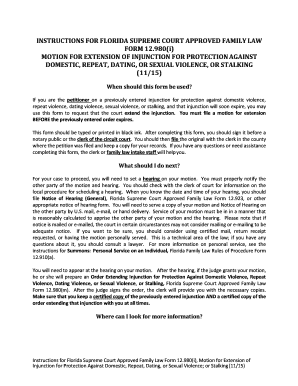
Should this form be used? If you are the petitioner on a previously entered injunction for protection against domestic violence, repeat violence, dating violence, sexual violence, or stalking, and that injunction will soon expire, you may use this form to request that the court extend the injunction. You must file a motion for extension BEFORE the previously entered order expires. This form should be typed or printed in black ink. After completing this form, you should sign it before a notary p.

How it works

  1. Open form

    Open form follow the instructions

  2. Easily sign form

    Easily sign the form with your finger

  3. Share form

    Send filled & signed form or save

How to fill out the FL 12.980(i) online

Filling out the FL 12.980(i) form is an important step for individuals seeking to extend an existing injunction for protection against domestic violence, repeat violence, dating violence, sexual violence, or stalking. This guide provides clear and user-friendly instructions to assist you in completing the form online.

Follow the steps to successfully complete your FL 12.980(i) form.

  1. Click the ‘Get Form’ button to obtain the FL 12.980(i) form and open it in your editor.
  2. Begin by entering the case information at the top of the form. Include the circuit court, county, case number, and division as required.
  3. Complete Section I by providing your full legal name as the petitioner. Include your current address and telephone number. If disclosing your address puts you in danger, use the ‘confidential’ option.
  4. In Section II, provide details about the respondent. Fill in any new information such as their address, employment, physical description, and any known aliases.
  5. Move to Section III and describe any attempts made to obtain injunctions by either party since the last order. Include any relevant court cases involving you and the respondent.
  6. Articulate the specific reasons why you are seeking an extension of the injunction in Section III. Be detailed and thorough in your explanation.
  7. Confirm your genuine fear of violence or stalking from the respondent in Section III.
  8. In Section IV, indicate your understanding of the court hearing requirement and state the duration you are requesting for the injunction.
  9. Complete the certification part at the end of the form by specifying how you served notice to the other party and by signing where indicated. Include the date and notary details.
  10. Once fully completed, you can save changes, download, print, or share the form as needed.

Complete your FL 12.980(i) form online today to ensure your request for an extension is filed promptly.

Get form

Experience a faster way to fill out and sign forms on the web. Access the most extensive library of templates available.
Get form

Related content

Download 12.980(i)
After the hearing, if the judge grants your motion, he or she will prepare an Order...
Learn more
SC02-2445 IN RE: AMENDMENTS TO ...
Comments regarding proposed Florida Family Law Rules Form 12.980(d)(1), Temporary...
Learn more
proceedings
ASCIENTIFIC COMPUTATION FORUM, sponsored by the. International Business Machines...
Learn more

Related links form

NC DSS-8107D 2024 ID ITD 3932 2016 VA Civilian Review Board Application - City Of Richmond 2024 USAID Water Quality Assurance Plan Guidance Note 2018

Questions & Answers

Get answers to your most pressing questions about US Legal Forms API.

Contact support

A temporary injunction is a court order that provides immediate relief by postponing certain actions until a hearing can be conducted. This type of order is typically intended to prevent harm or injustice during the pendency of a legal proceeding. When exploring options under FL 12.980(i), it’s crucial to grasp how temporary injunctions function and their implications for your particular case.

A FL motion for contempt is a formal request to the court to impose penalties against an individual who has failed to comply with a court order, including existing injunctions. This motion highlights the seriousness of following court directives and can lead to various consequences for non-compliance. Understanding the nuances of such motions ensures parties know their rights and obligations under the law.

To successfully obtain an injunction, four key elements must typically be established: likelihood of success on the merits, irreparable harm, balance of equities, and public interest. These elements serve as criteria that the court evaluates during the injunction process. By adhering to the standards set by FL 12.980(i), applicants increase their chances of a favorable outcome.

The three main types of injunctions include temporary injunctions, permanent injunctions, and preliminary injunctions. Each type has specific purposes and procedures, tailored to different situations and needs. By navigating the guidelines set forth in FL 12.980(i), you can determine which type of injunction best suits your case.

An injunction is a significant legal order that can affect individual rights and responsibilities; thus, it should not be taken lightly. Violating an injunction can lead to serious legal consequences, including contempt of court charges. It’s essential for parties involved to fully comprehend the implications of injunctions outlined under FL 12.980(i) to avoid unnecessary legal trouble.

The primary purpose of an injunction is to maintain the status quo and protect the rights of parties involved until the court can make a final ruling. It prevents potentially harmful actions that could undermine the legal proceedings. By understanding FL 12.980(i), individuals can better navigate the injunction process and secure necessary protections in their case.

A temporary injunction serves as a court order that limits or restricts an individual or entity from taking specific actions until a final decision is reached in a case. This legal tool is crucial in preventing irreparable harm before the court can fully evaluate the situation. Utilizing the FL 12.980(i) framework ensures that the procedures for obtaining such an injunction are clear and effective.

In Florida, the burden of proof for obtaining an injunction typically requires demonstrating that irreparable harm will occur without it. The petitioner must provide clear evidence showing the need for protection under the guidelines of FL 12.980(i). Understanding this burden is essential, and consulting with a legal expert can help you gather the necessary documentation to support your case.

Dissolving an injunction in Florida involves filing a motion with the court where the injunction was issued. You must demonstrate to the court, following procedures established in FL 12.980(i), that there is no longer a valid reason for the injunction to remain in effect. A qualified legal professional can assist in preparing your motion and presenting a strong argument for dissolution.

To get an injunction dropped in Florida, you will need to file a motion to dismiss the injunction, typically supported by evidence and arguments that justify the dismissal. Ensure that this aligns with the requirements of FL 12.980(i) for effectiveness. Engaging a lawyer can help you craft a compelling case to the court, increasing your chances of success.

Get This Form Now!

Use professional pre-built templates to fill in and sign documents online faster. Get access to thousands of forms.
Get form
If you believe that this page should be taken down, please follow our DMCA take down processhere.
Get FL 12.980(i)
Get form
  • Adoption
  • Bankruptcy
  • Contractors
  • Divorce
  • Home Sales
  • Employment
  • Identity Theft
  • Incorporation
  • Landlord Tenant
  • Living Trust
  • Name Change
  • Personal Planning
  • Small Business
  • Wills & Estates
  • Packages A-Z
  • Affidavits
  • Bankruptcy
  • Bill of Sale
  • Corporate - LLC
  • Divorce
  • Employment
  • Identity Theft
  • Internet Technology
  • Landlord Tenant
  • Living Wills
  • Name Change
  • Power of Attorney
  • Real Estate
  • Small Estates
  • Wills
  • All Forms
  • Forms A-Z
  • Other Templates
  • Legal Hub
  • About Us
  • Help Portal
  • Legal Resources
  • Blog
  • Affiliates
  • Contact Us
  • Delete My Account
  • Site Map
  • Industries
  • Forms in Spanish
  • Localized Forms
  • State-specific Forms
  • Forms Kit
  • Real Estate Handbook
  • All Guides
  • Notarize
  • Incorporation services
  • For Consumers
  • For Small Business
  • For Attorneys
  • USLegal
  • FormsPass
  • pdfFiller
  • signNow
  • altaFlow
  • DocHub
  • Instapage
Form Packages
  • Adoption
  • Bankruptcy
  • Contractors
  • Divorce
  • Home Sales
  • Employment
  • Identity Theft
  • Incorporation
  • Landlord Tenant
  • Living Trust
  • Name Change
  • Personal Planning
  • Small Business
  • Wills & Estates
  • Packages A-Z
Form Categories
  • Affidavits
  • Bankruptcy
  • Bill of Sale
  • Corporate - LLC
  • Divorce
  • Employment
  • Identity Theft
  • Internet Technology
  • Landlord Tenant
  • Living Wills
  • Name Change
  • Power of Attorney
  • Real Estate
  • Small Estates
  • Wills
  • All Forms
  • Forms A-Z
  • Other Templates
Customer Service
  • Legal Hub
  • About Us
  • Help Portal
  • Legal Resources
  • Blog
  • Affiliates
  • Contact Us
  • Delete My Account
  • Site Map
  • Industries
  • Forms in Spanish
  • Localized Forms
  • State-specific Forms
  • Forms Kit
Legal Guides
  • Real Estate Handbook
  • All Guides
Prepared for you
  • Notarize
  • Incorporation services
Our Customers
  • For Consumers
  • For Small Business
  • For Attorneys
Our Sites
  • USLegal
  • FormsPass
  • pdfFiller
  • signNow
  • altaFlow
  • DocHub
  • Instapage
Social Media
Call us now toll free:
+1 833 426 79 33
As seen in:
© Copyright 1999-2026 airSlate Legal Forms, Inc. 17 Station Street, Ste. 203, Brookline, MA 02445
  • Your Privacy Choices
  • Terms of Service
  • Privacy Notice
  • Content Takedown Policy
  • Bug Bounty Program