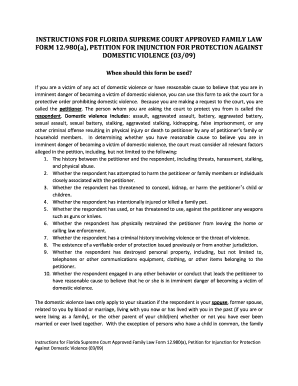
Of any act of domestic violence or have reasonable cause to believe that you are in imminent danger of becoming a victim of domestic violence, you can use this form to ask the court for a protective order prohibiting domestic violence. Because you are making a request to the court, you are called the petitioner. The person whom you are asking the court to protect you from is called the respondent. Domestic violence includes: assault, aggravated assault, battery, aggravated battery, sexual assau.
Open form follow the instructions
Easily sign the form with your finger
Send filled & signed form or save
How to fill out the FL 12.980(a) online
Filling out the FL 12.980(a), the petition for injunction for protection against domestic violence, is a crucial step for individuals seeking legal protection. This guide will provide clear, step-by-step instructions to help users complete the form online effectively.
Follow the steps to successfully complete the FL 12.980(a) online.
- Click 'Get Form' button to access the FL 12.980(a) document and open it in the editor.
- Begin with Section I: Petitioner. Fill in your full legal name, current address, and contact information. If necessary for safety, utilize Petitioner’s Request for Confidential Filing of Address.
- Move to Section II: Respondent. Provide the respondent’s current address and relationship to you. Include as much detail as possible to ensure proper identification.
- In Section III: Case History and Reason for Seeking Petition, clearly outline any past interactions with the respondent and specific incidents of domestic violence or threats.
- Proceed to Section IV: Temporary Exclusive Use and Possession of Home. Indicate whether you require temporary exclusive access to your shared residence.
- Fill out Section V: Temporary Parenting Plan with Temporary Time-Sharing Schedule for Minor Children if applicable. Include details about your child(ren) and any necessary time-sharing arrangements.
- Complete Section VI: Temporary Support if you are seeking financial assistance from the respondent. Specify amounts for temporary alimony or child support.
- In Section VII: Injunction, summarize your requests for protection from the respondent, detailing any specific measures you feel are necessary.
- Finally, review all information for accuracy, save your changes, and follow the prompts to download, print, or share the completed form as needed.
Complete your FL 12.980(a) petition online to ensure you have the protection you need.
Experience a faster way to fill out and sign forms on the web. Access the most extensive library of templates available.
Related content
Form 12.980(a) is used to request a protective order against domestic violence, including...
Jul 8, 2004 — When should this form be used? You may use this form if your Petition for...
ASCIENTIFIC COMPUTATION FORUM, sponsored by the. International Business Machines...
Get answers to your most pressing questions about US Legal Forms API.
How to fill out a FL 330?
Filling out a FL 330 form involves entering comprehensive details about your case, including names, dates, and other relevant legal information. Ensure that you accurately capture all required data as per the guidelines provided with the form. Seeking out sample forms and expert advice available on USLegalForms can help you better understand how to incorporate FL 12.980(a) into your submission.
How to fill out Florida Form 82040?
Filling out Florida Form 82040 requires you to provide detailed information regarding the specific legal issue at hand. Carefully read the instructions on the form before entering your information to avoid any mistakes. If you encounter challenges while completing the form, you can access sample documents from USLegalForms, especially those that clarify elements of FL 12.980(a).
How to fill out a family law financial affidavit short form?
To fill out a family law financial affidavit short form, start by entering your personal information, including income, expenses, and asset details. Be thorough in listing all relevant financial information to provide a complete picture of your finances. Utilizing tools from USLegalForms can streamline this process and ensure you properly integrate aspects of FL 12.980(a) into your affidavit.
Do I have to fill out FL 160?
Yes, if you are involved in certain family law cases, you must fill out FL 160. This form is essential for providing financial disclosure during legal proceedings. Completing FL 160 ensures that all parties have a clear understanding of financial responsibilities. For guidance on how to accurately complete this form, you can refer to resources on USLegalForms that include details addressing FL 12.980(a).
How to fill out a certification of title?
Filling out a certification of title requires you to provide specific information about the property or vehicle in question. Begin by entering the details of the title holder, the item description, and any pertinent identification numbers. Remember to double-check all entries for accuracy, as mistakes could lead to complications. If you need clarity on the process, you can find helpful examples and templates related to FL 12.980(a) on USLegalForms.
How to fill out a certificate of title in Florida?
To fill out a certificate of title in Florida, start by gathering the necessary information, such as the vehicle identification number and the owner's details. Next, complete the application form provided by the Florida Department of Highway Safety and Motor Vehicles. Ensure that all fields are accurately filled out, as any errors can delay processing. For more help, consider using resources like USLegalForms, which offers detailed guidance on FL 12.980(a) and related forms.
Does a temporary restraining order stay on your record in Florida?
In Florida, a temporary restraining order does not automatically become part of your permanent record. However, it can appear in certain background checks, depending on the circumstances surrounding the order. If a motion to dismiss the order is granted or the case concludes without further incident, your record may reflect this. If you need help understanding the implications, platforms like US Legal Forms can provide guidance and access to necessary legal information.
What is a fl motion for contempt?
A FL motion for contempt specifically refers to the formal request to the court related to noncompliance with a Florida court order. In many family law cases, this motion is critical for enforcing agreements surrounding custody or support, as established in FL 12.980(a). Filing this motion demonstrates your willingness to uphold legal commitments while seeking the court's assistance. It's an essential tool for ensuring accountability in family law matters.
How do you get rid of a restraining order in Florida?
To get rid of a restraining order in Florida, you often need to file a motion to dissolve the order with relevant evidence. This process may involve presenting your case in front of a judge who will determine whether the order is still necessary. If you have shown a significant change in circumstances, the court might grant your request. Utilizing resources like US Legal Forms can help streamline this process and ensure you complete the necessary paperwork correctly.
What's the difference between a motion and a petition?
A motion is a request for the court to make a specific ruling, while a petition initiates a legal proceeding. In the context of family law, a motion often seeks to enforce or modify existing orders, which can be detailed in FL 12.980(a). On the other hand, a petition generally requests action related to a new issue, prompting the court to hear a case for the first time. Understanding this difference can assist you in navigating legal procedures effectively.
Use professional pre-built templates to fill in and sign documents online faster. Get access to thousands of forms.
If you believe that this page should be taken down, please follow our DMCA take down process here.