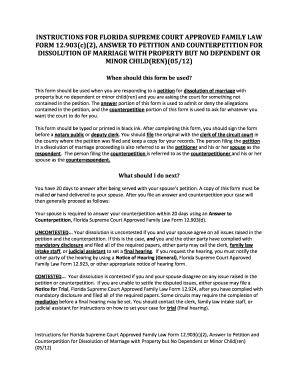
Should this form be used? This form should be used when you are responding to a petition for dissolution of marriage with property but no dependent or minor child(ren) and you are asking the court for something not contained in the petition. The answer portion of this form is used to admit or deny the allegations contained in the petition, and the counterpetition portion of this form is used to ask for whatever you want the court to do for you. This form should be typed or printed in black ink.

How it works
  • Open form

    Open form follow the instructions

  • Easily sign form

    Easily sign the form with your finger

  • Share form

    Send filled & signed form or save

How to fill out the FL 12.903(c)(2) online

Filling out the FL 12.903(c)(2) form is an important step in responding to a petition for dissolution of marriage with property, without dependent or minor children. This guide provides clear, step-by-step instructions to help users complete the form accurately and effectively, ensuring that all necessary information is provided.

Follow the steps to fill out the FL 12.903(c)(2) form online

  1. Click ‘Get Form’ button to obtain the form and open it in the editor.
  2. Begin with the 'Answer to Petition' section. Indicate which allegations from the petition you agree with or disagree with, and create a statement for any allegations you cannot admit or deny.
  3. Proceed to the 'Counterpetition for Dissolution of Marriage' section. Specify the jurisdiction and residency details of either spouse.
  4. Provide marriage history by entering the date of marriage and, if applicable, the date of separation.
  5. Confirm the absence of minor or dependent children and whether the wife is currently pregnant.
  6. In 'Marital Assets and Liabilities,' choose whether there are any marital assets or liabilities, and indicate how they will be treated.
  7. Detail any spousal support request in the 'Spousal Support (Alimony)' section, specifying the amount and frequency if applicable.
  8. Fill out the 'Other' section if there are any additional requests, such as a name change.
  9. In the 'Request' section, summarize the main requests you are asking the court to include in the final judgment.
  10. After reviewing all entries for accuracy, save your changes. You can then download, print, or share the completed form as necessary.

Start filling out your forms online today for a smoother legal process.

Get form

Experience a faster way to fill out and sign forms on the web. Access the most extensive library of templates available.

Related content

Florida Supreme Court Approved Family Law Form...

Form 12.903(c)(2) is used to respond to a dissolution petition with property, no minor...

Learn more
Supreme Court of Florida

Dec 16, 2010 — ... 12.903(c)(2) (no dependent or minor child ... Dependent or Minor...

Learn more
Questions & Answers

Get answers to your most pressing questions about US Legal Forms API.

Contact support

What is Florida statute 61.13(2)(c)(2)?

Florida statute 61.13(2)(c)(2) addresses the court's authority to determine child support based on various factors, such as each parent’s income and the child’s needs. This statute plays a crucial role in ensuring fair support arrangements that prioritize the well-being of children involved in divorce proceedings. Understanding this law is vital for navigating child support issues effectively. FL 12.903(c)(2) can provide additional clarification on this matter.

Florida does not mandate a specific separation period before you can file for divorce. The law states that a spouse must only prove that the marriage is irretrievably broken. However, both parties may benefit from a period of separation to discuss and negotiate important issues like asset division and custody arrangements. Resources such as FL 12.903(c)(2) offer detailed insights into handling these discussions.

Florida divorce rules require the completion of specific forms and adherence to procedural timelines. It is essential to file the appropriate documents, attend mandated mediation sessions if applicable, and present your case to the court if you cannot reach an agreement. Furthermore, rules around custody and visitation will also be strictly enforced. For complete guidance, examining FL 12.903(c)(2) can provide crucial information.

To file for divorce in Florida, at least one spouse must have resided in the state for six months prior to filing. The petitioner must demonstrate that the marriage is irretrievably broken or provide evidence of mental incapacity. Additionally, all marital and financial issues will be considered during the divorce proceedings. Referencing FL 12.903(c)(2) can help clarify these requirements and streamline the process.

Yes, a petition for dissolution of marriage is essentially the legal term for filing for divorce in Florida. This petition formally initiates the divorce process, allowing the court to address matters like asset division, alimony, and child custody. Understanding the legal terminology is important, as it helps clarify your rights and responsibilities during this time. Utilizing resources like FL 12.903(c)(2) can guide you through the nuances of the petition.

In a divorce, your wife may be entitled to equitable distribution of marital assets, which includes property, savings, and retirement accounts. This distribution is not necessarily equal, but rather fair, based on various factors, such as the duration of the marriage and each person's financial situation. If there are children involved, considerations for child support and custody arrangements also come into play. To navigate through these complexities, FL 12.903(c)(2) provides legal guidance.

In some cases, a financial affidavit can be waived in Florida, especially in simplified cases. However, if the court requires one, you must submit the appropriate paperwork. Understanding when you need an affidavit can be crucial, and using the FL 12.903(c)(2) can clarify the process.

Yes, many counties in Florida allow you to request a copy of your divorce decree online. By visiting your local Clerk of Court's website, you can find the appropriate forms to complete. This service can save you time and simplify retrieving important documents.

To get a copy of your divorce decree in Florida, contact the Clerk of Court where you filed your divorce. You can often request copies in person, by mail, or online. The process can vary by county, so visit their website for specific instructions and necessary fees.

You can request a digital copy of your divorce decree by contacting the Clerk of Court in your county. Many counties allow you to fill out a request form online, which makes it convenient. Ensure you have your case number and any required identification ready to expedite the process.

Get This Form Now!

Use professional pre-built templates to fill in and sign documents online faster. Get access to thousands of forms.

If you believe that this page should be taken down, please follow our DMCA take down process here.

Get FL 12.903(c)(2)