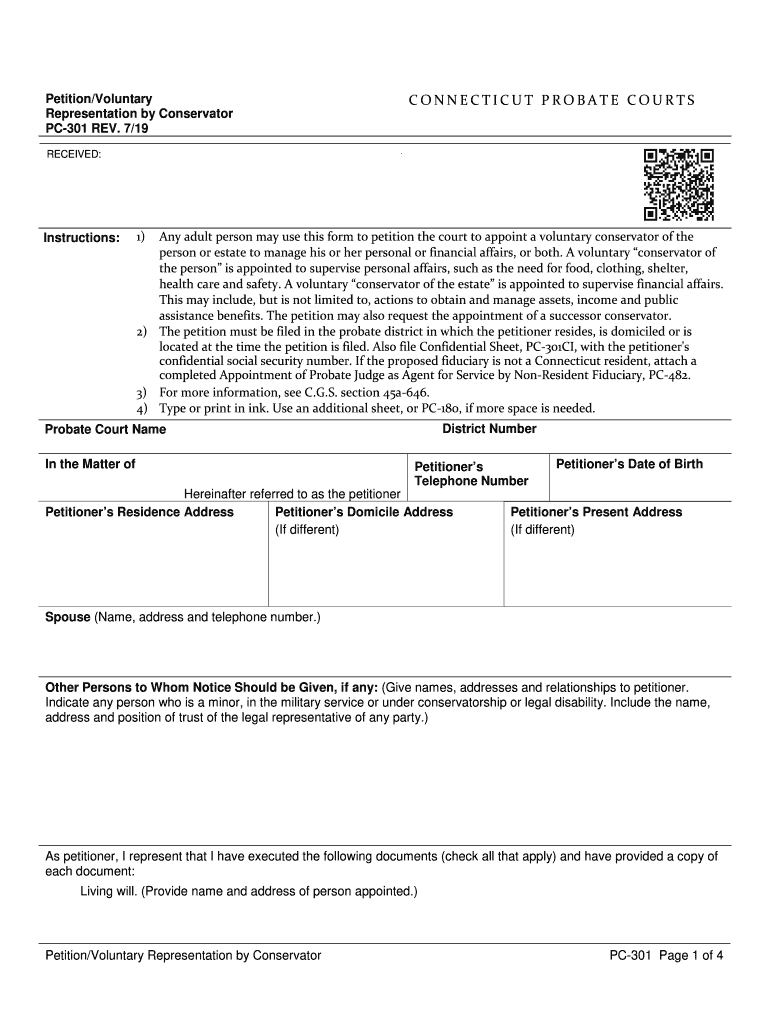
A voluntary conservator of the person or estate to manage his or her personal or financial affairs, or both. A voluntary conservator of the person is appointed to supervise personal affairs, such as the need for food, clothing, shelter, health care and safety. A voluntary conservator of the estate is appointed to supervise financial affairs. This may include, but is not limited to, actions to obtain and manage assets, income and public assistance benefits. The petition may also reque.
Loading

Open form follow the instructions

Easily sign the form with your finger

Send filled & signed form or save
How to fill out the CT PC-301 online
The CT PC-301 form is used to petition the Connecticut Probate Court for the appointment of a voluntary conservator to manage personal or financial affairs. This guide will walk you through each section of the form, offering detailed and supportive instructions to help you complete it correctly.
Follow the steps to accurately complete the CT PC-301 online.
- Click ‘Get Form’ button to access the CT PC-301 form and open it in the online editor.
- Begin by filling in the district number and the name of the probate court where your petition will be filed.
- In the section labeled ‘In the Matter of’, enter the name of the person for whom you are seeking a conservator.
- Provide your telephone number, residency address, domicile address (if different), and date of birth in the appropriate fields.
- If applicable, fill in the name, address, and telephone number of your spouse. This section is important, even if you list other contacts or representatives later.
- List any additional persons who should be notified about this petition, including their names, addresses, and relationships to you. Be sure to indicate if any of these individuals are minors or under conservatorship.
- In the next section, check all documents you have executed and provide the requested contact information for each representative, such as a health care agent or power of attorney.
- Indicate whether you own real property, receive public assistance or care, or are a veteran, and provide necessary details as requested.
- Complete the section requesting the appointment of a conservator by selecting the type of conservator you are petitioning for (person, estate, or both), and outline their duties.
- Finish the form by signing and dating it in the designated areas. Include the proposed conservator's information and signature, if applicable.
- Once you have filled out all sections, you can save your changes, download the document, print it, or share it as needed.
Start filling out your CT PC-301 form online today to ensure your request is processed efficiently.
Experience a faster way to fill out and sign forms on the web. Access the most extensive library of templates available.
Related content
Instructions: 1) Any adult person may use this form to petition the court to appoint a...
This course is a continuation of RT 301 Critical Care I introducing advanced concepts in...
Está a ler o manual do utilizador do PC Portátil. Este manual dispõe de informações...
Get answers to your most pressing questions about US Legal Forms API.
How much does an estate have to be worth to go to probate in CT?
In Connecticut, if an estate is valued at more than $40,000, it generally needs to go through the probate process. This threshold applies to personal property and real estate, ensuring proper management and distribution by the court. The probate process, as guided by CT PC-301, helps in addressing issues such as creditor claims and asset distribution. Utilizing resources from US Legal Forms can support your understanding of the probate requirements.
What is section 36.5 of the CT Probate Court rules of procedure?
Section 36.5 of the CT Probate Court rules addresses the procedures for filing certain motions and applications in probate cases. It outlines requirements for documentation, timelines, and notice to interested parties. Understanding this section can assist those dealing with probate in adhering to key procedural standards consistently. Familiarity with CT PC-301 can also enhance your ability to successfully navigate related processes.
What is a PC 450 probate form in CT?
The PC 450 form is a vital document used in Connecticut probate proceedings. It serves to provide the court with an inventory of the estate's assets, ensuring transparency and proper handling of the estate. This form complements the CT PC-301, as both play significant roles in the probate process. Utilizing tools like US Legal Forms can help you access and correctly complete this form.
What is petition voluntary representation by conservator pc 301?
The petition for voluntary representation by a conservator, also referred to as CT PC-301, is a legal document. It allows a conservator to file on behalf of an individual who may be unable to represent themselves due to incapacity. This procedure facilitates the management of their affairs efficiently, ensuring their interests are safeguarded. Understanding the nuances of this petition can be essential for appropriate representation.
Do I need a lawyer for probate in CT?
While it is not mandatory to hire a lawyer for probate in Connecticut, having legal assistance can simplify the process significantly. A knowledgeable attorney can help you navigate the paperwork, ensuring compliance with CT PC-301 and other relevant regulations. An attorney can also provide valuable advice on how to handle disputes or other complexities that may arise during probate. Ultimately, having professional guidance can save you time and reduce stress.
What are the responsibilities of a conservator in Connecticut?
In Connecticut, a conservator has specific duties, including managing the financial matters of the individual under their care. This includes paying bills, managing investments, and ensuring that the conservatee's basic needs are met. The conservator must act in the best interest of the individual, keeping accurate records of all transactions. Familiarity with CT PC-301 can help guide conservators through their responsibilities effectively.
What are the two types of conservatorship?
In Connecticut, there are two main types of conservatorship: conservatorship of the person and conservatorship of the estate. Conservatorship of the person involves making personal decisions on behalf of someone who cannot do so. On the other hand, conservatorship of the estate focuses on managing financial matters and property. Understanding these types is crucial when filling out the CT PC-301 form.
How long does it take to get conservatorship in Connecticut?
The timeline for obtaining conservatorship in Connecticut varies based on individual circumstances and court schedules. Typically, once you submit the CT PC-301 form, it can take several weeks to months before a hearing occurs. Factors such as court availability, required notifications to interested parties, and potential opposition can influence this timeframe.
How do I apply for a conservatorship in CT?
To apply for a conservatorship in Connecticut, you need to gather necessary documentation and complete the CT PC-301 form. This form outlines the situation and justifies why a conservatorship is necessary. Once submitted to the court, following the legal procedures, including notifying interested parties, is crucial for a successful application.
How do I file for a conservatorship in CT?
Filing for a conservatorship in Connecticut begins with completing the CT PC-301 form. This form requires details about the person needing protection, the proposed conservator, and the specific reasons for requesting conservatorship. After filling it out, you must file the form with the appropriate court and serve notice to relevant parties, ensuring a transparent process.
Use professional pre-built templates to fill in and sign documents online faster. Get access to thousands of forms.
If you believe that this page should be taken down, please follow our DMCA take down process here.
This form is available in several versions. Select the version you need from the drop-down list below.