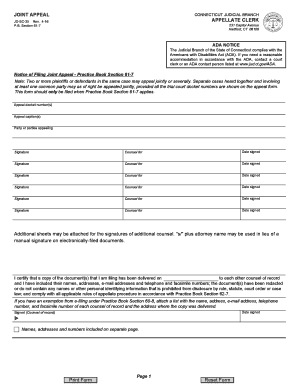
S with the Americans with Disabilities Act (ADA). If you need a reasonable accommodation in accordance with the ADA, contact a court clerk or an ADA contact person listed at www.jud.ct.gov/ADA. Notice of Filing Joint Appeal - Practice Book Section 61-7 Note: Two or more plaintiffs or defendants in the same case may appeal jointly or severally. Separate cases heard together and involving at least one common party may as of right be appealed jointly, provided all the trial court docket numbers ar.
Open form follow the instructions
Easily sign the form with your finger
Send filled & signed form or save
How to fill out the CT JD-SC-35 online
The CT JD-SC-35 form is used for filing a joint appeal in accordance with Practice Book Section 61-7. This guide will provide step-by-step instructions to ensure that users can complete the form accurately and efficiently.
Follow the steps to complete the CT JD-SC-35 form online.
- Click ‘Get Form’ button to obtain the form and open it in the editor.
- Enter the appeal docket number(s) in the designated field. Ensure that all relevant docket numbers related to the appeal are included.
- Fill in the appeal caption(s). This section should reflect the title of the case exactly as it appears in court documents.
- Identify the party or parties appealing in the specified fields. Clearly list all individuals or entities involved in the appeal.
- Secure the signatures of all counsel representing the parties appealing. You may use 's/' along with the attorney's name in lieu of a traditional signature for electronically filed documents.
- Indicate the date when the signatures were provided next to each counsel's name.
- If additional counsel needs to be listed, attach separate sheets for their signatures, ensuring all required information is included.
- Certify that copies of the document(s) being filed have been delivered to each other counsel of record, including their names, addresses, email addresses, and telephone and fax numbers.
- If applicable, attach a list of counsel of record if you have an exemption from e-filing under Practice Book Section 60-8.
- After completing the form, review all entries for accuracy. Save your changes, and download or print the completed form as necessary.
Complete the CT JD-SC-35 online today to ensure your joint appeal is filed correctly.
Experience a faster way to fill out and sign forms on the web. Access the most extensive library of templates available.
Related content
JD-SC-35 Rev. 2-25. P.B. Section 61-7. CONNECTICUT JUDICIAL BRANCH. APPELLATE CLERK. 231...
by CJ Shan · 2014 · Cited by 7 — CE projection - Distance from the projection of the...
Lea detenidamente el manual entero antes de montar la piscina. - Antes de comenzar la...
Get answers to your most pressing questions about US Legal Forms API.
What two reasons would be cause for appeal of a verdict?
In CT JD-SC-35, two main reasons that might justify an appeal of a verdict are the misapplication of law and juror misconduct. Misapplication of law refers to incorrect legal standards being applied during the trial, while juror misconduct can involve biases or improper communications impacting the deliberation process. These factors can undermine the integrity of the trial, providing legitimate grounds for appeal.
What are 2 ways that a case can be appealed?
A case can be appealed in CT JD-SC-35 through either a notice of appeal or a motion for reconsideration. A notice of appeal formally requests the higher court's review of the lower court's decision, whereas a motion for reconsideration asks the same court to review its ruling based on new evidence or legal arguments. Each method has specific procedures and timelines you must follow.
How to file pro se in CT?
Filing pro se in CT JD-SC-35 involves submitting your appeal paperwork without an attorney. Begin by gathering all necessary documents, including the notice of appeal and any supporting materials. The Connecticut Judicial Branch offers resources and forms on its website that can assist you through the process of filing on your own.
What is the most common reason for an appeal?
The most common reason for an appeal in CT JD-SC-35 is the presence of a legal error during the trial process. This includes incorrect jury instructions, improper admission or exclusion of evidence, or misapplication of the law. Appellate courts typically focus on these errors, as they can significantly affect the trial's outcome.
What are the odds of winning an appeal?
The odds of winning an appeal in situations related to CT JD-SC-35 vary depending on several factors, such as the nature of the case and the strength of the legal arguments presented. Statistically, fewer than 20% of appeals succeed because appellate courts often defer to the original court's findings. However, a well-prepared argument focusing on clear legal errors can improve your chances.
What are two ways in which one can appeal to the Supreme Court?
In CT JD-SC-35, you can appeal to the Supreme Court through a direct appeal or by filing a petition for a writ of certiorari. A direct appeal occurs when a party contests a decision from a lower court that directly arises under state law. Alternatively, a petition for a writ of certiorari requests the Supreme Court to review a lower court's ruling, typically involving significant legal or constitutional questions.
What are the grounds to make an appeal?
In the context of CT JD-SC-35, the grounds for making an appeal typically include legal error, lack of evidence, or procedural issues observed during the trial. These errors must significantly impact the case outcome to warrant an appeal. It's crucial to understand that an appeal is not a retrial; rather, it's a review of the original trial's process and decisions.
How do I file an appearance in Connecticut court?
Filing an appearance in Connecticut court requires submitting a specific form to the clerk of the court where your case is located. Make sure you complete the form accurately, following the guidelines outlined in CT JD-SC-35. The process might vary depending on the type of case, so familiarize yourself with the court's requirements. Online platforms like US Legal Forms can guide you through the filing process, ensuring you meet all necessary standards.
How do I retire from the practice of law in CT?
To retire from the practice of law in Connecticut, you must comply with the specific regulations set forth by the Connecticut Bar Association. This typically involves notifying the Bar of your retirement and ensuring that your clients are informed. Utilizing the resources available through CT JD-SC-35 can simplify this process, providing the necessary steps and documentation for a successful retirement from your legal practice.
How do I retire from law practice?
Retiring from law practice involves several steps, including notifying your clients, transitioning their cases, and completing any outstanding obligations. Many lawyers find it beneficial to create a retirement plan that meets the CT JD-SC-35 guidelines, ensuring a smooth transition. It’s wise to consult with an estate planner or financial advisor to address all aspects of your retirement and legacy planning.
Use professional pre-built templates to fill in and sign documents online faster. Get access to thousands of forms.
If you believe that this page should be taken down, please follow our DMCA take down process here.
This form is available in several versions. Select the version you need from the drop-down list below.