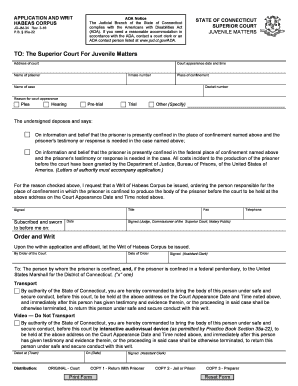
Ed a reasonable accommodation in accordance with the ADA, contact a court clerk or an ADA contact person listed at www.jud.ct.gov/ADA. STATE OF CONNECTICUT SUPERIOR COURT JUVENILE MATTERS TO: The Superior Court For Juvenile Matters Address of court Court appearance date and time Name of prisoner Inmate number Place of confinement Name of case Docket number Reason for court appearance Plea Hearing Pre-trial Trial Other (Specify) The undersigned deposes and says: On information and.
Open form follow the instructions
Easily sign the form with your finger
Send filled & signed form or save
How to fill out the CT JD-JM-34 online
The CT JD-JM-34, also known as the Application and Writ of Habeas Corpus, is an essential legal document for requesting the appearance of a prisoner in court. This guide will provide you with clear, step-by-step instructions to comprehensively fill out this form online.
Follow the steps to fill out the CT JD-JM-34 online.
- Click ‘Get Form’ button to access the CT JD-JM-34 form and open it in the editor.
- Enter the name of the superior court for juvenile matters in the designated field. This specifies the court associated with your application.
- Provide the address of the court where the form will be submitted. This ensures that the application reaches the correct location.
- Fill in the court appearance date and time. Be precise, as this informs all parties involved when the prisoner is expected to appear.
- Complete the fields for the name of the prisoner, inmate number, and place of confinement. Ensure accuracy in these entries, as they are critical for identifying the individual in question.
- Indicate the name of the case and the docket number. This information ties the application to the specific legal matter.
- Select the reason for the court appearance from the provided options (plea, hearing, pre-trial, trial, other). Specify details if necessary.
- In the section regarding the undersigned's information and signature, provide all required details, including contact information.
- Review the order and writ portion, confirming that the commands for transport or video appearance are clearly stated. Select the appropriate option based on the situation.
- Once all fields are completed, review the document for any missing information before saving changes. Users can then download, print, or share the form as needed.
Complete your documents online today and ensure proper legal proceedings.
Experience a faster way to fill out and sign forms on the web. Access the most extensive library of templates available.
Related content
Please submit at least 7 (seven) days before the date of the scheduled event. Granted...
by MRG Queiroz · 2013 · Cited by 2 — ABSTRACT. Objectives: To evaluate the efficacy of...
Get answers to your most pressing questions about US Legal Forms API.
How do I file for visitation rights in CT?
To file for visitation rights in Connecticut, you need to complete the appropriate legal forms and submit them to the court. This process often involves detailing your relationship to the child and your proposed visitation schedule. Using resources like USLegalForms can simplify the process, providing the CT JD-JM-34 and other necessary documentation to ensure you properly follow the legal steps.
What are the three types of cases handled in juvenile court?
Juvenile court typically handles three main types of cases: delinquency cases, dependency cases, and status offenses. Delinquency cases involve criminal behavior, while dependency cases concern a child's welfare and protection. Status offenses deal with actions that are only considered offenses due to the individual's age, and understanding these categories is important when dealing with the CT JD-JM-34 form.
What are the 4 steps in the juvenile justice process?
The juvenile justice process includes four key steps: initial contact, petition filing, adjudication, and disposition. During these steps, the CT JD-JM-34 petition plays a crucial role in determining the juvenile's legal fate. By understanding each phase, families can better navigate the system and advocate effectively for their youth.
What is a petition in juvenile justice?
A petition in juvenile justice, like the CT JD-JM-34, is a formal request submitted to the court, outlining the facts of a case concerning a juvenile. This document initiates legal proceedings and can relate to matters such as delinquency or dependency. It is essential for establishing the groundwork for court intervention and protecting the youth involved.
How do I get sent to Juvie?
Being sent to Juvie generally occurs when a juvenile is found to be involved in criminal activities. This may happen following an arrest or through a court petition, such as the CT JD-JM-34. Understanding the reasons for such involvement can help you address issues and seek support through community resources.
How to file a petition in juvenile court?
To file a petition in juvenile court, you must first complete the necessary forms, which include the CT JD-JM-34 petition. Next, you will submit these forms to the appropriate juvenile court in your area. It is also advisable to consult with a legal professional for guidance throughout the process to ensure all requirements are met.
How long do you have to sue someone in CT?
In Connecticut, the time you have to sue someone, known as the statute of limitations, varies depending on the type of claim. For most personal injury claims, you generally have two years from the date of the incident to file a lawsuit. However, some cases involving written contracts might allow you up to six years. Understanding these timelines is crucial, and using the CT JD-JM-34 can guide you in your legal journey. UsLegalForms can also assist you with the paperwork and provide resources for timely filing.
How do I file an appearance in Connecticut court?
To file an appearance in Connecticut court, you need to complete the appropriate form, which is often labeled as the CT JD-JM-34. This form allows you to notify the court of your intention to represent yourself or another party. After filling out the form, submit it to the clerk's office, along with any required filing fees. Using platforms like UsLegalForms can help simplify this process by providing the necessary forms and guidance.
Can you use a handwritten bill of sale in CT?
Yes, you can use a handwritten bill of sale in CT as long as it contains all necessary details about the transaction. However, using the CT JD-JM-34 template is preferable, as it ensures you do not overlook any important information. A properly formatted document can help prevent disputes in the future.
How should I write out a bill of sale?
Writing out a bill of sale involves clear and concise language. Start by stating the names and addresses of both parties, followed by a detailed description of the item being sold. For a legally binding document, use the CT JD-JM-34, which provides a structured format that helps you include all essential elements.
Use professional pre-built templates to fill in and sign documents online faster. Get access to thousands of forms.
If you believe that this page should be taken down, please follow our DMCA take down process here.