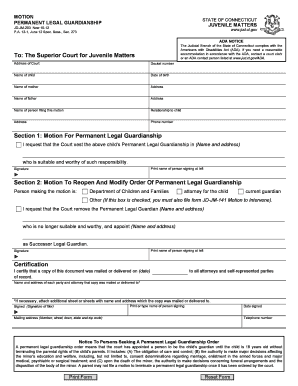
Ate of Connecticut complies with the Americans with Disabilities Act (ADA). If you need a reasonable accommodation in accordance with the ADA, contact a court clerk or an ADA contact person listed at www.jud.ct.gov/ADA. To: The Superior Court for Juvenile Matters Address of Court Docket number Name of child Date of birth Name of mother Address Name of father Address Name of person filing this motion Relationship to child Address Phone number Section 1: Motion For Permanent Legal Gua.
Loading
Open form follow the instructions
Easily sign the form with your finger
Send filled & signed form or save
How to fill out the CT JD-JM-203 online
Filling out the CT JD-JM-203 form is a critical step in establishing a permanent legal guardianship in the State of Connecticut. This guide will provide you with clear, step-by-step instructions to ensure that you complete the form accurately and efficiently.
Follow the steps to successfully complete the form online
- Click ‘Get Form’ button to obtain the form and open it in the online editor.
- Begin by entering the necessary court information. Input the address of the Superior Court for Juvenile Matters, along with the relevant docket number for your case.
- Provide the child's information. Enter the child's name and date of birth to properly identify them within the legal context.
- Fill in the names and addresses of the child's parents. This information is essential and should be accurate to demonstrate the guardianship context.
- Identify yourself as the person filing the motion. Include your name, relationship to the child, address, and phone number to establish your connection.
- In Section 1, state the request for permanent legal guardianship by entering the name and address of the proposed guardian. Clearly print the name of the person signing to authenticate your request.
- If applicable, use Section 2 to file a motion to reopen and modify the order of permanent legal guardianship. Specify the person making the motion, and if it's someone other than the Department of Children and Families or current guardian, check 'Other' and file form JD-JM-141.
- Complete the certification section by noting the date on which you mailed or delivered a copy of the document to all relevant parties. Include their names and addresses, and print or type your name for clarity.
- Sign the document where indicated, providing your signature and the date signed to finalize the filing.
- Review the completed form for accuracy and make any necessary changes. Finally, save your changes, download, print, or share the form as needed.
Complete your documents online with confidence today!
Experience a faster way to fill out and sign forms on the web. Access the most extensive library of templates available.
Related content
JD-JM-203 Rev. 1-22. P.A. 21-15. To: The Superior Court for Juvenile Matters. Docket...
5) Police will include the JD-JM-218 with the Order to Detain affidavit submitted to the...
Soft tissue imaging of the pelvis, abdomen, and chest can include chest CT and...
Get answers to your most pressing questions about US Legal Forms API.
What is a plenary guardian in CT?
A plenary guardian in Connecticut has comprehensive authority over the person or estate of another individual, often in cases where the person is incapacitated. This authority may include making medical, financial, and personal decisions. Understanding the role and responsibilities of a plenary guardian is essential, and CT JD-JM-203 outlines these details well. For additional clarification, uslegalforms can serve as a helpful resource.
How do you transfer guardianship to another person?
To transfer guardianship in Connecticut, you need to petition the court for a transfer. This process involves providing valid reasons and ensuring that the new guardian meets the court's standards. It's important to navigate CT JD-JM-203 for procedural details. Utilizing resources like uslegalforms can help facilitate the transfer process efficiently.
Does guardianship override parental rights in CT?
In general, guardianship can affect parental rights in Connecticut, especially when a court determines that guardianship is in the best interest of the child. While parents retain some rights, guardianship can limit their authority. Therefore, it’s important to refer to CT JD-JM-203 for specific legal implications. For detailed advice, consulting uslegalforms can offer insights into parental rights versus guardianship.
How do I file for guardianship in CT?
Filing for guardianship in Connecticut involves completing a petition and submitting it to the appropriate court. You'll also need to provide notice to the parties involved, which can be crucial for the process. Referring to CT JD-JM-203 offers a comprehensive guide on necessary steps and forms. To simplify the filing process, platforms like uslegalforms provide valuable templates.
What are the different types of guardianships in CT?
Connecticut recognizes several types of guardianships, including guardianship of the person, guardianship of the estate, and limited guardianship. Each type serves unique purposes and requirements. Understanding the distinctions can be essential when navigating CT JD-JM-203. For specific guidance on selecting the right type, consider using resources from uslegalforms.
How long does guardianship last in CT?
In Connecticut, the duration of guardianship can vary based on the type of guardianship established. Generally, guardianship lasts until the court terminates it or the person under guardianship reaches adulthood. In cases involving minors, guardianship ends when the child turns 18. If you have questions about specific circumstances, referring to CT JD-JM-203 can provide clarity.
How to get guardianship without going to court?
In some cases, it may be possible to obtain guardianship without formal court intervention, often through an agreement known as a power of attorney. However, this option is limited and generally designed for situations where the individual can still give consent. To pursue alternatives, you should seek legal advice and consider the specifics of CT JD-JM-203 for possible pathways outside of the courtroom.
How to become a legal guardian in CT?
To become a legal guardian in Connecticut, you must file a petition with the probate court. The process includes providing relevant documentation and possibly undergoing a background check. After reviewing your petition, the court will schedule a hearing to decide whether granting you guardianship is in the best interest of the individual. Documents associated with CT JD-JM-203 make this application process clearer.
What is the difference between a guardian and a legal guardian?
A guardian typically refers to someone who looks after a minor or a person unable to manage their affairs. A legal guardian, however, has formal court approval to make decisions on behalf of another individual. This distinction is important, as legal guardianship comes with specific legal responsibilities enforced by the court. Understanding these terms within the context of CT JD-JM-203 is essential to navigating the guardianship landscape.
How to get guardianship of an adult with a disability?
To obtain guardianship of an adult with a disability, you will need to file a petition with the court, demonstrating that the individual requires assistance in making decisions. This process typically involves submitting medical evaluations and attending a court hearing. The court will assess whether guardianship will empower, rather than hinder, the individual’s ability to live a fulfilling life. Referencing CT JD-JM-203 can streamline the process.
Use professional pre-built templates to fill in and sign documents online faster. Get access to thousands of forms.
If you believe that this page should be taken down, please follow our DMCA take down process here.