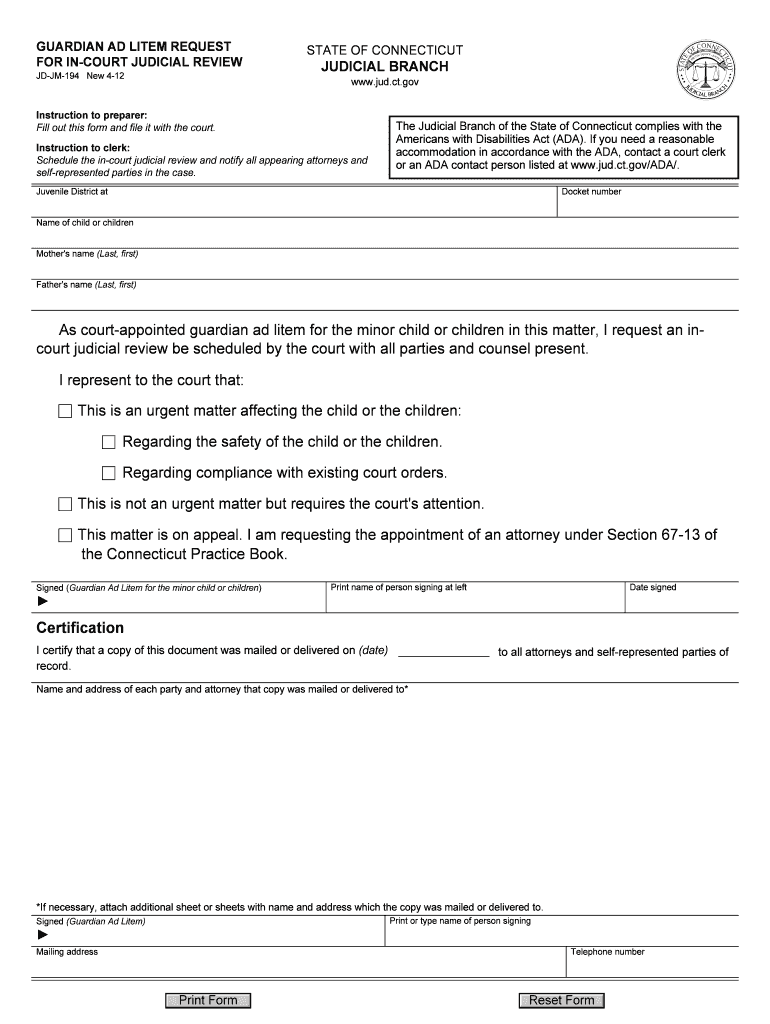
Rt. Instruction to clerk: Schedule the in-court judicial review and notify all appearing attorneys and self-represented parties in the case. The Judicial Branch of the State of Connecticut complies with the Americans with Disabilities Act (ADA). If you need a reasonable accommodation in accordance with the ADA, contact a court clerk or an ADA contact person listed at www.jud.ct.gov/ADA/. Juvenile District at Docket number Name of child or children Mother's name (Last, first) Father's name (L.
Loading

Open form follow the instructions

Easily sign the form with your finger

Send filled & signed form or save
How to fill out the CT JD-JM-194 online
The CT JD-JM-194 form, also known as the guardian ad litem request for in-court judicial review, is an essential document for individuals seeking court-appointed representation for minor children. This guide provides clear and comprehensive steps to help users effectively fill out this form online.
Follow the steps to complete the CT JD-JM-194 online.
- Press the ‘Get Form’ button to access the CT JD-JM-194 document, which will open in an online editing tool.
- Begin by entering the Juvenile District where the case is being handled.
- Input the docket number associated with the case.
- Provide the name of the child or children involved, ensuring to use the correct spelling.
- Next, fill in the mother's name in the format of last name followed by first name.
- Enter the father's name, also in the format of last name followed by first name.
- Indicate your status as the court-appointed guardian ad litem for the minor child or children and request that the court schedules an in-court judicial review with all parties present.
- Select the appropriate checkbox to indicate whether this matter is urgent, relates to the safety of the child, compliance with court orders, not urgent but needing attention, or is on appeal requiring attorney appointment.
- Sign the form as the guardian ad litem, printing your name next to the signature.
- Date your signature to confirm when the form was completed.
- In the certification section, certify that a copy of the document was mailed or delivered, and provide the date of mailing.
- List the names and addresses of all parties and attorneys to whom the copy was sent, attaching additional sheets if necessary.
- Finally, provide your mailing address and telephone number.
- Once all fields are completed, you can save changes, download, print, or share the filled-out form.
Take action now and fill out the CT JD-JM-194 online to ensure a smooth judicial process.
Experience a faster way to fill out and sign forms on the web. Access the most extensive library of templates available.
Related content
JD-JM-194 Rev. 1-22. P.A. 21-15. Instruction to preparer: Fill out this form and file it...
by CE Rochitte · 2012 — CT angiography using dual source CT: technique and initial...
We are honoured to present the 2017 edition of the European Association of Urology (EAU)...
Get answers to your most pressing questions about US Legal Forms API.
What does a Guardian ad litem do in CT?
A Guardian ad litem in Connecticut represents the best interests of a child in legal proceedings. They conduct investigations, gather relevant information, and make recommendations to the court to ensure the child's welfare. Understanding their role can be essential in cases involving custody and other sensitive matters. For more detailed insights on their responsibilities, refer to CT JD-JM-194, which can facilitate your understanding of this crucial role.
Who pays for the Guardian ad litem?
In Connecticut, the court typically determines who pays for the Guardian ad litem based on the case circumstances. Often, the parties involved may be ordered to cover the costs, or the court can appoint a program where the fees are handled differently. If you're unsure about the financial responsibilities, CT JD-JM-194 provides clarity on this matter, helping you prepare for potential costs.
Does the judge always listen to the Guardian ad litem?
Judges in Connecticut do consider the recommendations of a Guardian ad litem, especially in cases involving children. While the judge is not required to follow these recommendations, they take them seriously because they come from a professional who understands the child’s best interests. If you are involved in a case with a Guardian ad litem, understanding the implications can help navigate your situation effectively with the insights provided by CT JD-JM-194.
How long do you have to file small claims in CT?
In Connecticut, you generally have six years from the date of the incident to file a small claims case. However, specific claims may have different timelines, so it's crucial to understand the nature of your claim. To ensure you meet all deadlines and requirements, consider reviewing the detailed information outlined in CT JD-JM-194. This can help you make informed decisions about your case.
How do I delay jury duty in CT?
To delay jury duty in Connecticut, you must file a request with the court that issued your summons. This process involves filling out a form and providing a valid reason for your request. The court has the discretion to grant or deny your request, so it's important to act promptly. If you need guidance on how to navigate this, CT JD-JM-194 offers resources to help simplify the process.
How does a guardian ad litem make a decision?
A guardian ad litem makes decisions based on comprehensive investigations, interviews, and observations. They focus on the child’s best interests, analyzing all gathered information before making recommendations to the court. Engaging with the process as outlined in CT JD-JM-194 can provide clarity and direction.
What to expect when a guardian ad litem visits?
When a guardian ad litem visits, expect them to ask questions and observe the child’s living conditions. Their goal is to gather comprehensive information to make informed recommendations. Preparing for their visit can ease the process, particularly under the guidelines of CT JD-JM-194.
How powerful is a guardian ad litem?
The power of a guardian ad litem lies in their ability to advocate for the child’s best interests. They influence court decisions significantly with their thorough reports and recommendations. Familiarizing yourself with their role in CT JD-JM-194 will enhance your understanding of their impact on your case.
Does the judge always agree with the guardian ad litem?
While judges often consider the guardian ad litem's recommendations seriously, they do not always agree with them. The court ultimately makes the final decision based on all evidence presented, including the guardian's input. Staying informed about CT JD-JM-194 can help you understand this dynamic better.
How much power does a guardian ad litem have?
A guardian ad litem possesses considerable authority, mainly regarding the welfare of the child involved in a case. They conduct investigations and make recommendations to the court, which carries substantial weight during proceedings. Understanding their role in CT JD-JM-194 can help you navigate the legal landscape more effectively.
Use professional pre-built templates to fill in and sign documents online faster. Get access to thousands of forms.
If you believe that this page should be taken down, please follow our DMCA take down process here.