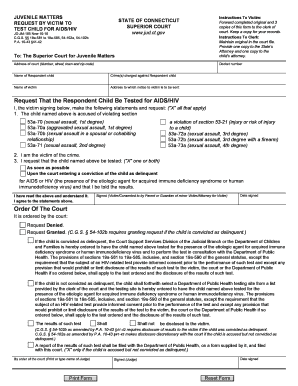
Rk of court. Keep a copy for your records. Instructions To Clerk: Maintain original in the court file. Provide one copy to the State's Attorney and one copy to the child's attorney. Address of court (Number, street, town and zip code) Docket number STATE OF CONNECTICUT SUPERIOR COURT www.jud.ct.gov JD-JM-185 New 10-10 C.G.S. 19a-581 to 19a-585, 54-102a, 54-102b P.A. 10-43 41-42 Name of Respondent child Crime(s) charged against Respondent child Name of victim Address to which notic.
Loading
Open form follow the instructions
Easily sign the form with your finger
Send filled & signed form or save
How to fill out the CT JD-JM-185 online
The CT JD-JM-185 form is a crucial document for requesting a test for AIDS or HIV for a child involved in juvenile matters. This guide provides clear, step-by-step instructions to help users complete this form online effectively.
Follow the steps to fill out the CT JD-JM-185 form online.
- Click ‘Get Form’ button to obtain the form and open it in the editor.
- Begin filling out the form by providing the address of the court, including the number, street, town, and zip code. Ensure that this information is accurate.
- Enter the docket number assigned to your case, which helps identify the specific court file related to your request.
- Fill in the name of the respondent child and the details concerning the crime(s) they are charged with. It is important to check that this information aligns with court records.
- Provide the name of the victim and the address to which notice should be sent. This ensures that all communications are directed appropriately.
- In the section requesting the test, mark the appropriate boxes to indicate your request. You may choose to have the child tested as soon as possible or upon conviction.
- Read the statements carefully, ensuring that you understand them before signing. This indicates your agreement to the provided information.
- Sign and date the form. If you are signing on behalf of a minor victim, indicate your consent as a parent or guardian.
- Review the form for accuracy and completeness before proceeding. After confirmation, you can save any changes made, download a copy for your records, print the document, or share the form as necessary.
Complete your CT JD-JM-185 form online today for efficient processing.
Experience a faster way to fill out and sign forms on the web. Access the most extensive library of templates available.
Related content
by SP Bhatt · 2016 · Cited by 33 — CT-derived measures of lung mechanics improve the...
by LR Souza · 2004 · Cited by 30 — ABSTRACT. Diarrhea caused by Cryptosporidium sp is...
Introduction. Benign prostatic hyperplasia (BPH) is a histologic diagnosis that refers to...
Get answers to your most pressing questions about US Legal Forms API.
What are three things each juvenile is entitled to in the juvenile trial?
As mentioned, each juvenile is entitled to legal representation, a fair hearing, and privacy protection during the juvenile trial. These rights are foundational to ensuring that young individuals have a chance to present their cases in a supportive environment. Legal representation plays a crucial role in guiding them through complex legal proceedings. The emphasis on a fair hearing and privacy creates a respectful space, helping juveniles to engage without fear of stigma.
How to file a petition in juvenile court?
To file a petition in juvenile court, begin by gathering necessary information and documentation pertaining to the case. You will need to complete the appropriate forms, such as the CT JD-JM-185, which outlines the nature of the complaint and any supporting evidence. Once you have prepared the petition, submit it to the juvenile court clerk along with any required fees. Lastly, ensure you understand the next steps in the legal process to advocate effectively for the juvenile's interests.
What are the three basic components of the juvenile justice system?
The juvenile justice system comprises law enforcement, juvenile courts, and correctional facilities. Law enforcement agencies work to ensure safety and handle incidents involving juveniles. Juvenile courts provide a legal framework for adjudicating cases, focusing on rehabilitation rather than punishment. Correctional facilities, including secure and community-based programs, aim to rehabilitate juveniles and reintegrate them into society. Familiarizing yourself with the CT JD-JM-185 can help navigate these components.
What are 3 things each juvenile is entitled to in the juvenile trial?
In a juvenile trial, each juvenile is entitled to legal representation, a fair hearing, and privacy protection. Legal representation ensures that the juvenile has an advocate during proceedings, which is crucial for a fair outcome. The hearing must be impartial and conducted according to the principles of justice, allowing juveniles to present their side of the story. Additionally, privacy protection keeps sensitive information confidential, promoting a more supportive environment for the youth involved. Understanding the CT JD-JM-185 form can provide clarity on these entitlements.
How to file for custody in CT?
To file for custody in Connecticut, you must submit the appropriate forms, including the CT JD-JM-185, to the court. This form will outline your custody requests and the reasons behind them. Understanding the custody process is essential for protecting your rights and the well-being of your child. Consider consulting with a legal expert to navigate this complex process effectively.
What happens if a judge doesn't rule on a motion?
If a judge does not rule on a motion, the case may remain unresolved, prolonging the matter for the involved parties. You can follow up with the court for updates on your motion. Using the CT JD-JM-185 can help clarify the expectations surrounding rulings. Engaging a legal professional may also provide you with more direct answers regarding your situation.
What is a motion to open judgment in CT?
A motion to open judgment in Connecticut allows a party to request that the court reconsider or vacate a previous judgment. This can be based on new evidence or a legal mistake. Utilizing the CT JD-JM-185 form is beneficial for filing this motion properly. Seeking legal advice can enhance your chances of success.
How long does a judge have to rule on a motion in CT?
Judges in Connecticut are expected to rule on motions within a reasonable time, often a few months. The CT JD-JM-185 form is essential in this process as it helps detail your motion clearly, which may influence the speed of the ruling. Keeping communication open with the court can also provide updates on your case's progress.
How long are judgments good for in Connecticut?
In Connecticut, a judgment generally lasts for 20 years unless it is renewed. After this period, the plaintiff must take action to ensure the judgment remains valid. The CT JD-JM-185 can assist you in understanding the renewal process. Staying proactive about your judgments is important to protect your interests.
How long does a judge have to make a decision on a motion?
A judge in Connecticut usually has a reasonable time frame to decide on a motion, but the timeline can vary. Typically, you expect a decision within a few weeks to a couple of months. If you’re using the CT JD-JM-185 form, it can simplify your motion process, potentially speeding up the decision-making. Staying informed about your case can help manage your expectations.
Use professional pre-built templates to fill in and sign documents online faster. Get access to thousands of forms.
If you believe that this page should be taken down, please follow our DMCA take down process here.