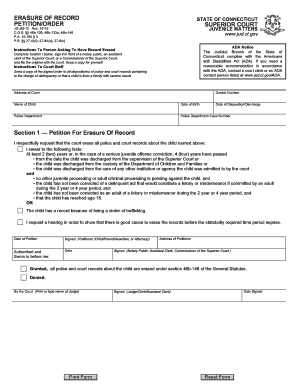
27-8A(c); 27-9(c) ADA Notice The Judicial Branch of the State of Connecticut complies with the Americans with Disabilities Act (ADA). If you need a reasonable accommodation in accordance with the ADA, contact a court clerk or an ADA contact person listed at www.jud.ct.gov/ADA. Instructions To Person Asking To Have Record Erased Complete Section I below, sign it in front of a notary public, an assistant clerk of the Superior Court, or a Commissioner of the Superior Court, and file the original.

How it works
  • Open form

    Open form follow the instructions

  • Easily sign form

    Easily sign the form with your finger

  • Share form

    Send filled & signed form or save

How to fill out the CT JD-JM-12 online

The CT JD-JM-12 form is designed for individuals seeking to have records erased related to juvenile matters in Connecticut. This guide provides a clear, step-by-step approach on how to complete the form online effectively.

Follow the steps to fill out the CT JD-JM-12 form online.

  1. Click ‘Get Form’ button to access the online version of the CT JD-JM-12 form and launch it in your preferred document editor.
  2. Begin filling out Section I by providing the address of the court where you will be filing the petition. Make sure to include the docket number, name of the child, date of birth, and date of disposition or discharge.
  3. Next, identify the relevant police department and provide the corresponding police department case number to maintain accurate records.
  4. In the 'Petition for Erasure of Record,' complete the statement where you respectfully request the court to erase records about the child named. Clearly affirm that the required time period has passed and that no other legal issues are pending.
  5. If applicable, indicate that the child has a record due to being a victim of trafficking, and request a hearing to demonstrate good cause if necessary.
  6. After filling out the petition, ensure to include the date of the petition, your signature as the petitioner (whether you are the child, parent, guardian, or attorney), and the address of the petitioner.
  7. Once completed, sign the document in front of a notary public, assistant clerk, or commissioner of the Superior Court to validate your submission.
  8. Submit the original signed form to the court and keep a copy for your records. Subsequently, you may also need to ensure that a signed order is sent to all relevant depositories of police and court records regarding the charge.
  9. Finally, after reviewing the filled form, save changes, download, print, or share the document as needed.

Complete your documents online for a smoother and more efficient process.

Get form

Experience a faster way to fill out and sign forms on the web. Access the most extensive library of templates available.

Related content

Official Court Forms of the Connecticut Judicial...

Print, Download. JD-JM-012, Erasure of Record, Petition/Order, Rev. 12/22. JM012.pdf...

Learn more
2016 State of Connecticut, Judicial Branch

An example of the JD-JM-214, Juvenile Detention Eligibility Screen, form will follow on...

Learn more
Mayo Adhesive Probability Score

Aug 21, 2014 — The Mayo Adhesive Probability Score is an image-based system to predict...

Learn more
Questions & Answers

Get answers to your most pressing questions about US Legal Forms API.

Contact support

What is the juvenile law in Connecticut?

Juvenile law in Connecticut encompasses various statutes that invoke the justice system for individuals under 18. It focuses on rehabilitation and supports programs aimed at helping troubled youth. The CT JD-JM-12 serves as an essential resource to better understand these legal frameworks.

In Connecticut, a judge typically has a reasonable period to rule on a motion, but there are no strict time limits defined. The timeline may vary depending on case complexity and court schedules. Understanding the implications of CT JD-JM-12 can provide insights into this process.

The Romeo and Juliet law in Connecticut addresses consensual sexual relationships between minors close in age. This law aims to prevent the prosecution of young individuals who engage in such relationships, thus recognizing the nuances of youth and consent. Familiarizing yourself with CT JD-JM-12 will help clarify how this law operates.

Filing a petition in juvenile court requires completing the appropriate paperwork and submitting it to the court clerk's office in Connecticut. The CT JD-JM-12 provides detailed guidance on these forms and the filing process. It's important to gather necessary documentation and possibly consult legal resources for assistance.

In Connecticut, a motion to open typically requires filling out specific forms designated by the court. The CT JD-JM-12 outlines the process for submitting this motion, which allows parties to request the court to reopen a previous decision. Utilizing resources like US Legal Forms can simplify this filing process.

A juvenile in Connecticut is defined as an individual who is under 18 years old. The juvenile system in CT JD-JM-12 aims to support rehabilitation and growth instead of focusing solely on punishment. Knowing this age distinction is vital when addressing legal matters involving minors.

In Connecticut, the minor law outlines the legal responsibilities and rights of individuals under the age of 18. It provides guidelines for the treatment of minors in the legal system, emphasizing their rehabilitation over punishment. Understanding the CT JD-JM-12 can help navigate these laws effectively.

In juvenile trials, each juvenile has essential rights that protect their interests. They are entitled to a fair hearing, the opportunity to confront witnesses, and the ability to seek a plea bargain if applicable. Engaging with forms like CT JD-JM-12 can facilitate access to these entitlements, ensuring a smoother judicial process.

During a juvenile trial, each juvenile is entitled to several important rights. They have the right to be informed of the charges against them, the right to legal representation, and the right to present evidence in their defense. Utilizing resources like CT JD-JM-12 can help ensure these rights are effectively upheld throughout the case.

The juvenile justice system consists of three primary components: law enforcement, the court system, and correctional facilities. Law enforcement handles the initial investigation and apprehension of juveniles, while the court system adjudicates cases and determines outcomes. Finally, correctional facilities provide rehabilitation and support services to juveniles, emphasizing the importance of using tools like CT JD-JM-12 to streamline court processes.

Get This Form Now!

Use professional pre-built templates to fill in and sign documents online faster. Get access to thousands of forms.

If you believe that this page should be taken down, please follow our DMCA take down process here.

Get CT JD-JM-12