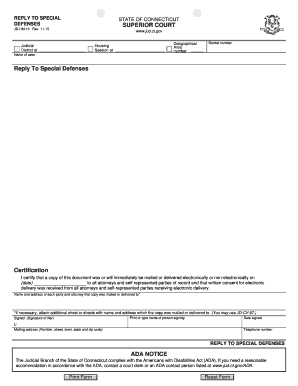
Reply To Special Defenses Certification I certify that a copy of this document was or will immediately be mailed or delivered electronically or non-electronically on (date) to all attorneys and self-represented parties of record and that written consent for electronic delivery was received from all attorneys and self-represented parties receiving electronic delivery. Name and address of each party and attorney that copy was mailed or delivered to* *If necessary, attach additional sheet or sh.

How it works
  • Open form

    Open form follow the instructions

  • Easily sign form

    Easily sign the form with your finger

  • Share form

    Send filled & signed form or save

How to fill out the CT JD-HM-16 online

Filling out the CT JD-HM-16 form is an essential step in responding to special defenses in a housing case in Connecticut. This guide provides clear, step-by-step instructions to ensure you can complete the form accurately and efficiently.

Follow the steps to complete the CT JD-HM-16 form online

  1. Click ‘Get Form’ button to acquire the form and access it in the editor.
  2. Begin by entering the judicial district and geographical area number at the top of the form where indicated.
  3. Next, fill in the housing session details and the docket number associated with your case.
  4. Provide the name of your case in the designated field for clear identification.
  5. In the certification section, state the date you will mail or deliver copies of the document, ensuring that all relevant parties are noted.
  6. List the name and address of each party and attorney that the document was sent to. Use an additional sheet if necessary.
  7. Print or type the name of the person signing the document in the specified area.
  8. Sign the document in the space provided for the signature of the filer and include the date signed.
  9. Fill in your telephone number and mailing address with complete details.
  10. Once all sections are completed, review the information for accuracy. You can save your changes, download the form, print it for physical submission, or share it as needed.

Complete your CT JD-HM-16 form online today for a seamless filing experience.

Get form

Experience a faster way to fill out and sign forms on the web. Access the most extensive library of templates available.

Related content

REPLY TO SPECIAL DEFENSES - Connecticut Judicial...

JD-HM-16 Rev. 6-19. Reply To Special Defenses. Name of case. ADA NOTICE. The Judicial...

Learn more
Pediatric Radiology Normal Measurements

Normal measurements in pediatric radiology is being compiled by pediatric radiologists...

Learn more
Contemporary management of ureteral strictures

CT urography remains the gold standard for the diagnosis of ureteral stricture disease...

Learn more
Questions & Answers

Get answers to your most pressing questions about US Legal Forms API.

Contact support

How long do you have to file small claims in CT?

In Connecticut, you typically have a specific period to file a small claims case, which is often within six years from the date of the issue. This timeframe can depend on the nature of your claim, so it's crucial to understand your situation. To file successfully, you will need appropriate documentation like the CT JD-HM-16 form. Consider turning to US Legal Forms for easy access to essential legal documents.

In Connecticut, the maximum amount you can sue for in small claims court is $5,000. This limit allows individuals to seek compensation for various disputes without needing extensive legal representation. If your claim exceeds this amount, you may need to pursue other court options. Utilizing the CT JD-HM-16 form can streamline your small claims process and ensure you are well-prepared.

In Connecticut, the statute of limitations varies depending on the type of claim you have. For most personal injury cases and contracts, you generally have three years to file a lawsuit. However, it's essential to act promptly, as deadlines can affect your ability to recover damages. Ensure you have the correct documentation, like the CT JD-HM-16, to support your case.

Taking someone to small claims court can often be worthwhile, especially if the amount owed is significant to you. The process is typically less complicated and less costly than other legal avenues. With the right information, like the CT JD-HM-16 form, you can present your case effectively. Consider using US Legal Forms to access necessary documents and guidance throughout this process.

No, in Connecticut, a landlord cannot legally evict a tenant without a court order. The process must go through proper channels, starting with sufficient notice and culminating in a court judgment. Relying on the CT JD-HM-16 form is essential to document your case effectively and follow the legal protocol. Understanding these regulations helps ensure that both parties are treated fairly during eviction proceedings.

Evicting a tenant in Connecticut can be straightforward if the landlord follows legal procedures, but it can also be challenging with the right defenses in play. It requires proper documentation, including the CT JD-HM-16 form, and an understanding of tenant rights. In cases of disputes, engaging legal resources or consultations can simplify the complexities involved. Therefore, being informed and prepared is key.

The timeline for evicting a tenant in Connecticut varies based on several factors, including the reason for eviction and the tenant's response. After filing for eviction, a court hearing is scheduled, which might take several weeks. Once a judgment is issued, landlords can take steps to remove the tenant, which may take additional time. Utilizing resources like CT JD-HM-16 can expedite this process by providing the necessary legal framework.

In Connecticut, the eviction process can begin as soon as a tenant breaches the lease agreement. Initially, landlords must provide a notice to quit, allowing the tenant time to remedy the situation. Typically, after this notice, landlords can proceed with filing for eviction under forms such as CT JD-HM-16 if the tenant does not comply. It's essential to follow the legal process to ensure the eviction is enforceable.

In Connecticut, special defenses refer to specific arguments that a tenant can present in court to contest an eviction. Common examples include claims of retaliatory eviction or the landlord’s failure to maintain a habitable living space. Understanding these defenses is crucial, especially when dealing with legal documents like CT JD-HM-16, to ensure your rights are protected. Uslegalforms offers resources that help tenants navigate these complexities.

An affirmative defense in Connecticut allows a defendant to introduce new evidence or arguments that, if proven, can reduce their liability. Under the CT JD-HM-16 standards, this type of defense acknowledges the plaintiff’s claims but presents additional facts that justify the defendant's actions. Utilizing affirmative defenses effectively can lead to a favorable resolution in your case. Engaging with legal tools helps in constructing these defenses accurately.

Get This Form Now!

Use professional pre-built templates to fill in and sign documents online faster. Get access to thousands of forms.

If you believe that this page should be taken down, please follow our DMCA take down process here.

CT JD-HM-16 Form

This form is available in several versions. Select the version you need from the drop-down list below.

Get CT JD-HM-16