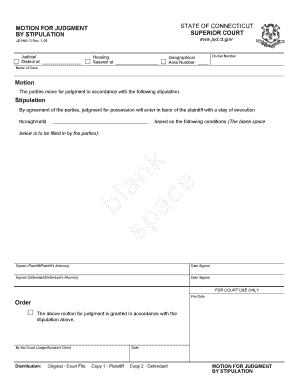
Of Case Motion The parties move for judgment in accordance with the following stipulation. Stipulation By agreement of the parties, judgment for possession will enter in favor of the plaintiff with a stay of execution through/until based on the following conditions (The blank space bl sp an ac k e below is to be filled in by the parties): Signed (Plaintiff/Plaintiff's Attorney) Date Signed Signed (Defendant/Defendant's Attorney) Date Signed FOR COURT USE ONLY File Date Order The abo.

How it works
  • Open form

    Open form follow the instructions

  • Easily sign form

    Easily sign the form with your finger

  • Share form

    Send filled & signed form or save

How to fill out the CT JD-HM-13 online

Filling out the CT JD-HM-13 form is an important process for parties involved in a housing case in Connecticut. This guide provides step-by-step instructions to help users complete the form accurately and efficiently.

Follow the steps to successfully complete the CT JD-HM-13 form online.

  1. Click the ‘Get Form’ button to access the document and open it in your editor.
  2. Indicate the Judicial District where the motion is being filed by selecting the appropriate district from the list.
  3. Fill in the Housing Session where applicable, ensuring that the correct geographical area number is included.
  4. Enter the docket number assigned to your case. This number is essential for identifying your case within the court system.
  5. Provide the name of the case, making sure to include all parties involved in the legal matter.
  6. In the Motion section, clearly state the request for judgment according to the stipulation agreed upon by both parties.
  7. In the Stipulation section, write down the conditions for judgment, including the stay of execution period, in the space provided.
  8. Have the plaintiff or the plaintiff's attorney sign and date the form in the designated area.
  9. Similarly, obtain the signature and date from the defendant or the defendant’s attorney in the specified section.
  10. Complete any court use sections as necessary, including the file date and any required judicial signatures.
  11. After filling out the form, review all information for accuracy and completeness. You can then save your changes, download, print, or share the completed document as needed.

Complete your CT JD-HM-13 form online today for smooth processing.

Get form

Experience a faster way to fill out and sign forms on the web. Access the most extensive library of templates available.

Related content

MOTION FOR JUDGMENT BY STIPULATION

Stipulation. By agreement of the parties, judgment for possession will enter in favor of...

Learn more
Pediatric Radiology Normal Measurements

Normal measurements in pediatric radiology is being compiled by pediatric radiologists...

Learn more
Primary Urethral Carcinoma - Cloudfront.net

Imaging work-up should include computed tomography of the chest, abdomen and pelvis for...

Learn more
Questions & Answers

Get answers to your most pressing questions about US Legal Forms API.

Contact support

How to write a strong motion to dismiss?

To craft a strong motion to dismiss, focus on articulating the specific legal grounds for the dismissal, provide clear arguments, and include supporting evidence or case law. Structure your motion logically and ensure clarity to persuade the court. The CT JD-HM-13 form can be a valuable resource in organizing and presenting your motion effectively.

The Rule 12 motion to dismiss addresses failures in the initial pleading, such as lack of jurisdiction or failure to state a claim. This rule allows defendants to challenge the legal sufficiency of the complaint before trial. Having the CT JD-HM-13 on hand can help streamline the process of drafting a strong Rule 12 motion.

A motion for summary judgment in Connecticut is a request for the court to rule in favor of one party based on the evidence presented without going to trial. This motion asserts that there is no significant dispute of material fact that warrants a trial. Utilizing resources like the CT JD-HM-13 can help in preparing an effective motion.

A motion to dismiss typically includes a statement of the grounds for dismissal, relevant legal citations, and supporting arguments. It should clearly articulate why the plaintiff's complaint fails to meet legal standards. For those drafting such motions, the CT JD-HM-13 provides a useful template to ensure all necessary elements are addressed.

In Connecticut, the response time for a motion for summary judgment is also 30 days. It is important to prepare a well-structured response during this time to present your case effectively. Using the CT JD-HM-13 can help ensure that your response is complete and addresses the arguments made in the motion.

You typically have 30 days to respond to a motion for summary judgment in Connecticut. This response should include supporting documents and any evidence you wish the court to consider. By using the CT JD-HM-13, you can create a comprehensive response that meets all necessary legal requirements.

In Connecticut, you generally have 15 days to respond to a motion after it has been filed. It's crucial to adhere to this timeline to avoid possible dismissal of your claims or defenses. Ensure you use the appropriate documentation, such as the CT JD-HM-13, to strengthen your response within this period.

In Connecticut, a motion to dismiss can be filed for several reasons, including lack of subject matter jurisdiction, lack of personal jurisdiction, or failure to state a claim upon which relief can be granted. Each ground must be clearly defined to persuade the court. Utilizing the CT JD-HM-13 can assist in articulating these grounds effectively and enhancing your submission.

Rule 19 pertains to the necessary joinder of parties in a lawsuit. A motion to dismiss under this rule may arise when a party essential to the suit has not been joined. Courts generally evaluate whether the missing party's absence impairs the court's ability to provide complete relief. Understanding this can help litigants effectively utilize the CT JD-HM-13 in similar situations.

When a motion for summary judgment is filed, the opposing party has the opportunity to respond. The court then reviews the motion, considering evidence and arguments presented by both sides. If the court finds that there is no genuine dispute of material fact, it may grant the motion, resulting in a judgment without a trial. For those navigating this process, using the CT JD-HM-13 form can streamline the procedure.

Get This Form Now!

Use professional pre-built templates to fill in and sign documents online faster. Get access to thousands of forms.

If you believe that this page should be taken down, please follow our DMCA take down process here.

CT JD-HM-13 Form

This form is available in several versions. Select the version you need from the drop-down list below.

Get CT JD-HM-13