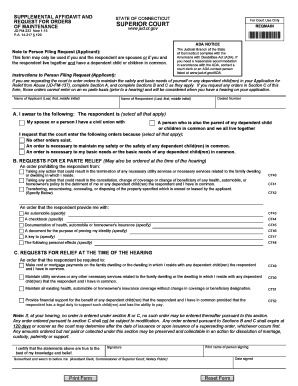
NOTICE Note to Person Filing Request (Applicant): This form may only be used if you and the respondent are spouses or if you and the respondent live together and have a dependent child or children in common. Instructions to Person Filing Request (Applicant): The Judicial Branch of the State of Connecticut complies with the Americans with Disabilities Act (ADA). If you need a reasonable accommodation in accordance with the ADA, contact a court clerk or an ADA contact person listed at www.jud.ct.
Open form follow the instructions
Easily sign the form with your finger
Send filled & signed form or save
How to fill out the Ct Orders online
Filling out the Ct Orders form is an essential step in seeking necessary legal protections or support. This guide aims to provide users with a clear and systematic approach to completing the form accurately and efficiently.
Follow the steps to complete your Ct Orders form online.
- Click ‘Get Form’ button to access the Ct Orders form and open it in your preferred editor.
- Begin by entering your name in the 'Name of Applicant' field, including your last name, first name, and middle initial.
- Next, fill in the 'Docket Number' provided in your court documents. This number is critical for your case identification.
- Complete the 'Name of Respondent' field with the last name, first name, and middle initial of the respondent involved in your case.
- In Section A, select the appropriate options indicating your relationship with the respondent, specifically highlighting if they are your spouse or a parent of your child(ren). Additionally, state your reasons for seeking the court orders by checking all applicable options.
- Move to Section B for requests for ex parte relief. Check the necessary actions you want to prohibit the respondent from taking that could harm your or your dependent child(ren)'s well-being.
- Specify any personal property or documentation you are requesting from the respondent, under the appropriate items listed in Section B.
- In Section C, outline requests for relief that you wish to be considered during the hearing. Ensure you clearly indicate essential payments or services you require to be maintained by the respondent.
- At the bottom of the form, ensure you certify that the statements are true to the best of your knowledge. Affix your signature in the designated area.
- Finally, review all sections for accuracy, then utilize the options to save changes, download, print, or share your completed form as necessary.
Start filling out your Ct Orders form online today to ensure your requests are submitted accurately.
Experience a faster way to fill out and sign forms on the web. Access the most extensive library of templates available.
Related content
Superior Court. Superior Court Standing Orders. Civil Matters - Statewide - Rev. 9/3/24...
CT ORDERING GUIDE. Body Part. Reason for exam. Oral prep. IV contrast. Procedure to...
CT. CODES. CT Head or Brain. 70450, 70460, 70470. CT Orbits, Sella, Posterior-Fossa, IACs...
Get answers to your most pressing questions about US Legal Forms API.
Can you look up restraining orders in CT?
Yes, you can look up restraining orders in Connecticut, as they are part of the public records. This access allows individuals to verify existing orders and understand their implications. You can utilize online resources or court offices for this information. If you need assistance navigating these records or related Ct Orders, USLegalForms is available to help simplify the process.
How do I start a small claims case in CT?
Starting a small claims case in Connecticut involves filing a complaint with the appropriate court. You will need to prepare necessary documentation, including the details of your claim and the amount you are seeking. The process is designed to be straightforward, allowing individuals to resolve disputes efficiently. USLegalForms can provide helpful guidance, ensuring you understand the steps regarding Ct Orders and small claims.
What is an order to show cause CT?
An order to show cause in Connecticut is a legal document that requires a party to appear in court and explain why a certain action should not be taken. This type of order is often used in cases involving Ct Orders, such as motions to modify a restraining order. It effectively prompts a hearing where the involved parties can present their arguments to a judge. For streamlined assistance with such legal processes, consider exploring USLegalForms.
Are restraining orders public record in Connecticut?
Yes, restraining orders are indeed public records in Connecticut. This accessibility allows individuals to review the details of Ct Orders, ensuring transparency in the legal system. However, it is crucial to remember that while the documents are public, personal information may sometimes be kept confidential to protect privacy. Using services like USLegalForms can simplify the process of obtaining these records.
What is the statute of a restraining order in CT?
In Connecticut, the statute governing restraining orders is outlined in Title 46b of the Connecticut General Statutes. The law specifies the conditions under which a restraining order may be issued and the duration of the order. Typically, a temporary restraining order is valid for a short period, while a permanent order can last for several years. Understanding these regulations helps individuals better handle Ct Orders.
Are restraining orders public in CT?
Yes, restraining orders in Connecticut are generally considered public records. This means that anyone can access these documents, which include details about the order and the parties involved. However, certain information may be redacted to protect sensitive details. You can find more about Ct Orders and how to navigate these records through platforms like USLegalForms.
What does CT stand for?
CT stands for Computed Tomography, which is an advanced imaging technology that combines X-ray equipment with computer technology. This process allows medical professionals to create detailed images of your body's internal structures. Understanding what CT represents can help demystify the procedure when discussing Ct Orders with your healthcare provider.
What is a CT order?
A CT order is a formal request initiated by your healthcare provider to perform a CT scan. This order outlines specific information about your medical condition and diagnostic needs. It's an important step that ensures the imaging team is prepared to provide the best possible care based on your unique situation.
Why is a CT ordered?
A healthcare provider may order Ct Orders to investigate potential health concerns that require precision imaging. This decision often stems from symptoms, previous test results, or routine health evaluations. The goal is to ensure that any issues can be diagnosed accurately and addressed promptly.
What is the main reason for a CT scan?
The primary reason for requesting Ct Orders is to obtain detailed cross-sectional images of your internal organs and structures. This visualization aids in the detection of diseases, injuries, and abnormalities that standard imaging may not reveal. Understanding these conditions is essential for your timely and effective treatment.
Use professional pre-built templates to fill in and sign documents online faster. Get access to thousands of forms.
If you believe that this page should be taken down, please follow our DMCA take down process here.