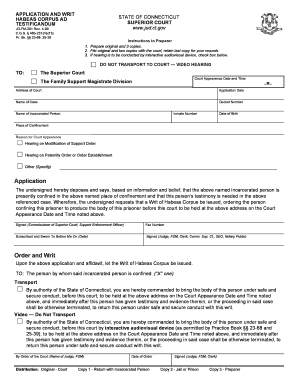
1. Prepare original and 3 copies. 2. File original and two copies with the court, retain last copy for your records. 3. If hearing is to be conducted by interactive audiovisual device, check box below. DO NOT TRANSPORT TO COURT VIDEO HEARING The Superior Court TO: Court Appearance Date and Time The Family Support Magistrate Division .M. Address of Court Application Date Name of Case Docket Number Inmate Number Name of Incarcerated Person Date of Birth Place of Confinement Reaso.
Loading
Open form follow the instructions
Easily sign the form with your finger
Send filled & signed form or save
How to fill out the CT JD-FM-201 online
Filling out the CT JD-FM-201 form is an essential process for requesting a writ of habeas corpus. This guide provides clear and user-friendly instructions to assist you in completing the form accurately and efficiently online.
Follow the steps to successfully complete the CT JD-FM-201 form.
- Click ‘Get Form’ button to access the CT JD-FM-201 form and open it for completion.
- Begin by entering the court appearance date and time in the designated fields. This information is crucial for scheduling your request.
- Fill in the name of the court and the address where the court is located. Accurate details ensure that your application is directed to the correct location.
- Enter the application date, along with the name of the case and the corresponding docket number. This step establishes the context of your request.
- Provide the inmate number and the name of the incarcerated person along with their date of birth and place of confinement. These details are essential for identification purposes.
- Select the reason for the court appearance by checking the appropriate box. You can choose from a modification of support order, a paternity order, or other specified reasons.
- In the application section, state your request for the writ. It is important to affirm the necessity of the incarcerated person's testimony in the relevant case.
- Sign the form where indicated, and provide your fax number for communication purposes.
- Ensure that the section for the judge's signature is left blank. The judge will sign this after reviewing the application.
- Upon completion, review the form for accuracy and save your changes. You may then download, print, or share the form as needed.
Begin filing documents online to ensure a smooth and efficient process.
Experience a faster way to fill out and sign forms on the web. Access the most extensive library of templates available.
Related content
The undersigned swears, based on information and belief, that the incarcerated person is...
by I Ayres · 2021 · Cited by 1 — Temporary Restraining Orders ("TROs") provide victims...
This manual covers service and maintenance for John Deere 110 and 112 tractors (serial no...
Get answers to your most pressing questions about US Legal Forms API.
What does order of habeas corpus mean?
An order of habeas corpus mandates the production of a detainee in court to determine if their imprisonment is lawful. This order serves as a critical check on unlawful detentions, protecting individual rights. When working with CT JD-FM-201, recognizing the significance of this order can empower you to advocate effectively for yourself or others.
What does ad prosequendum mean?
Ad prosequendum is a legal phrase indicating a role in pursuing or conducting litigation. Essentially, when someone is brought forward ad prosequendum, they are summoned to continue with the judicial process. Familiarizing yourself with this term can enhance your understanding of the legal applications relevant to CT JD-FM-201.
How to fill out a writ of habeas corpus?
Filling out a writ of habeas corpus requires careful attention to details. You must include information about the prisoner, the reason for their detention, and the specific relief requested from the court. For guidance, the CT JD-FM-201 form provides a structured way to ensure all necessary information is effectively captured.
What is the habeas corpus order ad prosequendum?
The habeas corpus order ad prosequendum is a legal directive that allows a prisoner to be brought before the court for trial. This order ensures that individuals in custody can participate in their legal proceedings, enhancing the fairness of the judicial process. If you encounter this term while dealing with CT JD-FM-201, knowing its implications can be very beneficial.
What is habeas corpus ad Testificandum?
Habeas corpus ad Testificandum is a legal term used to require a person to appear in court to give testimony. This writ is essential for bringing a detainee into court to provide evidence crucial to a case. If you're working with CT JD-FM-201, understanding this concept can help you navigate legal proceedings more effectively.
What is the writ of habeas corpus ad Testificandum?
The writ of habeas corpus ad testificandum is a specific order that allows a person who is imprisoned to be brought to court to testify. This legal mechanism ensures that essential witness testimony is not lost, even if the witness is currently incarcerated. Utilizing this writ can be vital for the integrity of a case, especially when working with legal forms such as CT JD-FM-201.
What is the meaning of Testificandum?
Testificandum is a legal term that refers to a subpoena issued to compel a witness to testify. This legal order requires the individual to appear and provide evidence in court. It plays an important role in the judicial process, helping to gather important facts for legal proceedings. Understanding this term is beneficial when dealing with documents like CT JD-FM-201.
What does writ of habeas corpus mean in simple terms?
The writ of habeas corpus is a legal tool that protects individual freedom. It allows a person to challenge their detention before a court. Essentially, it ensures that no one can be held without lawful justification. This concept is crucial in understanding legal rights within the framework of forms like CT JD-FM-201.
Can I file my CT tax return online?
Yes, you can file your Connecticut tax return online through the Connecticut Department of Revenue Services and various approved tax filing services. Filing online is efficient and often faster, allowing you to receive your refund quicker. Just make sure your online submission includes all necessary information as required by forms like the CT JD-FM-201.
How to file a complaint with the insurance commissioner in Connecticut?
To file a complaint with the insurance commissioner in Connecticut, you need to gather documentation regarding your issue and complete the complaint form available on the Department of Insurance website. Submitting your complaint provides essential information to the commissioner for review and response. Resources like US Legal Forms can assist you in organizing your complaint effectively, especially when related to the CT JD-FM-201.
Use professional pre-built templates to fill in and sign documents online faster. Get access to thousands of forms.
If you believe that this page should be taken down, please follow our DMCA take down process here.